Draping a five-sided thermal blanket over an uninsulated pallet deck, leaving a 3 mm gap along a vertical corner seam, or resting 80 kg of overhead coolant directly on product cartons causes premature temperature excursions, crushed upper payload layers, and rejected pharmaceutical or food freight. Unlike a one-piece molded parcel cooler, a unitized 370 L to 1,200+ L insulated pallet shipper is a multi-panel mechanical structure erected onto a four-way forklift base where a single omitted base pad, unstrapped rabbet joint, or vacuum-compromised VIP panel invalidates 100+ kg of conditioned refrigerant.
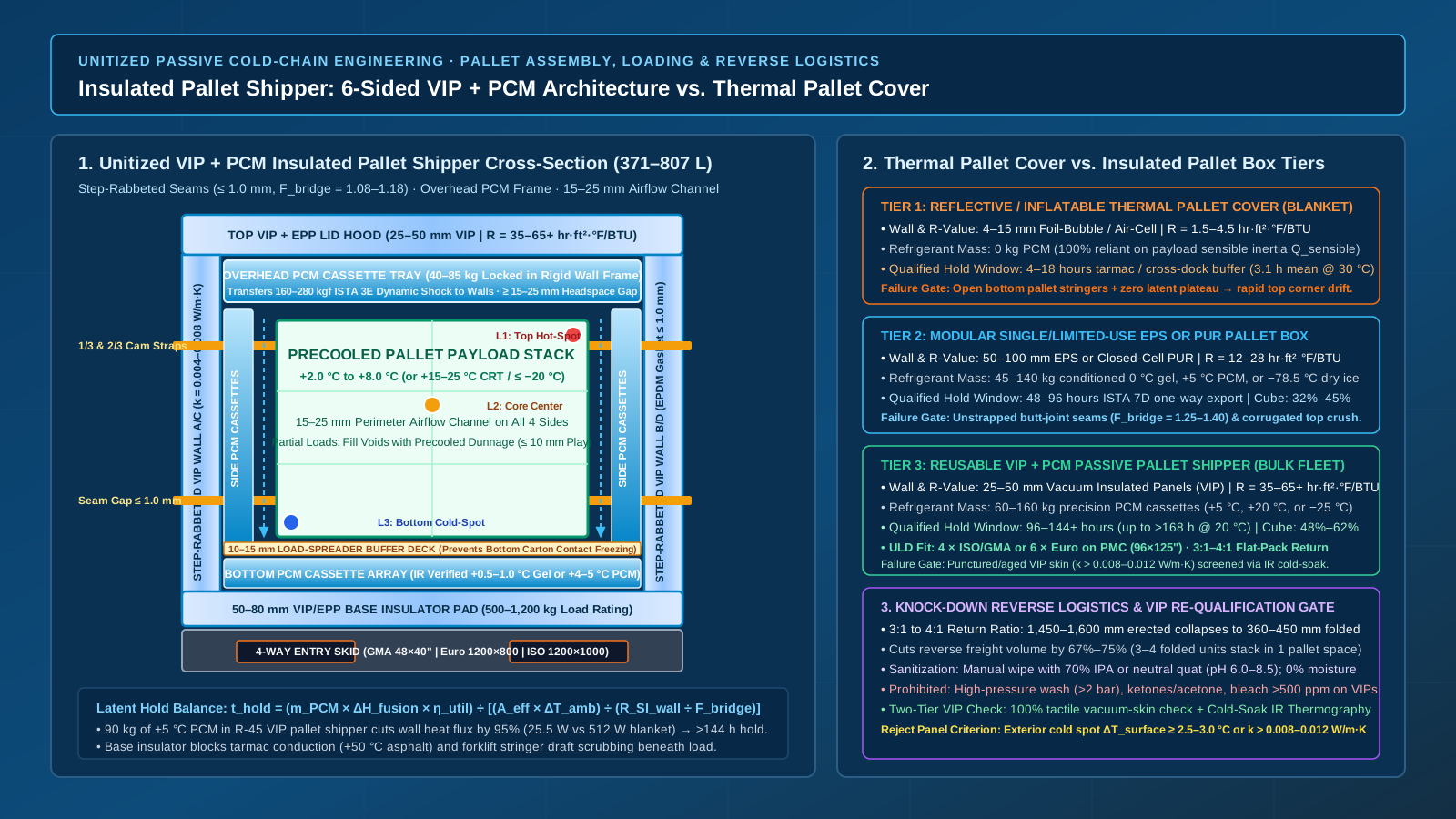
Deploying a reliable passive pallet shipper cold chain workflow requires two engineering controls: first, matching lane duration and ambient exposure to the correct unitized architecture by evaluating thermal pallet cover vs insulated pallet box performance across effective R-value (R = 1.5–4.5 vs 12–28 vs 35–65+ hr·ft²·°F/BTU) and phase-change heat-sink mass (0 kg vs 45–160 kg); second, executing a four-stage station checklist that isolates base-deck forklift thermal bridges, compresses step-rabbeted corner seams to ≤ 1.0 mm (F_bridge = 1.08–1.18), locks 40–85 kg of overhead PCM into rigid load-transfer frames with 15–25 mm airflow channels and three-point USP <1118> logger mapping, and returns collapsed shells at a 3:1 to 4:1 knock-down ratio under 70% IPA sanitization and infrared VIP vacuum screening.
Quick specs: governing parameters for unitized pallet shipper operations
Before staging pallet skids, wall panels, and conditioned Phase Change Material (PCM) cassettes at a packout automation cell, verify the nine quantitative parameters that govern unitized pallet hold time, structural load transfer, and reverse-logistics turnaround.
| Engineering Parameter | Symbol & Units | Operational Target / Benchmark | Governing Reference & Station Consequence |
|---|---|---|---|
| Thermal pallet cover resistance | R_cover (hr·ft²·°F/BTU / m²·K/W) |
R = 1.5–4.5 (R_SI = 0.26–0.79 m²·K/W); 0 kg PCM |
IPC CooLiner Pallet Covers; 4–18 h tarmac buffer reliant on product thermal inertia |
| EPS / PUR pallet box resistance | R_foam (hr·ft²·°F/BTU / m²·K/W) |
R = 12–28 (R_SI = 2.1–4.9 m²·K/W); 50–100 mm walls |
Cold Chain Technologies White Paper; 48–96 h hold with 45–140 kg gel/PCM |
| Reusable VIP + PCM pallet resistance | R_VIP (hr·ft²·°F/BTU / m²·K/W) |
R = 35–65+ (R_SI = 6.2–11.4+ m²·K/W); 25–50 mm VIP |
Peli BioThermal Crēdo Xtreme; 96–144+ h ISTA 7D hold with 60–160 kg PCM |
| Base-deck compressive load rating | m_static (kg) / G_shock (G) |
500–1,200 kg static (1.5G–3.0G forklift shock) |
50–80 mm VIP/EPP or PUR base pad isolates four-way forklift stringer drafts |
| Corner & lid seam gap tolerance | d_seam (mm / in.) & F_bridge |
≤ 1.0 mm (0.040 in.) feeler gauge; F_bridge = 1.08–1.18 |
Unstrapped butt joints (2–4 mm gap) raise F_bridge to 1.25–1.40+ (-20% to -35% hold) |
| Overhead PCM mass & crush force | m_PCM_top (kg) / F_crush (kgf) |
40–85 kg (6–12 plates) → 160–280 kgf at 2.0G–3.5G |
ISTA 3E / 7D Overview; requires rigid wall/lid retention frame (≥ 15–25 mm top gap) |
| Perimeter airflow & void clearance | L_air (mm) / L_play (mm) |
15–25 mm perimeter channel; ≤ 10 mm lateral carton play |
WHO TRS 961 Annex 9 Supplement 13; blocks chimney short-circuiting on partial loads |
| Spatial temperature logger array | N_loggers (count & accuracy) |
3 loggers (Top hot-spot, Core center, Bottom cold-spot; ±0.5 °C) |
Sensitech TempTale Ultra Probe; captures 3.5–6.5 °C vertical cavity stratification |
| Knock-down ratio & VIP IR gate | H_erect : H_fold & ΔT_surface |
3:1 to 4:1 (360–450 mm folded); IR cold-soak ΔT < 2.5 °C |
Peli Crēdo Series 4 Guide Rev. F; quarantines VIP panels with k > 0.008–0.012 W/(m·K) |
This pallet-level engineering reference extends the administrative receiving states and seven-field release traveler defined in our reusable cold-chain packaging return inspection guide, scales the Fourier heat-conduction and sweat-conditioning rules from temperature controlled packaging payload and PCM sizing up to 370–1,200 L bulk containers, and adapts bench-level verification from our cold-chain packout process checklist to multi-operator pallet erection.
Takeaway: Treat a unitized pallet shipper as a structural six-sided thermal enclosure whose qualified hold time depends equally on its insulation architecture (R-value and PCM latent mass) and its mechanical assembly tolerances (≤ 1.0 mm seam compression, base-deck isolation, and framed overhead coolant support).
Thermal pallet cover vs insulated pallet box: architecture and hold-time envelope
In unitized passive pallet shipper cold chain operations covering payload volumes from 350 L to 1,200+ L and gross pallet weights from 250 kg to 1,000+ kg, packaging engineers routinely evaluate thermal pallet cover vs insulated pallet box configurations. The governing thermodynamic boundary is whether the pallet system relies solely on the sensible thermal inertia of the precooled product behind a thin radiative and convective barrier (thermal pallet cover / cargo blanket), or encapsulates the load inside a six-sided structural shell paired with an engineered phase-change latent heat sink (insulated pallet box / reusable VIP + PCM pallet shipper).
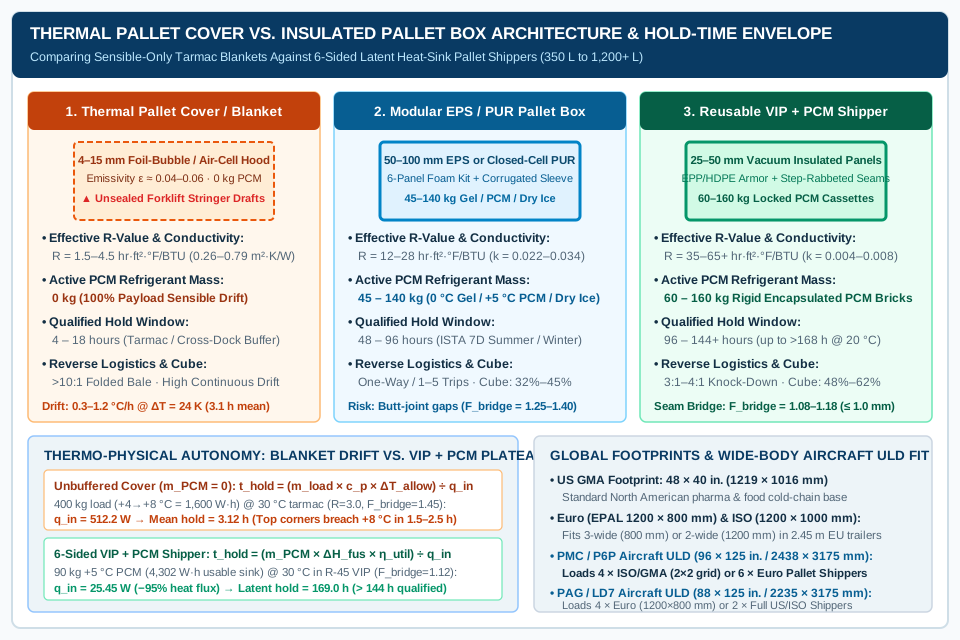
Three-tier unitized pallet architecture comparison matrix
The table below compares the three passive unitized pallet classes across wall construction, effective thermal resistance (R-value and thermal conductivity k), active phase-change refrigerant mass (m_PCM), qualified hold duration under ISTA Procedure 7D, volumetric cube efficiency, and primary field failure modes.
| Architectural Feature | Tier 1: Reflective / Inflatable Thermal Pallet Cover (Cargo Blanket) | Tier 2: Modular Single-Use or Limited-Use EPS / PUR Pallet Box |
Tier 3: Reusable VIP + PCM Passive Pallet Shipper (Modular Bulk Fleet) |
|---|---|---|---|
| Wall Construction & Thickness | 4 – 15 mm (0.16 – 0.60 in.) dual-sided metallized polyester/aluminum foil (emissivity ε ≈ 0.04–0.06) over air-bubble cells, synthetic fiberfill, or inflatable air columns (IPC CooLiner) |
50 – 100 mm (2.0 – 4.0 in.) molded Expanded Polystyrene (EPS, 24–30 kg/m³) or closed-cell Polyurethane (PUR / PIR, 35–45 kg/m³) 6-panel kit inside heavy double/triple-wall corrugated sleeve |
25 – 50 mm (1.0 – 2.0 in.) Vacuum Insulated Panels (VIP, evacuated fumed-silica core < 1–5 mbar in metallized film) armored inside EPP, HDPE, or composite shells (Peli Crēdo Xtreme) |
Effective R-Value & Conductivity k |
R = 1.5 – 4.5 hr·ft²·°F/BTU (R_SI = 0.26 – 0.79 m²·K/W; core k ≈ 0.033–0.038 W/(m·K) plus radiant reflectance across a 15–25 mm dead-air space) |
R = 12 – 28 hr·ft²·°F/BTU (R_SI = 2.1 – 4.9 m²·K/W; k = 0.030–0.034 W/(m·K) for EPS, 0.022–0.026 W/(m·K) for closed-cell PUR) |
R = 35 – 65+ hr·ft²·°F/BTU (R_SI = 6.2 – 11.4+ m²·K/W; center-of-panel k = 0.0040–0.0050 W/(m·K), assembled wall k = 0.0060–0.0080 W/(m·K)) |
Active PCM Latent Mass (m_PCM) |
0 kg (None) — relies 100% on precooled product sensible heat capacity (Q_sensible = m_payload × c_p × ΔT_allowable) |
45 – 140 kg of conditioned 0 °C water-gel bricks, +5 °C organic PCM pouches, or -78.5 °C dry ice mounted in perimeter/top corrugated trays |
60 – 160 kg of rigid encapsulated PCM cassettes (+4 °C/+5 °C for 2–8 °C, +20 °C for 15–25 °C CRT, or -21 °C / -25 °C frozen) locked in 6-sided channels |
| Qualified Hold-Time Envelope | 4 – 18 hours (tarmac solar radiation shield, cross-dock transfer, or multi-temp reefer door-opening buffer; unsuitable for multi-day unrefrigerated freight) |
48 – 96 hours under ISTA 7D Summer and Winter cyclic profiles for +2 °C to +8 °C, +15 °C to +25 °C CRT, or ≤ -20 °C frozen distribution |
96 – 144+ hours under extreme ISTA 7D / 7E profiles (120 h at +30 °C up to > 168 h at +20 °C per Crēdo Xtreme specs), meeting WHO Supplement 13 & IATA PCR |
Volumetric Efficiency (V_payload ÷ V_ext) |
75% – 88% (minimal wall thickness, but zero autonomous multi-day thermal hold) |
32% – 45% (75–100 mm thick foam walls and internal gel trays consume 55%–68% of exterior shipping cube) |
48% – 62% (371 L Half-Pallet to 807 L+ Full-Pallet usable volume; thin VIP walls recover 15%–20% more payload cube than foam) |
| Reverse Logistics & Fleet Reuse | Folds into a compact duffle or bale (> 10:1 volume reduction) or recycled as single-use polyethylene film |
Shipped flat in multi-box kits; deployed primarily on one-way export lanes (zero return freight) or limited local loops (2–5 cycles) |
Collapses flat via modular knock-down hinges/locks at a 3:1 to 4:1 return height ratio (cutting reverse freight cube by 67%–75%) across multi-year fleet life |
| Dominant Operational Failure Mode | Unsealed bottom pallet stringers allow convective chimney drafts; foil touching wet cartons loses radiant air gap; continuous 0.3–1.2 °C/h drift |
Unstrapped butt-joint foam seams open 2–4 mm under forklift racking (F_bridge = 1.25–1.40); heavy top gel trays crush upper cartons when damp |
Undetected VIP vacuum loss (punctured barrier film raising k from 0.004 to 0.020 W/m·K), unconditioned PCM cassettes, or omitted base insulator pad |
Thermo-physical drift math: why pallet blankets fail after 4 to 18 hours while VIP pallet shippers hold 144+ hours
Comparing the governing energy-balance equations explains why a reflective thermal pallet cover cannot substitute for a six-sided insulated pallet shipper when an air-cargo or ocean lane experiences an unrefrigerated tarmac delay or customs hold.
Case A: Unbuffered thermal pallet cover (m_PCM = 0 kg, sensible payload drift only)
As documented in Insulated Products Corporation (IPC) CooLiner pallet cover specifications, a reflective foil-bubble or non-woven cargo blanket draped over a pallet contains zero phase-change material (m_PCM = 0 kg). All heat entering through the cover and pallet base is absorbed directly by the sensible heat capacity of the product load (Q_sensible = m_payload × c_p_payload × ΔT_allowable), forcing the payload temperature to drift continuously toward ambient:
Formula: t_hold_blanket = (m_payload × c_p_payload × ΔT_allowable) ÷ [ (A_pallet × ΔT_ambient) ÷ (R_SI_cover ÷ F_bridge_skirt) ]
- Worked Screening Calculation (
+30 °CSummer Tarmac Exposure): Evaluate a400 kgpallet of biologics or refrigerated food (specific heat c_p_payload = 3.6 kJ/(kg·K) = 1.0 W·h/(kg·K)) precooled to+4.0 °Cwith an upper excursion limit of+8.0 °C(allowable warming ΔT_allowable = 4.0 K).- Sensible Thermal Reserve (
Q_sensible):Q_sensible = 400 kg × 1.0 W·h/(kg·K) × 4.0 K = 1,600 W·h(5,760 kJ). - Heat Ingress Rate Across the Pallet Cover (
q_in_blanket): Draped in a reflective bubble pallet hood (R-value = 3.0 hr·ft²·°F/BTU→R_SI_cover = 0.53 m²·K/W, exterior surface areaA_pallet = 7.8 m², bottom-skirt convective bridging multiplierF_bridge_skirt = 1.45) on a+30.0 °Cramp (mean payload temperature +6.0 °C→ΔT_ambient = 24.0 K):q_in_blanket = (7.8 m² × 24.0 K) ÷ (0.53 m²·K/W ÷ 1.45) = 187.2 ÷ 0.3655 = 512.2 W. - Mean and Corner Breach Time (
t_hold_blanket):t_hold_blanket = 1,600 W·h ÷ 512.2 W = 3.12 hours. Because external heat concentrates along the upper corners and top layer before conducting into the pallet core, top perimeter cartons breach+8.0 °Cin1.5 to 2.5 hours. Even inside a milder+18.0 °Ccross-dock staging zone (ΔT_ambient = 12.0 K) with a bottom insulated pad tightening the skirt factor toF_bridge_skirt = 1.20, heat ingress remainsq_in_blanket = (7.8 × 12.0) ÷ (0.53 ÷ 1.20) = 211.9 W, limiting total hold time to1,600 ÷ 211.9 = 7.55 hours.
- Sensible Thermal Reserve (
Case B: 6-sided VIP + PCM insulated pallet shipper (latent heat sink plateau)
Inside a six-sided insulated pallet shipper, inward heat flux is intercepted by 60 to 160 kg of encapsulated Phase Change Material (PCM) cassettes locked around the perimeter and top hood. So long as the PCM cassettes remain in their solid-to-liquid melting plateau (e.g., +4.5 °C to +5.0 °C for organic paraffin PCM), the internal cavity air stays pinned inside the +2.0 °C to +8.0 °C window without consuming the payload’s own sensible reserve:
Formula: t_hold_shipper = (m_PCM × ΔH_fusion × η_utilization) ÷ [ (A_eff × ΔT_ambient) ÷ (R_SI_wall ÷ F_bridge_rabbet) ]
- Worked Screening Calculation (Same Pallet Inside an
R-45VIP + PCM Shipper at+30 °C): Load the same pallet into a reusable VIP + PCM pallet shipper (Peli BioThermal Crēdo Xtreme class:R-value = 45 hr·ft²·°F/BTU→R_SI_wall = 7.92 m²·K/W, geometric mean areaA_eff = 7.2 m², step-rabbeted seam bridging factorF_bridge_rabbet = 1.12) charged withm_PCM = 90 kgof+5.0 °Corganic paraffin PCM cassettes (latent enthalpy ΔH_fusion = 210 kJ/kg = 58.33 W·h/kg, corner utilization factorη_utilization = 0.82).- Usable Latent Heat Sink (
Q_latent_usable):Q_latent_usable = 90 kg × 58.33 W·h/kg × 0.82 = 4,305 W·h(15,498 kJ). - Wall Heat Ingress Rate (
q_in_shipperat+30.0 °Cambient vs+5.0 °CPCM boundary,ΔT_ambient = 25.0 K):q_in_shipper = (7.2 m² × 25.0 K) ÷ (7.92 m²·K/W ÷ 1.12) = 180.0 ÷ 7.071 = 25.46 W(a95.0%reduction in steady-state heat ingress compared with the512.2 Wthermal pallet cover). - Latent Hold Autonomy (
t_hold_shipper):t_hold_shipper = 4,305 W·h ÷ 25.46 W = 169.1 hours(exceeding144 hours/6 daysbefore exhausting the usable PCM phase-change plateau).
- Usable Latent Heat Sink (
Standard pallet footprints and wide-body aircraft ULD integration
Selecting an insulated pallet shipper for road or intercontinental air freight requires matching the shipper’s external base dimensions and assembled height to regional trailer widths and wide-body aircraft Unit Load Device (ULD) contours. Where route risk or lack of destination conditioning infrastructure favors powered containers, compare these passive pallet footprints against active ULD leases in our active vs passive cold-chain packaging analysis.
| Footprint / Aircraft ULD Class | Nominal Base Dimensions (mm / in.) |
Typical Assembled Pallet Shipper Envelope (L × W × H) |
Usable Payload Volume (V_payload) |
Trailer & Wide-Body Aircraft ULD (PMC / PAG / LD7) Loading Efficiency |
|---|---|---|---|---|
| US GMA Standard Pallet | 1219 × 1016 mm (48.0 × 40.0 in.) |
1220–1320 × 1020–1120 × 1150–1600 mm |
400 – 850 L (Full) / 250 – 420 L (Half) |
Standard North American pharma/food skid; fits 2-wide in US 2.59 m (102 in.) reefer/dry trailers and 4 units (2 × 2 grid) on a PMC aircraft ULD |
Euro Pallet (EUR 1 / EPAL) |
1200 × 800 mm (47.2 × 31.5 in.) |
1200–1260 × 800–860 × 1100–1550 mm |
350 – 650 L (Full) / 200 – 340 L (Half) |
Maximizes European 2.45 m internal trailer width (3 across at 800 mm or 2 across at 1200 mm); fits 6 units on a PMC ULD or 4 units on a PAG / LD7 ULD |
| ISO / Global Air-Cargo Base | 1200 × 1000 mm (47.2 × 39.4 in.) |
1200–1280 × 1000–1080 × 1140–1590 mm (e.g., Crēdo Xtreme) |
371 L (Half) to 807 L (Full) |
Global pharmaceutical air-freight standard; loads 4 units (2 × 2 grid) onto a 96 × 125 in. PMC / P6P ULD within Lower Deck (1625 mm) or Main Deck (2438+ mm) height limits |
| Quarter / Half-Height Modular | 800 × 600 mm or 1200 × 1000 mm (Half-Height Stack) |
1200 × 1000 × 950–1140 mm (Half-Pallet Height) |
180 – 400 L |
Allows vertical double-stacking in Main Deck air cargo or low-clearance regional delivery vans while using identical base/lid VIP components |
Rules-of-Thumb:
- If unrefrigerated exposure (tarmac staging, cross-dock transfer, plus worst-case customs delay) exceeds
6 to 12 hoursatΔT_ambient > 15 Kor lacks verified precooling across100%of the pallet core → disqualify unbuffered thermal pallet covers (m_PCM = 0 kg) and deploy a 6-sided insulated pallet box or VIP + PCM pallet shipper. - If shipping intercontinental air freight on
PMC / P6P(2438 × 3175 mm/96 × 125 in.) aircraft ULDs → specify1200 × 1000 mmISO or1219 × 1016 mmGMA VIP pallet shippers with an assembled height≤ 1580 mm(62.2 in.) so four shippers lock onto a single Lower-DeckPMCpallet beneath the1625 mm(64 in.) contour ceiling.
Takeaway: Use reflective or inflatable thermal pallet covers strictly as short-duration (4–18 h) radiative/convective tarmac shields on precooled high-mass loads; specify 50–100 mm EPS/PUR pallet boxes for 48–96 h one-way lanes and 25–50 mm reusable VIP + PCM pallet shippers for 96–144+ h high-value air and ocean lanes.
Step-by-step insulated pallet shipper assembly and loading protocol
Assembling a unitized insulated pallet shipper requires strict mechanical sequence discipline across four station stages. Whereas a bench operator packing a small parcel container handles a light one-piece foam shell, a pallet packout team aligns heavy multi-panel walls, tensions 12 to 15 linear meters of perimeter gaskets, suspends 40 to 85 kg of overhead refrigerant above crush-sensitive cartons, and maps vertical stratification across a 1.0 to 1.35 m tall cavity.
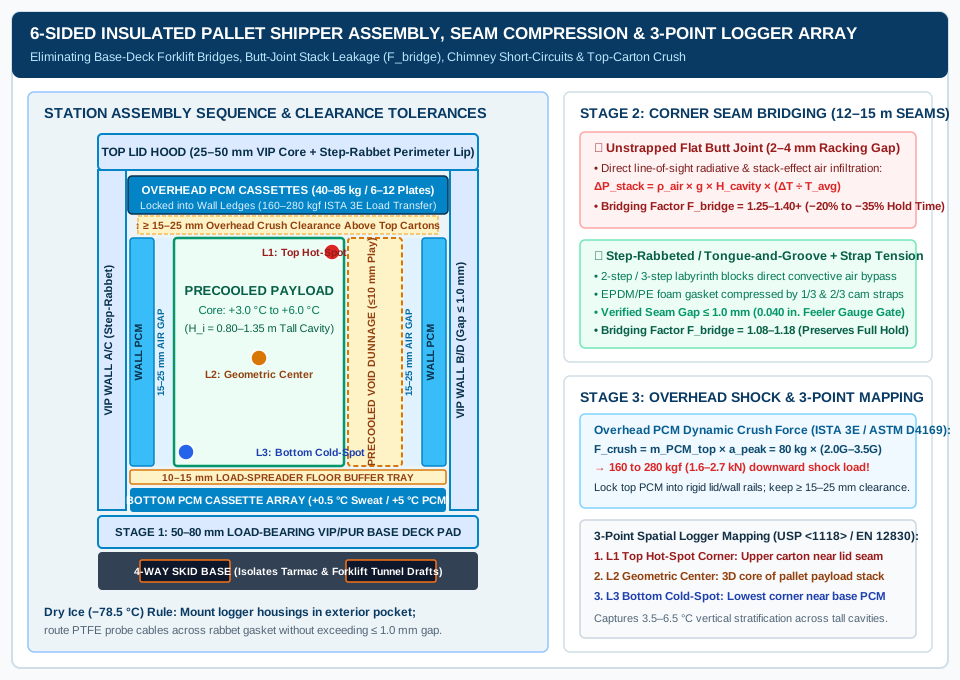
Stage 1: Base-deck and pallet stringer thermal isolation
A bare heat-treated wooden pallet (ISPM-15), presswood skid, or injection-molded HDPE warehouse pallet (140 to 165 mm deck height) contains open four-way forklift tine tunnels directly beneath a slatted or perforated top deck. Placing product cartons or draping a five-sided thermal hood directly onto an uninsulated pallet deck creates two severe thermal short-circuits:
- Convective Under-Deck Scrubbing: Forklift travel (
2.5 to 4.5 m/s), cross-dock door drafts, and airport ramp winds blow ambient air directly through the forklift stringer channels underneath the load, stripping boundary-layer resistance from the bottom layer of cartons. - Conductive Floor Heat Transfer: Sun-baked tarmac asphalt (
+45 °C to +55 °C) or sub-zero winter trailer floors (-10 °C to -18 °C) radiate and conduct directly across18 to 22 mmtop deck boards (pine/oak wood k ≈ 0.12 to 0.16 W/(m·K), solidHDPE k ≈ 0.45 to 0.50 W/(m·K)—15× to 60×more conductive than encapsulated VIP insulation).
Mandatory Station Execution — Base-Deck Isolation Sequence:
- Step 1.1 — Inspect the Four-Way Structural Skid: Before staging insulation components, inspect the integrated pallet runner base (
molded HDPE/composite skid or ISPM-15 wood base) for cracked stringers, missing bottom runner blocks, standing moisture, or protruding nail heads (which puncture bottom VIP barrier laminates under dynamic forklift shock). Verify that the container serial number carries aReleasedstatus on its reusable packaging refurbishment traveler. - Step 1.2 — Seat the Load-Bearing Insulated Base Deck Pad: Lock the bottom insulated deck panel (
50 to 80 mmhigh-density moldedEPPor closed-cellPURencapsulating a protected coreVIPpanel) squarely into the pallet perimeter locating rim. Because the base panel supports the combined mass of the payload, side walls, and coolant, verify that the OEM base pad is rated for500 to 1,200 kg(1,100 to 2,640 lb) static load and1.5G to 3.0Gdynamic forklift shock without compressing the evacuated silica core. - Step 1.3 — Install the Bottom PCM Cassette Array & Load-Spreader Buffer Floor: Place the recipe-specified bottom Phase Change Material (
PCM) cassettes or conditioned gel bricks into the recessed channels of the base deck before loading any product cartons. Verify every bottom cassette with a calibrated infrared (IR) or contact surface thermometer against the conditioning release gate established in our payload and PCM conditioning guide:0.0 °CWater-Gel Bricks: Sweated on single-layer open wire racks until frost melts into liquid droplets and surface temperature reads+0.5 °C to +1.0 °C;+4.5 °C to +5.5 °COrganic Paraffin PCM Cassettes (+2 °C to +8 °CRefrigerated Lanes): Conditioned to+4.0 °C to +5.0 °Csolid/phase-equilibrium specification;+20.0 °CCRT PCM Cassettes (+15 °C to +25 °CControlled Room Temperature Lanes): Conditioned to+17.0 °C to +19.0 °C. Immediately seat the load-spreader floor buffer deck (10 to 15 mmrigidHDPEgrid or double-wallB/C-flutecorrugated deck board,R_buffer = 0.17 to 0.30 m²·K/W) over the bottom PCM array so bottom product cartons never touch0 °Cor sub-cooled refrigerant surfaces.
Stage 2: Interlocking corner and wall seam geometry, VIP inspection, and strap tensioning
A modular four-wall pallet shipper contains four vertical corner joints (1.0 to 1.5 m tall each), four bottom wall-to-base perimeter seams, and four top lid-to-wall perimeter seams—totaling 12 to 15 linear meters (40 to 50 linear feet) of structural panel joints. When flat butt-jointed panels separate by even 2.0 to 4.0 mm under forklift braking, road vibration, or air-cargo pallet netting tension, buoyancy-driven stack pressure drives warm ambient air into the top seams while draining dense cold air out of the bottom seams:
Formula: ΔP_stack = ρ_air × g × H_cavity × (|T_ambient − T_cavity| ÷ T_mean_K)
Across a 1.25 m tall pallet cavity with a 25 K temperature differential (+30 °C ambient vs +5 °C internal), stack buoyancy continuously pumps air across any unsealed seam, inflating the enclosure bridging multiplier from F_bridge = 1.08–1.18 (compressed step-rabbet joint) to F_bridge = 1.25–1.40+ (gapped butt joint) and cutting qualified hold time by 20% to 35%.
| Corner & Wall Joint Design | Geometric Path & Gasket Interface | Target Compressed Seam Gap (d_seam) |
Effective Bridging Multiplier (F_bridge) |
Impact on 120 h Nominal Pallet Hold Time |
|---|---|---|---|---|
| Unstrapped Flat Butt Joint (Damaged foam edge or missing perimeter strap) | Straight-through 1-step planar interface; racking opens 2.0 – 4.0 mm line-of-sight air gap |
2.0 – 4.0 mm (0.080 – 0.160 in.) |
1.28 – 1.42 |
-22% to -35% loss (hold drops from 120 h to 78–93 h; early top-corner warming breach) |
Single Tongue-and-Groove / Ship-Lap Foam Joint (Standard modular EPS / PUR kit) |
2-step offset overlap (25–40 mm tongue depth) inside outer corrugated sleeve |
1.0 – 2.0 mm (0.040 – 0.080 in.) |
1.16 – 1.24 |
-10% to -18% loss (hold drops to 98–108 h if outer corrugated sleeve loosens in high humidity) |
Step-Rabbeted Labyrinth + Compressed EPDM/PE Gasket (Reusable VIP + EPP pallet shipper) |
2-step or 3-step interlocking rabbet with closed-cell EPDM / PE foam compression seal + cam straps |
≤ 1.0 mm (≤ 0.040 in.) verified with feeler gauge |
1.08 – 1.18 (1.12 design norm) |
100% qualified hold preserved (120–144+ h; blocks radiative and stack-effect air infiltration) |
Mandatory Station Execution — Wall Erection, VIP Check, and Strap Compression:
- Step 2.1 — Pre-Erection VIP Vacuum-Skin Rigidity Check (Peli Crēdo Series 4 User Guide Rev. F, p. 9): Before lifting each vertical wall panel (
Walls A, B, C, D) and the top lid hood, inspect the encapsulated Vacuum Insulated Panel (VIP). An intact evacuated VIP (internal pressure < 1 to 5 mbar, center-of-panelk = 0.0040 to 0.0050 W/(m·K)) feels rock-hard along its core edges and displays a taut, drum-tight metallized barrier skin conforming tightly to the fumed-silica core micro-texture. Immediate Hold Criterion: Quarantine and replace any panel exhibiting loose, pillowed, wrinkled, or blistered barrier film, visible foil punctures, or soft sponge-like flex. Atmospheric air ingress (P_internal → 1,013 mbar) degrades VIP conductivity4× to 5×(k > 0.008–0.012 W/(m·K)at partial vacuum loss, reaching0.020–0.026 W/(m·K)at full breach). - Step 2.2 — Three-Wall Walk-In Erection & Step-Rabbet Interlock: Lock Side Walls
A,B, andC(with their interior conditioned PCM cassettes seated and latched) into the base-deck perimeter channel in the manufacturer’s numbered sequence. Leaving the fourth front access wall (Wall D) open allows operators or pallet-walkie forks to load heavy carton layers ergonomically without scraping or puncturing the side VIP liners. Verify that every step-rabbeted, tongue-and-groove, or45°mitered corner joint seats flush to the bottom of its mating groove. - Step 2.3 — Closed-Cell Perimeter Gasket Continuity Check: Inspect all factory-bonded closed-cell
EPDMrubber or cross-linked polyethylene (PE) foam compression gaskets along the vertical corner rabbets and the top lid-seating rim. Quarantine any wall assembly with torn gasket strips, permanent compression set exceeding50%of original gasket height, or missing segments> 5 mm. - Step 2.4 — Horizontal and Vertical Cam-Buckle / Ratchet Strap Tensioning (
≤ 1.0 mmGate): Once the fourth wall (Wall D) and top lid hood are seated, install the external high-tensile woven polyester or polypropylene retention straps over rigid plastic corner protectors: two horizontal perimeter straps positioned at1/3and2/3wall height, plus two vertical cross-over straps locking the top lid to the pallet skid. Tension uniformly until the EPDM/PE gaskets compress and all12corner, base, and lid seam interfaces reject a1.0 mm(0.040 in.) feeler gauge blade.
Stage 3: Payload stacking clearance, internal airflow, overhead PCM retention, and 3-point logger mapping
Inside a 371 L to 807 L+ passive pallet cavity (internal height H_i = 0.80 to 1.35 m), natural convection governs temperature uniformity. If internal air circulation is blocked by over-stuffed cartons or short-circuited by an unbraced partial load, vertical temperature stratification (ΔT_vertical between the upper lid seam and lower floor deck) widens to 3.5 °C to 6.5 °C, triggering simultaneous top-corner high alarms (> +8.0 °C) and bottom-corner freeze alarms (< +2.0 °C).
1. Perimeter airflow channel (15 to 25 mm) and partial-load chimney blocking
Per WHO Technical Report Series No. 961, Annex 9, Supplement 13 (Qualification of temperature-controlled transport packaging), large passive containers must be qualified and packed to control both minimum and maximum payload configurations:
- Maintain a
15 to 25 mm(0.6 to 1.0 in.) Perimeter Airflow Channel: Never jam product cartons flush against interior wall-mounted PCM cassettes. Molded interior standoffs, vertical spacer ribs, or corrugated perimeter flutes must preserve a continuous15 to 25 mmvertical air gap around all four sides of the unitized carton stack. This boundary channel allows dense cold air descending from the overhead PCM hood to sweep uniform convective cooling around the perimeter without causing conductive freeze shock against the carton walls. - Eliminate Vertical Chimney Void Short-Circuiting on Partial Loads: When shipping a partial pallet load (
e.g., 40% to 75% of maximum carton count), leaving open footprint space or unbraced vertical headspace creates two failure mechanisms during transit braking and vibration:- Lateral Stack Shift: Unbraced cartons slide against one wall, crushing the
15–25 mmperimeter airflow channel on the impact side while opening a wide vertical chasm (“chimney”) on the opposite side where buoyant warm air plumes directly to the lid seam. - Warm Void Air Trap & Reduced Thermal Inertia: Unoccupied cavity volume traps warm packing-room air at closure while reducing total product sensible heat capacity (
Q_sensible). Station Control: Fill all unoccupied footprint positions and vertical headspace voids with pre-conditioned (precooled in the+2 °C to +8 °Ccold room) rigidEPSfoam dummy blocks, corrugated honeycomb void-fillers, or sealed inflatable dunnage cushions so lateral stack play is restricted to≤ 10 mm(0.40 in.) while keeping the15–25 mmperimeter airflow channel open.
- Lateral Stack Shift: Unbraced cartons slide against one wall, crushing the
2. Securing 40 to 85 kg of overhead top-hood PCM against top-carton crush (ISTA 3E)
In summer and universal pallet packouts, 30% to 45% of total phase-change refrigerant mass—typically 6 to 12 large PCM cassettes weighing 6.0 to 8.0 kg each, or 40 to 85 kg (88 to 187 lb) of total overhead mass—is positioned inside the top hood assembly above the payload to drive downward cold buoyancy convection and neutralize solar/ambient heat entering the lid.
Under ISTA Procedure 3E (Unitized Loads of Same Product) and ASTM D4169 mechanical distribution testing, unitized pallets experience vertical random vibration (0.5G to 1.5G RMS) and forklift rotational edge drops (150 to 230 mm drop height, generating 2.0G to 3.5G peak vertical deceleration). During a 2.0G to 3.5G road pothole or forklift set-down shock, an 80 kg overhead PCM array exerts a dynamic downward crushing force (F_crush) of:
Formula: F_crush = m_PCM_top × a_peak = 80 kg × (2.0G to 3.5G) = 160 to 280 kgf (1.57 to 2.75 kN / 352 to 617 lbf)
- Mandatory Mechanical Retention Rule: Never lay heavy overhead PCM cassettes or gel-brick trays directly on top of secondary pharmaceutical or food product cartons, and never rely on moisture-weakened single-wall corrugated corner posts to support overhead coolant. Lock all top PCM cassettes into the rigid molded inner lid retention tray, aluminum/composite load-transfer cross-bars, or stepped side-wall ledge slots so
100%of the160 to 280 kgfdynamic vertical load transfers down through the structural perimeter walls (EPP / PUR / heavy composite armor) to the base deck, maintaining a verified≥ 15 to 25 mm(0.6 to 1.0 in.) overhead crush clearance gap above the top layer of product cartons.
3. Three-point NIST-traceable data logger placement (USP <1118> / EN 12830)
While a small bench parcel box (< 30 L) typically rides with a single temperature monitor, a tall 370 to 1,200 L insulated pallet shipper develops three distinct thermal micro-zones across its 0.80 to 1.35 m internal height. Integrating the device start-up, sampling interval calculation (N = (T_hours × 60) ÷ I_minutes), and serial traceability rules from our cold-chain monitoring data logger packout guide, station operators install a three-point spatial sensor array compliant with USP <1118>, EN 12830, and WHO TRS 961 Supplement 13:
- Logger 1 — Top-Corner Hot-Spot Probe (
Upper Perimeter / Lid Seam Zone): Placed inside or secured to the top-most outer corner product carton nearest the lid-to-wall rabbet seam. Captures peak inward heat conduction and buoyant warm air accumulation during+30 °C to +45 °Csummer tarmac holds. - Logger 2 — Geometric Center Probe (
Core Payload Thermal Mass): Positioned at the three-dimensional geometric center (50% length, 50% width, 50% height) of the unitized carton stack. Tracks mean payload thermal inertia and confirms initial precooling equilibrium (+3.0 °C to +6.0 °C). - Logger 3 — Bottom-Corner Cold-Spot Probe (
Lower Perimeter / Base PCM Zone): Placed at the lowest outer corner product carton directly above the base-deck buffer tray and adjacent to the lower side-wall PCM cassettes. Detects dense cold air pooling and early sub-zero freeze shock (< +2.0 °C) during the first1 to 6 hoursafter closure or during-10 °C to -20 °Cwinter exposure.
- Deep-Frozen Dry Ice Pallet Exception (
-78.5 °C,UN 1845): When packing bulk pallet shippers with100 to 300 kgof dry ice pellets or slabs, never seal standard battery-powered electronic loggers inside the-78.5 °Ccavity (where lithium/alkaline batteries lose voltage and LCD screens freeze below -30 °C). Mount the Sensitech TempTale Ultra Dry Ice Probe housings inside the exterior molded document/monitor pocket and route the flat PTFE-jacketed probe cables across the step-rabbeted lid gasket interface without kinking the wire or holding the gasket open> 1.0 mm.
Stage 4: Knock-down reverse logistics, 70% IPA sanitization, and VIP re-qualification
Once a reusable insulated pallet shipper is unloaded at the receiving distribution center, its economic viability and next-trip thermal reliability depend on controlled disassembly, barrier-safe chemical disinfection, and quantitative VIP vacuum verification before re-entering packout automation stock.
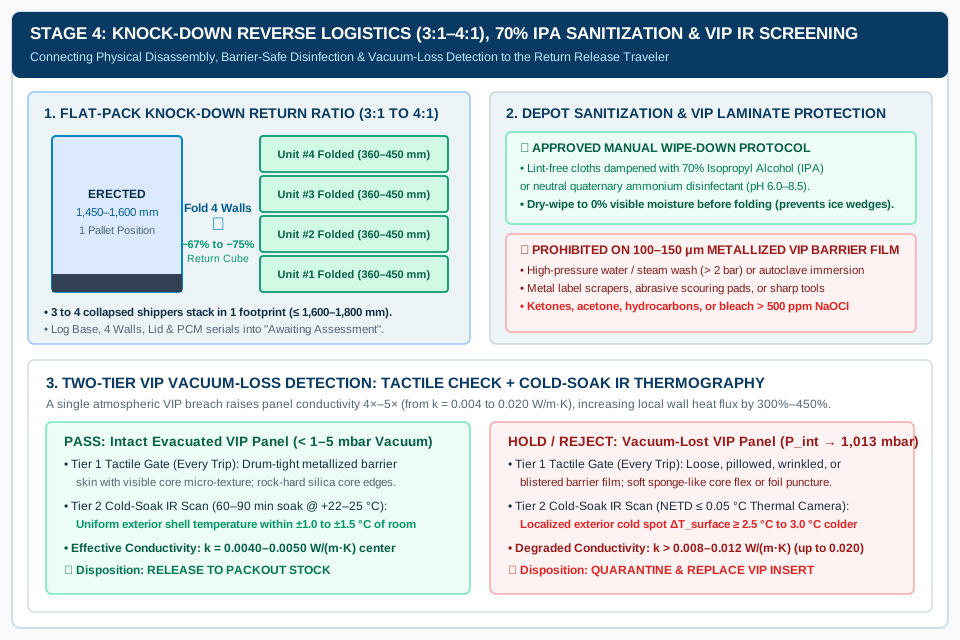
1. Knock-down mechanical folding and 3:1 to 4:1 return freight compression
Returning empty erected pallet shippers (1,450 to 1,600 mm tall) consumes 100% of outbound trailer and air-cargo ULD positions. Modular reusable bulk systems—such as the Peli BioThermal Crēdo Xtreme and rental fleets managed under Sonoco ThermoSafe reusable readiness workflows—solve reverse-logistics cube through a flat-pack knock-down architecture:
- Step 4.1 — Component Serial Scan & PCM Removal: Before unstrapping the empty container, scan the master unit ID, top lid ID, four wall panel IDs (
A, B, C, D), base skid ID, and PCM cassette batch IDs into theReceived / Awaiting Assessmentstate defined in our reusable cold-chain packaging return traveler. Extract all spent PCM cassettes and transfer them to dedicated conditioning racks or flat return transport totes. - Step 4.2 — Wall Hinge Release &
3:1 to 4:1Flat-Pack Stacking: Unlock the corner cam latches or pull-pins and fold/stack the four insulated wall panels flat inside the perimeter footprint between the base skid and top lid hood.- Assembled Outbound Height (
H_erect):1,450 to 1,600 mm(57.1 to 63.0 in.) per single pallet position. - Collapsed Knock-Down Height (
H_fold):360 to 450 mm(14.2 to 17.7 in.) per folded unit. - Reverse Logistics Stacking Ratio (
3:1 to 4:1): Stacking three to four collapsed pallet shippers vertically occupies a single pallet footprint (1,440 to 1,800 mmtotal stack height), reducing reverse ground and air freight volume by67% to 75%.
- Assembled Outbound Height (
2. Depot chemical sanitization without damaging 100 to 150 μm VIP barrier film
Encapsulated Vacuum Insulated Panels rely on a multi-layer metallized polymer barrier laminate (typically 100 to 150 μm thick PET / aluminum foil / PE heat-sealed envelope) to maintain an internal core vacuum below 1 to 5 mbar over a 5 to 10+ year fleet life. Improper depot washing destroys that barrier in a single cycle:
- Approved Manual Wipe-Down Procedure: Clean interior and exterior
EPP / HDPEprotective shells, EPDM perimeter gaskets, and rigidHDPEPCM cassette housings using lint-free non-abrasive cloths dampened with70% Isopropyl Alcohol (IPA)or a manufacturer-approved neutral-pH quaternary ammonium disinfectant (pH 6.0 to 8.5). Follow with a dry lint-free wipe and air-dry to0%visible surface moisture before folding or stacking panels (trapped water inside rabbet joints freezes into rigid ice wedges during cold-room staging, forcing seams open > 2.0 mm). - Strictly Prohibited Cleaning Actions on VIP Assemblies:
- NEVER spray exposed or semi-exposed VIP panels with high-pressure water or steam lances (
> 2 bar / 29 psi) or submerge panels in dip tanks, which delaminates heat-sealed flange seams and drives moisture into core breathers; - NEVER use metal putty knives, razor blades, or abrasive green scouring pads to scrape transit labels off VIP barrier skins (
use citrus-free adhesive remover on outer HDPE label placards only); - NEVER apply ketones (
acetone, MEK), aromatic hydrocarbons, strong acids/alkalis, or concentrated chlorine bleach (> 500 ppmsodium hypochlorite), which pit aluminum vapor-barrier layers and cause micro-pinhole vacuum decay.
- NEVER spray exposed or semi-exposed VIP panels with high-pressure water or steam lances (
3. Two-tier VIP thermal re-qualification: tactile check + cold-soak IR thermography
Because a single vacuum-degraded VIP panel in a six-panel pallet shipper increases local wall heat flux by 300% to 450% (k jumps from 0.0045 W/(m·K) to 0.020 W/(m·K)), reusable fleet depots enforce a two-tier thermal inspection gate before moving a unit from In Process to Released stock:
- Tier 1 — Every-Trip Tactile & Visual Gate (
100%of Returned Shippers): Per the Peli BioThermal Crēdo User Guide (Rev. F, p. 9), inspect all six modular VIP panels (Base, Walls A–D, Lid) during cleaning. Confirm drum-tight barrier film tension, sharp rigid silica core edges, and zero foil punctures. - Tier 2 — Periodic & Post-Excursion Cold-Soak Infrared (
IR) Thermography Screening: When a panel is housed inside a closedEPPor composite shell where the inner VIP foil cannot be touched directly—or during scheduled fleet re-qualification (every 6 to 12 monthsor following any unexplained transit temperature excursion investigated under our cold-chain packout troubleshooting guide)—perform a cold-soak IR thermography scan:- Test Setup: Load the assembled empty pallet shipper with conditioned cold PCM cassettes (or a
-20 °C / +2 °Cinternal cold source), close and strap the lid, and let the unit soak in a controlled+22.0 °C to +25.0 °Croom for60 to 90 minutes. - IR Camera Scan: Scan all six exterior faces (
4 walls, top lid, and elevated base underside) using a calibrated thermal imaging camera with thermal sensitivityNETD ≤ 0.05 °C(50 mK) (or measure direct panel conductivity/internal pressure via a heat-flux/vacuum gauge). - Quantitative Pass Gate: Intact VIP panels (
k = 0.0040–0.0050 W/(m·K)) maintain a uniform exterior shell temperature within±1.0 °C to ±1.5 °Cof ambient room temperature across the panel center. - Quantitative Reject & Replacement Gate: Any panel face displaying a localized exterior cold spot
ΔT_surface ≥ 2.5 °C to 3.0 °Ccolder than adjacent intact panels (corresponding to an effective panel conductivityk > 0.008 to 0.012 W/(m·K)) indicates partial or complete vacuum loss. Place the container inHeldstatus, swap out the failed modular VIP insert, and record the replacement serial number on the release traveler before returning the unit to packout automation.
- Test Setup: Load the assembled empty pallet shipper with conditioned cold PCM cassettes (or a
Rules-of-Thumb:
- If any corner or lid-rim joint on an erected pallet shipper accepts a
1.0 mm(0.040 in.) feeler gauge blade after strapping → do not dispatch; release the straps, inspect the rabbet groove for foreign debris, ice build-up, or a cocked PCM cassette, verify EPDM gasket continuity, and re-tension horizontal (1/3,2/3height) and vertical straps until all seams measure≤ 1.0 mm. - If a returned VIP pallet panel shows either a loose/pillowed barrier skin on tactile check OR an exterior surface cold anomaly
ΔT_surface ≥ 2.5 °Cduring a60–90 mincold-soak IR thermography scan → quarantine the unit immediately and replace the VIP core insert before releasing the container to packing stock.
Takeaway: Execute pallet assembly and turnaround as a closed four-stage loop: isolate the base skid with a load-bearing VIP/PUR deck pad, compress interlocking corner rabbets to ≤ 1.0 mm, suspend overhead PCM plates in rigid crush-prevention frames with 15–25 mm airflow channels and three-point logger mapping, and validate knock-down returns with 70% IPA cleaning and cold-soak IR screening.
Unitized pallet failure-mode diagnostics and seasonal coolant allocation
Even when a passive pallet shipper cold chain lane uses a qualified container model, field excursions occur when operators apply a single static coolant arrangement across extreme seasonal profiles or overlook mechanical wear on returned fleet components. When the three-point logger array (L1 Top Hot-Spot, L2 Core Center, L3 Bottom Cold-Spot) flags a temperature deviation at receiving, packaging engineers can isolate the exact assembly or component failure mode by comparing the spatial logger signatures against the diagnostic matrix below.
Spatial logger signature diagnostic matrix for pallet shippers
Excursion Signature Across L1 / L2 / L3 Loggers |
Primary Physical Root Cause | Quantitative Verification Check | Station Corrective Action |
|---|---|---|---|
L3 Bottom breaches < +2.0 °C within 1–5 h of closure (L1 Top & L2 Core remain +4.0 °C to +6.0 °C) |
Sub-cooled -18 °C to -22 °C water-gel bricks loaded without bench sweating, OR 10–15 mm load-spreader floor buffer deck omitted |
Check batch IR surface log (must be +0.5 °C to +1.0 °C at load) and verify presence of 10–15 mm HDPE/corrugated floor buffer tray (R_buffer ≥ 0.17 m²·K/W) |
Enforce single-layer wire-rack bench sweat (15–45 min + calibrated IR gun gate) or transition to +4.5 °C to +5.0 °C organic paraffin PCM cassettes |
L1 Top Corner breaches > +8.0 °C at 40%–65% of nominal hold time (L2 Core & L3 Bottom remain < +6.5 °C) |
Unstrapped corner/lid rabbet gap (> 2.0 mm) driving stack-effect air infiltration (ΔP_stack), OR partial load shipped without void dunnage (chimney short-circuit) |
Measure all 12 corner and lid seams with a 1.0 mm (0.040 in.) feeler gauge; inspect EPDM gasket compression set (< 50%) and partial-load void fill |
Replace worn EPDM perimeter gaskets, tension 1/3 and 2/3 horizontal cam straps + vertical cross straps to ≤ 1.0 mm, and brace partial loads to ≤ 10 mm play |
Single wall perimeter cartons warm or freeze prematurely while opposite wall holds +5.0 °C |
Localized VIP vacuum loss (P_internal → 1,013 mbar, raising panel k from 0.0045 to 0.020 W/(m·K)), OR wall PCM cassettes loaded with active face backward |
Run 60–90 min cold-soak IR thermography scan (NETD ≤ 0.05 °C); check for exterior cold spot ΔT_surface ≥ 2.5 °C to 3.0 °C below adjacent intact walls |
Quarantine failed wall serial in reusable return traveler, replace punctured/aged VIP core insert, and color-code inward PCM faces |
L3 Bottom warms rapidly (> +8.0 °C in Summer) or freezes (< 0.0 °C in Winter) ahead of L1 / L2 |
Base-deck VIP/PUR insulator pad omitted or crushed (> 1,200 kg overload), exposing bottom cartons to forklift stringer wind scrubbing and tarmac conduction |
Inspect 50–80 mm base insulator pad thickness and core rigidity; verify bottom PCM cassette array was installed beneath the floor buffer deck |
Lock intact 50–80 mm load-bearing VIP/PUR base pad onto 4-way skid before loading bottom PCM cassettes; never drape a 5-sided cover over bare pallet boards |
Upper layer of product cartons crushed (> 10 mm box deflection) with L1 erratic spikes |
40–85 kg overhead PCM array rested directly on secondary cartons or moisture-softened corrugated posts buckled under 160–280 kgf (2.0G–3.5G) shock |
Verify rigid top-hood PCM retention tray, composite cross-bars, or side-wall ledge slots; measure ≥ 15–25 mm headspace clearance above top carton layer |
Lock all overhead PCM cassettes into structural wall/lid retention rails so dynamic ISTA 3E vertical loads transfer down through the outer armor shell |
Seasonal and temperature-band PCM cassette allocation in bulk pallet shippers
While reusable VIP + +5 °C organic PCM pallet shippers (such as the Peli BioThermal Crēdo Xtreme) use a universal six-sided cassette recipe year-round by relying on the bidirectional latent enthalpy of paraffin PCM (melting at +5 °C in summer, solidifying at +4.5 °C in winter), modular EPS and PUR pallet boxes using dual-phase or 0 °C water-gel bricks require seasonal mass-split adjustments between summer heat-gain lanes and winter sub-zero lanes:
- Summer Heat-Gain Dominant Pallet Profile (
External Ambient +22 °C to +40 °C):- Coolant Mass Allocation: Position
35% to 45%of total refrigerant mass (40 to 85 kg) in the overhead top-hood retention frame,40% to 45%across the four upper/mid vertical perimeter walls, and15% to 20%in the bottom base deck. - Conditioning State: Solid-frozen
0 °Cgel bricks (sweated to +0.5 °C to +1.0 °CIR surface gate) or solid-conditioned+4.0 °CPCM cassettes absorb downward solar/ambient conduction through the lid and drive cold convective downdrafts through the15–25 mmperimeter airflow channels.
- Coolant Mass Allocation: Position
- Winter Sub-Zero Heat-Loss Dominant Pallet Profile (
External Ambient -10 °C to -25 °C):- Coolant Mass Allocation: Surround the payload with a continuous six-sided interlocking PCM shield (
25% top, 50% across all four walls, 25% bottom base deck) to block outward conductive heat loss through the pallet corners and cold trailer floor. - Conditioning State: In VIP +
+5 °Corganic PCM shippers, condition a specified fraction (or 100% in extreme winter recipes) of the+5 °Cparaffin cassettes in the liquid phase (+6.0 °C to +7.5 °C) so they release180 to 240 kJ/kgof latent fusion heat as they crystallize, holding the pallet interior above+2.0 °Cduring multi-day sub-zero ground or ramp holds.
- Coolant Mass Allocation: Surround the payload with a continuous six-sided interlocking PCM shield (
- Controlled Room Temperature (
CRT,+15.0 °C to +25.0 °C) & Deep-Frozen (≤ -20 °C/-78.5 °C) Pallet Profiles:- CRT (
+15 °C to +25 °C): Load symmetric six-sided+20 °CPCM cassettes conditioned at+17.0 °C to +19.0 °C, providing bidirectional protection against both> +30 °Ctarmac heat and< +5 °Ccargo-hold chilling. - Deep-Frozen Dry Ice (
-78.5 °C,UN 1845): Position60% to 75%of total dry-ice mass (100 to 300 kgbased on571 kJ/kgsublimation enthalpy) in the overhead top hood and upper perimeter bunkers so dense sublimatingCO₂gas (1.5×heavier than air) blankets the entire pallet stack downward, and verify that the pallet lid gasket ventsCO₂pressure cleanly without bursting straps while keeping external logger housings mounted in the exterior monitor recess.
- CRT (
Takeaway: Diagnose unitized pallet excursions by comparing L1 / L2 / L3 spatial logger signatures against seam-gap, base-pad, and VIP cold-soak metrics, and switch modular foam pallet configurations between top-heavy summer cooling and six-sided winter latent heat shielding.
Copyable station checklist: insulated pallet shipper assembly, loading, and knock-down
Operations and quality leads can copy this eight-step verification table directly into shift batch records or electronic manufacturing execution (MES / WMS) screens to connect physical pallet erection with ISTA 7D qualification profiles and station packout release records.
| Station Step | Operator Verification Action | Quantitative Acceptance Gate | Mandatory Hold & Quarantine Trigger |
|---|---|---|---|
| 1. Architecture & Lane Release | Match total route duration (t_transit + t_wait + t_delay) and pallet footprint (GMA 48×40 in. / Euro 1200×800 / ISO 1200×1000 / ULD) to qualified system tier |
Duration headroom M ≥ 0 h (Blanket ≤ 12 h vs EPS/PUR Box 48–96 h vs VIP+PCM Shipper 96–144+ h); traveler status = Released |
Thermal blanket selected for multi-day unrefrigerated lane, or returned shipper lacks signed release traveler |
| 2. VIP Integrity & Gasket Check | Inspect all 6 modular VIP panels (Base, Walls A–D, Lid) for vacuum skin tension; inspect perimeter EPDM / PE rabbet gaskets |
Drum-tight VIP film (k ≤ 0.008 W/(m·K); cold-soak IR ΔT_surface < 2.5 °C); gasket compression set < 50%, zero gaps > 5 mm |
Loose, blistered, or punctured VIP barrier film; soft core flex; torn or missing corner rabbet gasket |
| 3. Base Deck & Bottom PCM Array | Lock 50–80 mm load-bearing VIP/PUR base pad onto 4-way skid; load conditioned bottom PCM cassettes and seat load-spreader floor buffer |
Calibrated IR surface temp +0.5 °C to +1.0 °C (0 °C gel) or +4.0 °C to +5.0 °C (+5 °C PCM); 10–15 mm floor buffer deck seated |
Base insulator pad omitted (forklift stringer bridge), or -15 °C to -20 °C freezer bricks loaded without bench sweating |
| 4. Wall Erection & Corner Rabbets | Seat interlocking step-rabbeted / tongue-and-groove Walls A, B, C (with side PCM cassettes latched) into base perimeter channel |
All vertical rabbet joints seated flush (F_bridge = 1.08–1.18); wall serials matched to unit ID; PCM active faces oriented inward |
Mismatched wall serials, cocked bottom channel, or PCM cassette installed backward against outer wall |
| 5. Precooled Payload & Void Dunnage | Load precooled cartons (+2 °C to +8 °C core); preserve perimeter airflow gap and fill all partial-load footprint/headspace voids |
Verified payload core +3.0 °C to +6.0 °C; 15–25 mm perimeter airflow channel on all 4 sides; lateral carton play ≤ 10 mm |
Warm product loaded (> +8.0 °C), cartons jammed flush against 0 °C wall packs, or open vertical chimney voids on partial load |
| 6. 3-Point NIST Logger Array | Activate and place 3 USP <1118> / EN 12830 loggers (L1 Top hot-spot corner, L2 Geometric center, L3 Bottom cold-spot corner) |
NIST accuracy ±0.5 °C; memory N = (T_hours × 60) ÷ I_min verified; -78.5 °C dry-ice logger housings mounted externally |
Single logger used on tall pallet (> 0.8 m cavity), unstarted logger, or probe cable holding lid rabbet open > 1.0 mm |
| 7. Overhead PCM Frame & Strapping | Lock 40–85 kg overhead PCM cassettes into rigid top-hood retention frame; close Wall D + Lid and tension horizontal/vertical straps |
≥ 15–25 mm overhead carton clearance (zero top-crush under 160–280 kgf shock); all 12 seams pass ≤ 1.0 mm feeler gauge |
Top PCM resting directly on product cartons, or any corner/lid seam gap measuring > 1.0 mm (0.040 in.) |
| 8. Knock-Down Return & 70% IPA Clean | At return depot: log component serials, manual-wipe shells/cassettes with 70% IPA or neutral quat (pH 6.0–8.5), dry, and fold flat |
3:1 to 4:1 collapsed height ratio (360–450 mm folded height); 0% visible moisture before folding; traveler updated |
High-pressure wash (> 2 bar), metal scraper, ketone, or bleach (> 500 ppm) used on VIP film, or wet panels folded |
Takeaway: Embed all eight quantitative acceptance gates and hold triggers into the shift batch record so no pallet shipper leaves the station with an uninsulated base deck, a corner seam gap above 1.0 mm, or an unframed overhead coolant load.
Technical basis and scope
This unitized pallet assembly, loading, and reverse-logistics reference synthesizes equipment specifications, thermal qualification methodologies, and component inspection rules from Peli BioThermal Crēdo Xtreme bulk pallet shipper specifications, the Peli BioThermal Crēdo Cube Series 4 User Guide (UG-001-EN-E Rev. F), Insulated Products Corporation (IPC) CooLiner insulated pallet cover technical data, the Cold Chain Technologies passive thermal packaging white paper, WHO Technical Report Series No. 961 Annex 9 Supplement 13 (Qualification of temperature-controlled transport packaging), ISTA Procedure 7D (Edition 07-22) and ISTA 3E unitized pallet testing standards, Sonoco ThermoSafe reusable rental packaging readiness guidelines, and Sensitech TempTale Ultra Probe and Dry Ice Probe instructions (USP <1118> / EN 12830). Coldpack System (coldpacksystem.com) is an independent technical publication and is not affiliated with the container, liner, or monitoring manufacturers cited. Populate shipment-specific PCM cassette counts, conditioning soak temperatures, strap tension ratings, and pass/fail acceptance windows from the packaging owner’s qualified protocol under ISTA 7D / 7E, ISTA 3E, WHO TRS 961 Annex 9 Supplement 13, and USP <1079>.