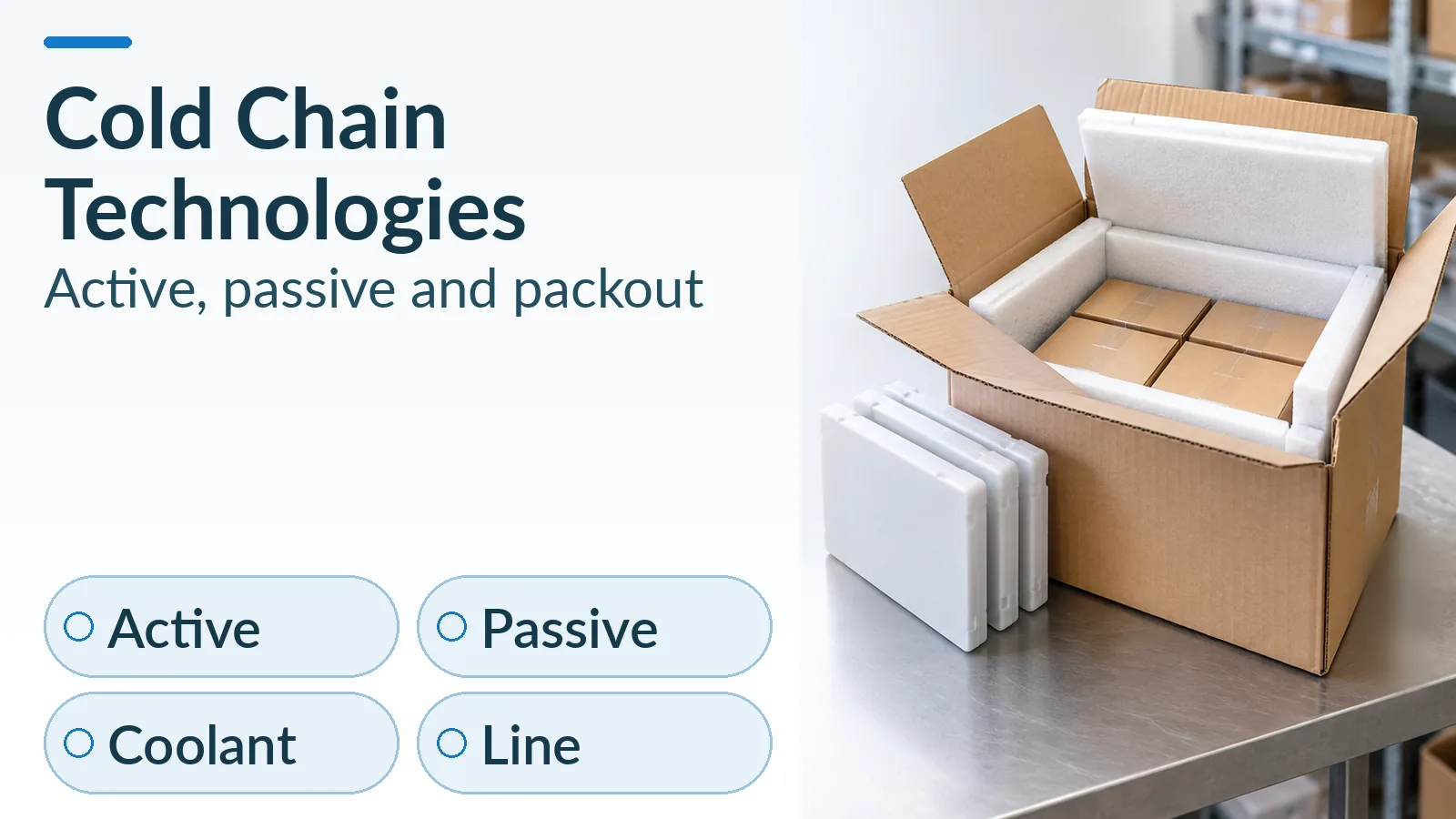
A temperature excursion can force shipment rejection when cold chain technologies are selected without allowing for delays. For active vs passive packaging, choose a temperature-controlled container or phase-change shipper whose documented performance covers the route; use packout automation to reproduce the approved assembly.
Cold chain technologies serve two linked decisions: how the payload stays within its temperature limits during transport, and how the shipping configuration is prepared consistently. Active containers use powered temperature control; passive phase-change systems combine insulation with conditioned thermal storage. An automated packout line can prepare and check a configuration, but its cycle rate does not establish transport protection. Compare the thermal evidence, preparation capacity and recovery arrangements together before choosing a technology for a particular payload and distribution lane.
Quick specs: establish the duty before comparing systems
The useful specification is a complete shipping duty: product limits, sealed exposure, payload and the support available along the route.
| Input or item | Typical value or source | Why it matters |
|---|---|---|
| Product temperature limits | Product owner’s approved stability and shipping requirements | A container set point alone cannot define product acceptance |
| Active control architecture | Envirotainer RelEye RLP specification: compressor cooling, electrical heating and rechargeable batteries | Power availability and remaining autonomy become operating inputs |
| Passive architecture | Peli BioThermal Crēdo Cube documentation: phase-change material (PCM) and vacuum insulated panels (VIPs) | Coolant preparation and insulation condition determine the starting configuration |
| Required protection duration | Time from pack closure through recipient unpacking, including staging and delay allowance | Carrier transit time can omit exposure before collection and after delivery |
| Packout release basis | Approved component identities, conditioning state and assembly instruction | A correctly sealed carton can still contain the wrong thermal configuration |
The cold-chain packaging machinery category covers equipment interfaces. Establish the thermal system first so an equipment specification has a defined configuration to preserve.
Active containers regulate temperature using an energy supply
An active container uses powered control to add or remove heat within its operating envelope. The RelEye RLP technical specification provides a concrete example: compressor refrigeration, electric heating and rechargeable NiMH batteries.
Its specification lists autonomy of 170 hours at 20°C ambient with the container temperature range at 2–8°C. These are reference conditions for that product, accessed October 2026. They are not an all-weather duration or a rating for every active container. Loading, door openings, ambient exposure and charging arrangements must be assessed against the relevant operating documentation.
Choose active control for an operating plan that can support its energy and handling requirements. Identify where staff can check charge, respond to alarms and arrange approved recharging or recovery. An unplanned hold without that support can exhaust the energy reserve even though temperature regulation initially works correctly.
Passive phase-change shippers depend on their prepared thermal reserve
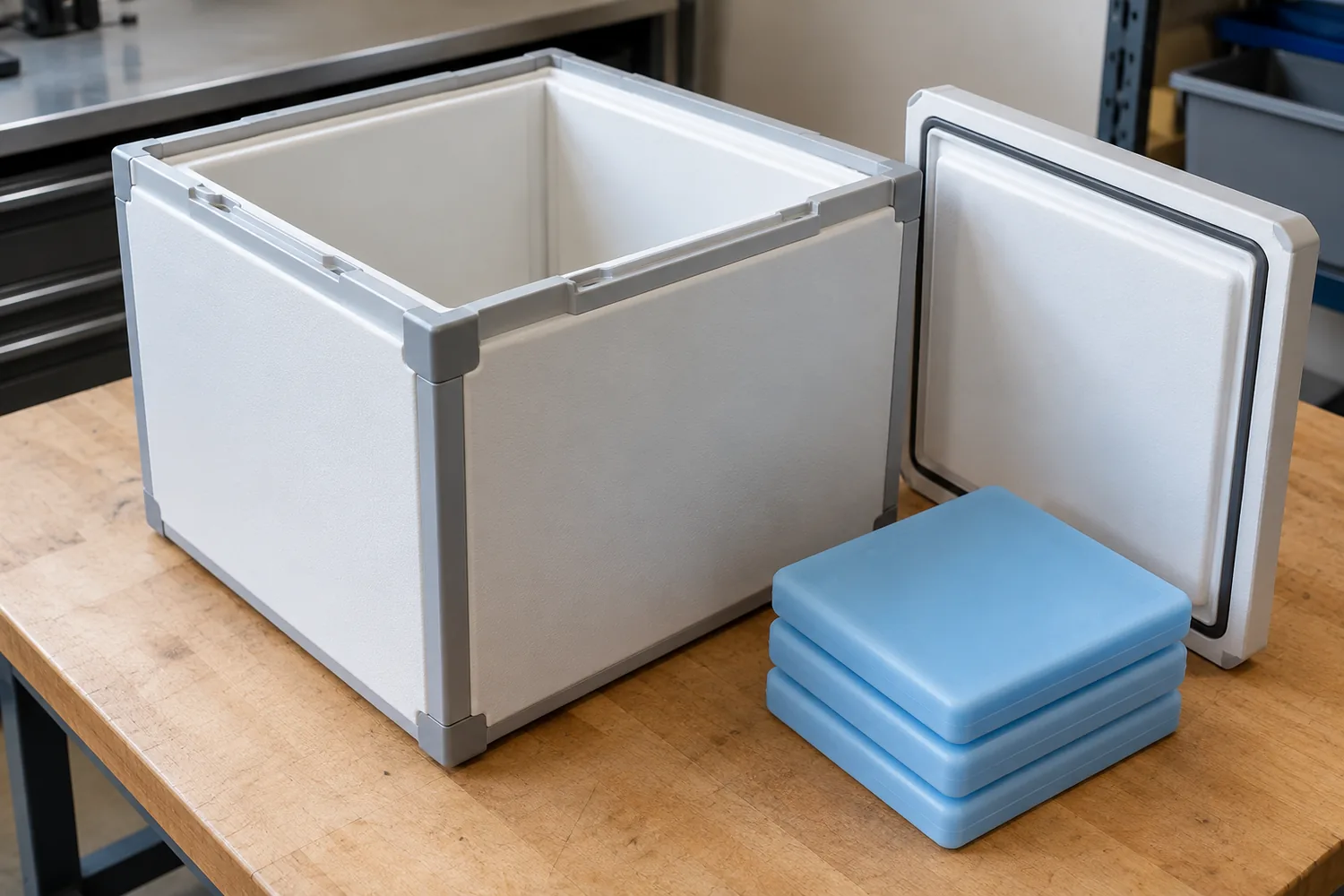
A passive PCM shipper limits heat transfer through insulation and uses the phase change of its conditioned coolant to buffer temperature. Its protection depends on the complete configuration and starting state.
Peli BioThermal describes Crēdo Cube as a passive reusable system combining PCM and VIPs. The Series 4 user guide, pages 3–4, gives different conditioning routes for particular operating circumstances. That matters operationally: a coolant panel’s identity does not establish that it has reached the required state for loading.
The same guide, page 9, calls for inspection of VIP rigidity and warns that loose skin can indicate vacuum loss. Reuse therefore introduces an inspection and replacement duty as well as a return flow. Follow the exact system instruction for conditioning and component acceptance; do not transfer one PCM preparation recipe to another formulation.
Compare the failure modes at the point where control is lost
Active and passive systems both need a route-appropriate performance basis. Automation addresses a different failure location: the assembly handoff before shipment.
| Approach | What supplies temperature protection | Evidence to match to the route | Dominant Failure Mode & Prevention |
|---|---|---|---|
| Active temperature-controlled container | Powered cooling or heating with insulation and stored energy | Operating envelope, payload/loading restrictions, autonomy conditions and recovery plan | Energy exhausted or airflow obstructed: verify charge and loading rules; provide supported charging and exception handling |
| Passive phase-change shipper | Insulation plus correctly conditioned coolant in the approved arrangement | Complete-pack report with matching payload, preparation and ambient profile | Incorrect coolant state, misplaced panels or damaged insulation: release conditioned components, verify placement and inspect reusable parts |
| Automated packout line | Repeats feeding, placement, checking and closure operations | Acceptance trials showing the approved configuration survives normal running, stops and restarts | Wrong or missing component repeatedly packed: identity checks, positive reject handling and controlled recipes |
These are failure mechanisms to evaluate, not a ranking of suppliers. An active system can also contain advanced insulation; a passive shipper can carry electronic monitoring. A powered logger does not by itself turn a passive thermal system into an active one.
Calculate duration headroom under comparable conditions
Duration headroom is the documented protection time minus the complete required exposure. Use this screening calculation only when the performance evidence covers the intended ambient profile, payload and preparation.
Formula: M = t_supported − (t_transit + t_sealed_wait + t_delay)
Here M is duration headroom in hours; t_supported is the protection duration supported by applicable evidence; t_transit is planned movement time; t_sealed_wait is other time spent sealed before unpacking; and t_delay is the planning allowance for disruption. Keep those time categories separate to avoid double counting.
Worked example — illustrative assumptions, not a product rating or test result: assume t_supported = 72 h, t_transit = 48 h, t_sealed_wait = 8 h, and t_delay = 24 h, with comparable thermal conditions and no credited recharge or reconditioning. Then M = 72 − (48 + 8 + 24) = −8 h. The plan exceeds its assumed evidence window by eight hours.
Rules-of-Thumb: If M < 0 h under the applicable payload and ambient conditions → choose a system with a longer supported protection window or a documented recovery arrangement, because the planned exposure exceeds the available thermal or energy reserve. A positive margin still requires checking temperature-profile severity; hours from a mild test cannot simply be subtracted from hours on a hotter route.
Packout automation preserves a thermal design
Automation can replace manual assembly tasks when it reproduces the approved configuration and detects exceptions. It does not replace either an active container’s temperature-control equipment or a passive shipper’s coolant and insulation.
For example, a coolant-placement station can verify that the specified panels are present. Its acceptance evidence must also address how conditioned panels are released to that station and what happens to work in progress during a stoppage. Increasing the sealer’s output cannot correct a shortage of released coolant upstream.
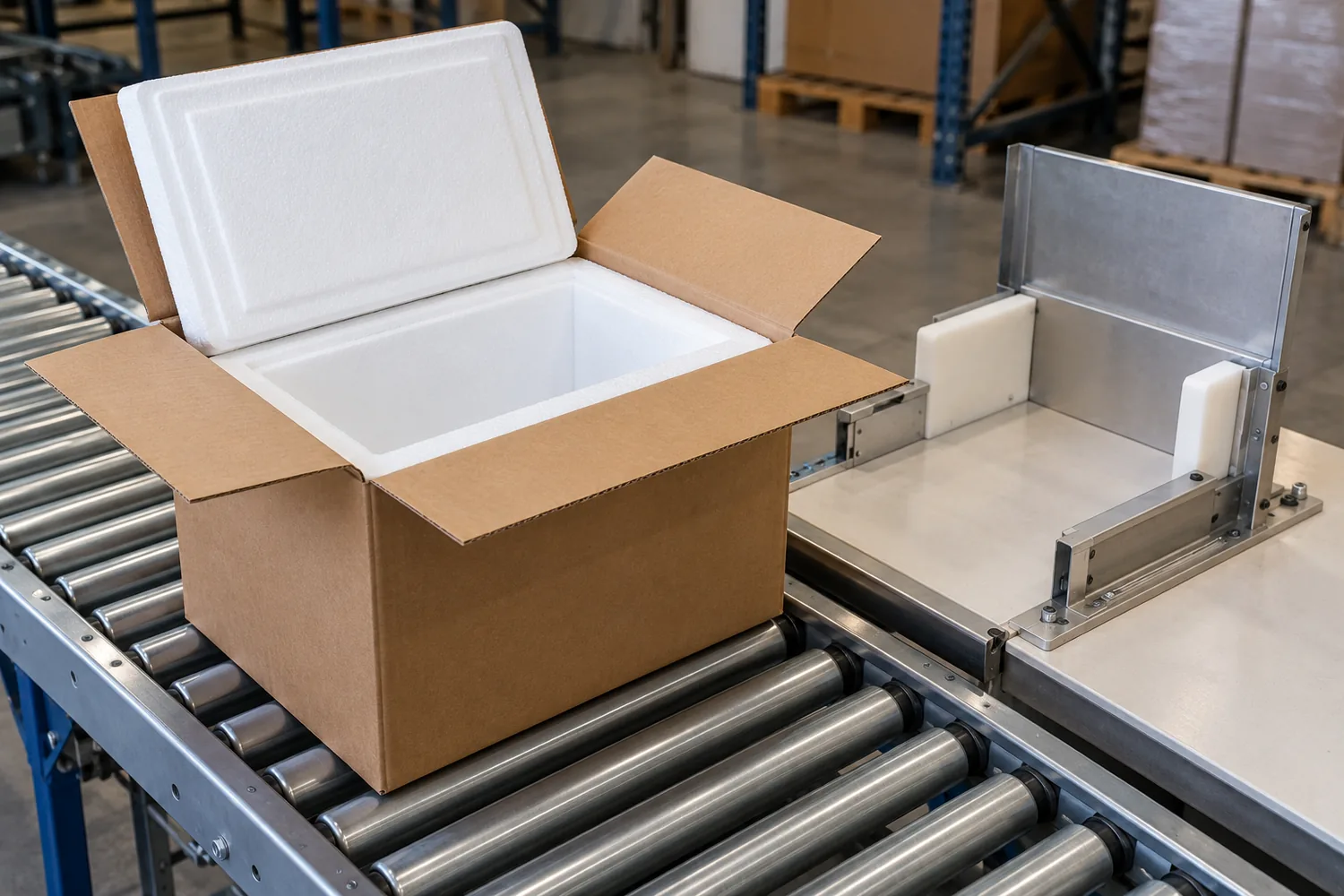
Use the equipment selection guide once these thermal responsibilities are settled. Its operation-by-operation worksheet is the next step for defining machine boundaries; the technology comparison here establishes what those boundaries must protect.
Account for the lifecycle work behind each shipment
Lifecycle workload includes preparation, waiting, inspection, recovery and return handling. Record these duties before comparing systems with different reuse or energy arrangements.
| Work item | Operating record to retain | Consequence when omitted |
|---|---|---|
| Passive preparation | Conditioning occupancy, released coolant availability and rejected components | Missed dispatch or assembly with an unready component |
| Active preparation | Charging access, checks and exception-response time | Container unavailable or insufficient reserve for the planned exposure |
| Reusable-system return | Return lead time, inspection, cleaning and replacement records | More assets tied up between usable trips |
| Packout automation | Accepted-pack count, restart rework and changeover downtime | Machine cycles overstate usable dispatch capacity |
The packout process checklist helps assign checks at dispatch. For returnable assets, the reusable cold-chain packaging guide follows the return-to-packout handoff. Neither an active nor a passive label establishes the lower lifecycle burden without those records.
Method and sources
This independent engineering comparison uses Envirotainer’s RelEye RLP specification for an example of active control, Peli BioThermal’s Crēdo Cube documentation for passive construction, and its Series 4 Rev F user guide for conditioning and inspection boundaries. Manufacturer specifications describe their named systems. The duration formula is an editorial planning screen; every numerical input in its worked example is an explicit assumption. Selection still requires the applicable complete-system evidence and route assessment.
Updated October 2026.