In cold chain logistics, refrigerated vs frozen packout discipline prevents accidental payload freeze damage and potency failure modes when chilled biologic lanes operate alongside sub-zero frozen shipping lines. For refrigerated vaccines, a single exposure to freezing temperatures of 0°C (32°F) or colder can completely destroy vaccine potency, and inactivated vaccines exposed to freezing temperatures may not appear frozen, giving no visual indication of reduced or lost potency. Vaccines licensed for refrigerator storage should be stored at 2°C-8°C (36°F-46°F), and liquid vaccines containing an aluminum adjuvant permanently lose potency when exposed to freezing temperatures.
Establishing physical and digital boundaries between chilled and sub-zero assembly benches is a core engineering requirement across packout automation lines handling biologics, diagnostics, and pharmaceutical payloads. When a single fulfillment hall packs both temperature bands, look-alike phase-change bricks, unconditioned freezer packs, and missing cardboard separators turn routine packout tasks into freeze-excursion hazards.
| Packout Control Parameter | Refrigerated Lane Requirement | Frozen or Sub-Zero Comparison | Primary Operational Failure Mode |
|---|---|---|---|
| Vaccine storage and adjuvant sensitivity | Vaccines licensed for refrigerator storage should be stored at 2°C-8°C (36°F-46°F) | Freezers maintain temperatures between -50°C and -15°C (-58°F and +5°F), while ultra-cold freezers maintain temperatures between -90°C and -60°C (-130°F and -76°F) | Liquid vaccines containing an aluminum adjuvant permanently lose potency when exposed to freezing temperatures |
| Look-alike U-tek gel pack dimensions | U-tek Gel Pack 426 (-1°C / +30°F phase temperature) with 48 oz (1361 g) fill and 6 case pack | U-tek Gel Pack 427 (-23°C / -10°F phase temperature) shares identical 10.50 x 7.80 x 1.20 in (267 x 197 x 30 mm) external dimensions | Identical pouch footprint swapped between chilled and frozen packout benches |
| Koolit gel pack series formulations | Koolit 500 series uses a 0°C (32°F) CMC-based gel formulation and 600 series encases a 0°C (32°F) polymer ice gel in a 5-mil white polyethylene pouch | Koolit 500-ST series uses a suppressed-temperature (ST) -23°C (-16.6°F) freezing point formula in a puncture-resistant nylon laminate film | Suppressed-temperature -23°C (-16.6°F) pouch loaded into a refrigerated product shipper |
| Crēdo Cube Series 4 vs Series 20M TICs | Series 4 TIC panel with +5˚C phase-change material is ready to load when an infrared thermometer reads between +3°C and +4.5°C at +22°C room temperature | Series 20M TIC panels with integrated -21˚C phase-change material surround the payload after conditioning in a −40°C (±3°C) freezer or below for a minimum of 24 hours (or as warm as −30°C [±3°C] with increased conditioning time) | Unconditioned Series 4 TIC (still ≤−18°C after freezer) or Series 20M −21˚C-PCM TIC (still at −40°C conditioning) loaded directly around chilled payload |
| Dry ice thermodynamic and air transport limits | Dry ice is solid carbon dioxide with a temperature of –109.3 °F (–78.5 °C) at 1 atmosphere and a triple point of –69.9 °F (–56.6 °C) at 60.4 psig (416 kPa) | Under § 173.217 of the HMR for air transport of dry ice (UN1845), packages exceeding 2.5 kg (5.5 lbs.) are fully regulated as dangerous goods | Dry ice must never be stored or transported in airtight containers; do not use dry ice for frozen vaccines |
Why Chilled vs Frozen Cold Chain Packout Requires Dedicated Lane Separation
In multi-therapy fulfillment warehouses, running a chilled vs frozen cold chain packout without dedicated station boundaries exposes temperature-sensitive vials and prefilled syringes to irreversible potency loss from freezing. Because phase change inside an insulated shipper occurs silently after lid closure, warehouse quality teams treat sub-zero coolant intrusion as a primary line-design failure mode alongside broader cold chain packaging problems and solutions.
Clinical storage rules and cold-chain equipment specifications define strict thermal boundaries between chilled, frozen, and ultra-cold lanes:
- Freezers maintain temperatures between -50°C and -15°C (-58°F and +5°F), while ultra-cold freezers maintain temperatures between -90°C and -60°C (-130°F and -76°F).
- Diphtheria-tetanus-containing vaccines (DT, Td), pertussis-containing vaccines (DTaP, Tdap), and HepA and HepB require 2°C-8°C (36°F-46°F) storage with a ‘Do not freeze’ instruction and no diluent, whereas MMRV and Varicella require -50°C to -15°C (-58°F-5°F) storage with diluent at 2°C-25°C (35°F-77°F).
- Lyophilized varicella-containing vaccines can be prone to losses in sterility if kept too cold due to increased gas permeability of the rubber vaccine vial, observed with use of dry ice at temperatures below -50°C or -58°F.
- If frozen vaccines must be transported, a portable vaccine freezer unit or qualified container and packout maintaining temperatures between -50°C and -15°C (-58°F and +5°F) (or between -90°C and -60°C [-130°F and -76°F] for ultra-cold transport) must be used, and dry ice must not be used because it might expose frozen vaccines to temperatures colder than -50°C (-58°F).
Dedicated coolant-freezing appliances also require physical segregation from vaccine storage refrigerators so operators never place vaccine cartons inside an ice-pack freezer:
- Freezing ice packs in the deep freezer (DF) maintains the cabinet temperature between -15°C and -25°C, freezing about 20–25 ice packs (8–10 kg of ice) and 35–40 ice packs (12–14 kg of ice) of 0.4 litre capacity in one day in small and large deep freezers respectively, and a break in the cold chain is indicated if temperature rises above +8°C or falls below +2°C in the ILR and above -15°C in the DF.
- Solar direct-drive water-pack freezers (WHO/PQS/E003/FZ03.2) require a minimum 24-hour water-pack freezing capacity of 1.6 kg for gross freezer volume less than 50 litres and 2.4 kg per each 50 litres for gross freezer volume equal to or greater than 50 litres (holding a minimum of 3.2 kg of water-packs and at least twice the daily water-pack freezing capacity), and all units must carry a factory-fitted non-removable label stating ‘Do not store vaccine in this freezer’ in letters a minimum of 20 mm high.
Coolant Phase-Change Chemistry and Look-Alike SKU Hazards
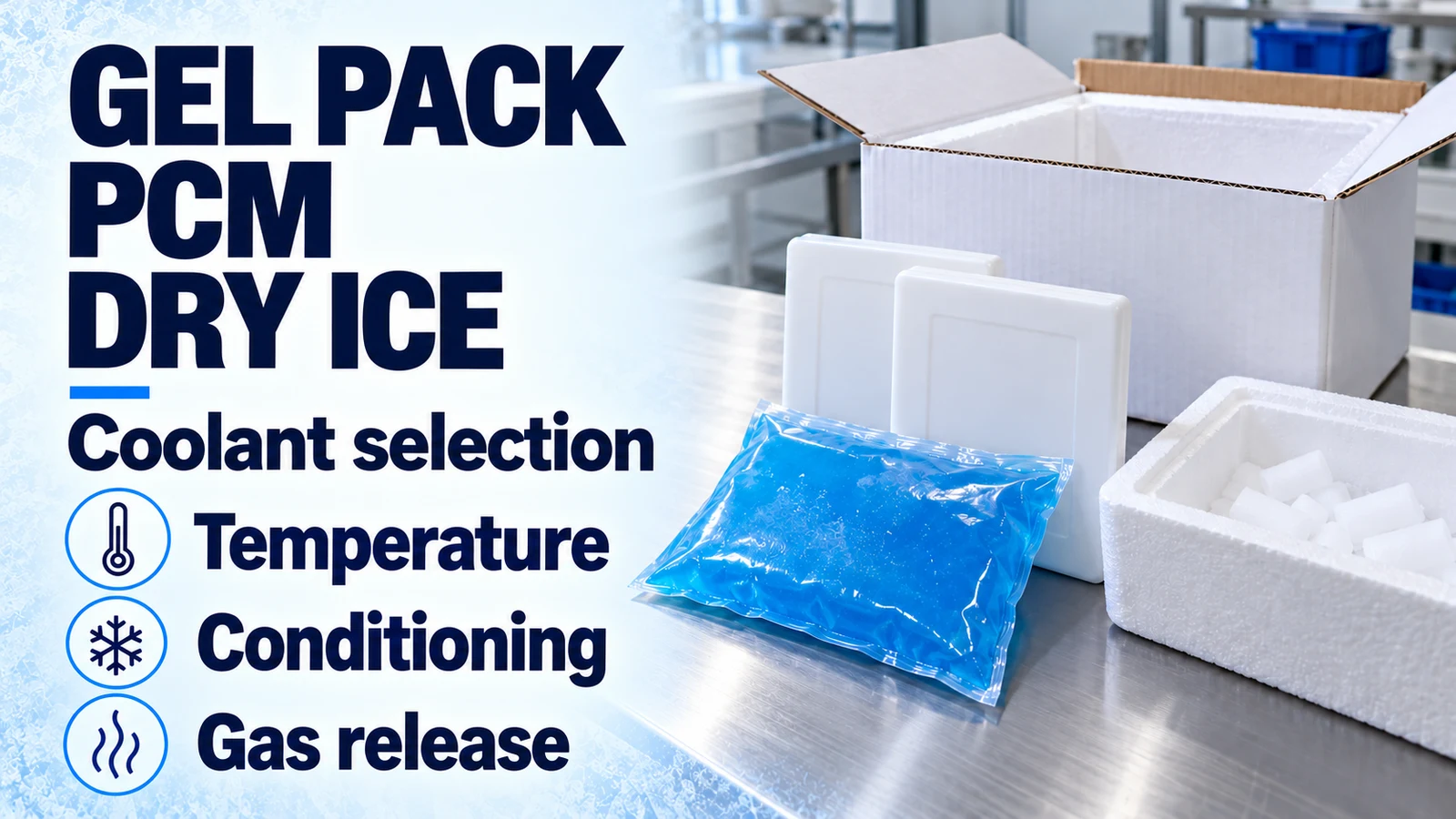
Accidental freezing on a 2-8c packout lane can result from the physical similarity among flexible gel packs, rigid water bottles, eutectic salt packs, and organic phase-change bricks. Operators comparing gel pack, PCM, and dry ice coolant selection must distinguish between water-based formulations that transition at the freezing point of water and sub-zero eutectic media engineered for frozen transport.
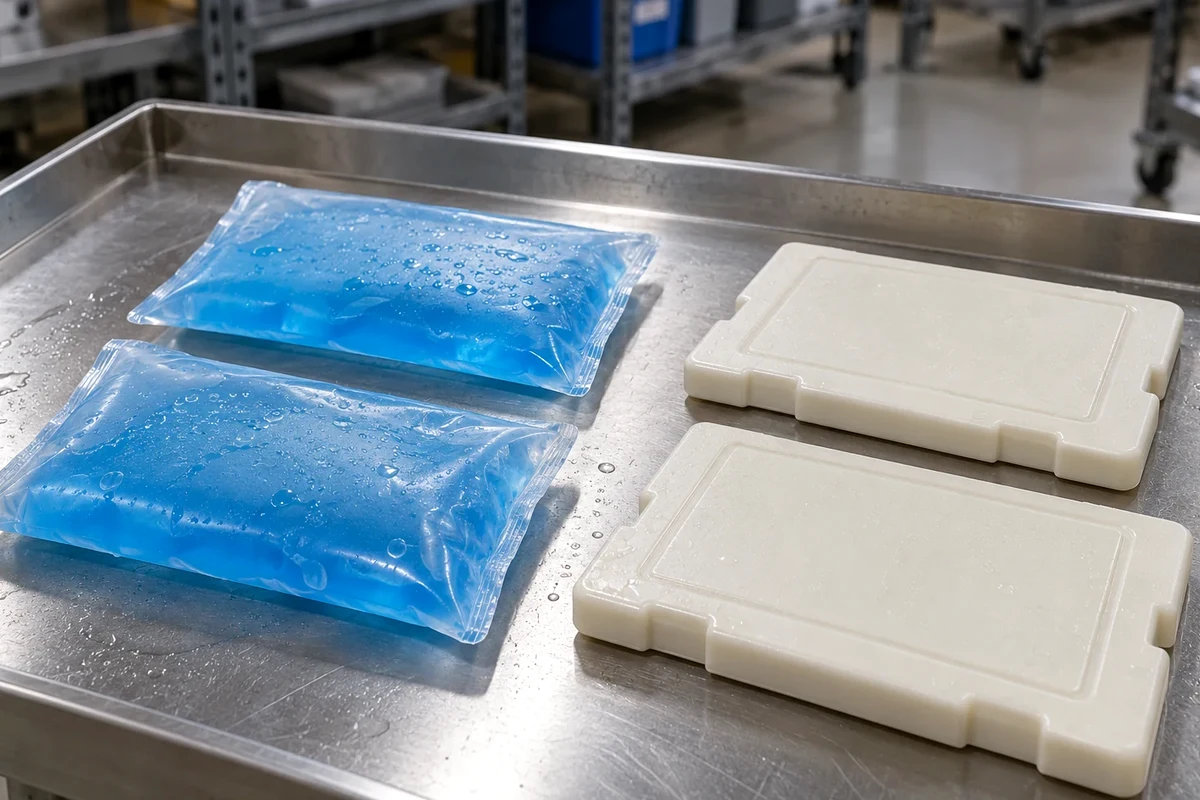
International vaccine cold-chain specifications and commercial refrigerant catalogs illustrate how coolant chemistries and container dimensions overlap across temperature regimes:
- Advanced phase change materials (PCMs) are chemically engineered so that their latent heat of fusion occurs at a temperature other than zero ° Celsius, phasing from liquid to solid at a pre-formulated temperature, whereas passive systems maintain a temperature-controlled environment inside an insulated enclosure using a finite amount of preconditioned coolant in the form of chilled or frozen gel packs, phase change materials, dry ice or others.
- A Cool-pack is defined as a water-pack pre-cooled to a temperature between + 2°C to +8°C before use, whereas an Icepack is defined as a water-pack frozen to a temperature between -5°C and -20°C before use and is used for the transport of oral polio vaccine (OPV) or stool specimens.
- Water-packs have a dimensional tolerance of ± 2.0mm (in mm) and a fill tolerance within ± 2% of rated water content: Type 1 (0.3 L, 0.25 to 0.35 litres) is 173 x 120 x 26 mm (max 70 g empty, 420 g filled), preferred Type 2 (0.3 L, 0.25 to 0.30 litres) is 163 x 90 x 34 mm (max 80 g empty, 380 g filled), Type 3 (0.4 L, 0.35 to 0.40 litres) is 163 x 94 x 34 mm (max 100 g empty, 500 g filled), and Type 4 (0.6 L, 0.55 to 0.60 litres) is 190 x 120 x 34 mm (max 120 g empty, 720 g filled).
- When filled water-packs are stacked on top of one another in a freezer at -20°C (±5°C) for 24 hours, the increase in sample thickness due to swelling must not exceed the measured dimensions from Test 2 by more than 25% for any sample, the thickness of each thawed sample must equal Test 2 (±1.0mm), and water-packs must not adhere to one another significantly when frozen.
In commercial pharmaceutical distribution, look-alike pouch and brick dimensions create an immediate swap risk when chilled and frozen SKUs are staged near the same conveyor line:
- The Standard PolarPack PP6 has a 6 oz (170 g) fill, a 96 case pack, a 0°C (+32°F) temperature rating, and external dimensions of 5.50 x 3.50 x 0.80 in (140 x 89 x 19 mm).
- The Standard PolarPack PP48 has a 48 oz (1361 g) fill, a 12 case pack, a 0°C (+32°F) temperature rating, and external dimensions of 10.50 x 7.50 x 1.30 in (267 x 191 x 32 mm).
- MoistureGuard PolarPacks (MG) use a multi-layered exterior whose outer film layer absorbs condensation to minimize surface condensation, and part MG12 has a 12 oz (340 g) fill, a 48 case pack, a 0°C (+32°F) temperature rating, and external dimensions of 6.00 x 5.50 x 0.80 in (152 x 140 x 19 mm).
- The semi-rigid PCM Brick TPB3020A has a 47 oz (1338 g) fill, a 12 case pack, a +4°C (+39°F) phase temperature, and external dimensions of 10.80 x 9.30 x 1.00 in (273 x 235 x 25 mm), while the thinner PCM Brick TPB3000A has a 24 oz (669 g) fill, a 24 case pack, a +4°C (+39°F) phase temperature, and external dimensions of 10.80 x 9.30 x 0.60 in (273 x 235 x 14 mm).
- The PCM Brick TPB3020Y has a 47 oz (1344 g) fill, a 12 case pack, a +20°C (+68°F) phase temperature, and external dimensions of 10.80 x 9.30 x 1.10 in (273 x 235 x 27 mm).
- The U-tek Gel Pack 427 (-23°C / -10°F phase temperature) and U-tek Gel Pack 426 (-1°C / +30°F phase temperature) share an identical 48 oz (1361 g) fill, 6 case pack, and external dimensions of 10.50 x 7.80 x 1.20 in (267 x 197 x 30 mm).
- The U-tek Gel Pack 429 (-1°C / +30°F phase temperature) and U-tek Gel Pack 432 (-23°C / -10°F phase temperature) share an identical 8 oz (227 g) fill, 36 case pack, and external dimensions of 6.00 x 4.00 x 0.80 in (152 x 102 x 19 mm).
- In the Koolit gel pack range, the 500 series uses a 0°C (32°F) CMC-based gel formulation in a puncture-resistant nylon laminate film (and the 600 series encases a 0°C [32°F] polymer ice gel in a 5-mil white polyethylene pouch) for refrigerated products, whereas the 500-ST series uses a suppressed-temperature (ST) -23°C (-16.6°F) freezing point formula in a puncture-resistant nylon laminate film for products that need to stay below freezing temperatures.
- ChillTech provides pre-qualified PCM systems for 2°C to 8°C shipments with durations up to 144 hours, while the Envoy Global seasonal platform uses four base shippers and five refrigerants to create 20 configurations supporting refrigerated and controlled room temperature shipments.
- Hydropac’s HydroPure water ice pack appears to ‘crack’ and changes from black to white once it has reached optimum freezing temperature, while its updated HydroFreeze water-based ice packs are thought to freeze 51% faster than Hydropac’s original water-based ice pack.
Because two pouches with identical length, width, thickness, and fill weight can differ in phase-change point by more than twenty degrees, mechanical slot gauges cannot detect a wrong-lane coolant. Dedicated staging racks and barcode verification at the packout bench are essential to prevent a suppressed-temperature eutectic pack from entering a chilled shipper.
Preconditioning Workflows and Packout Station Interlocks
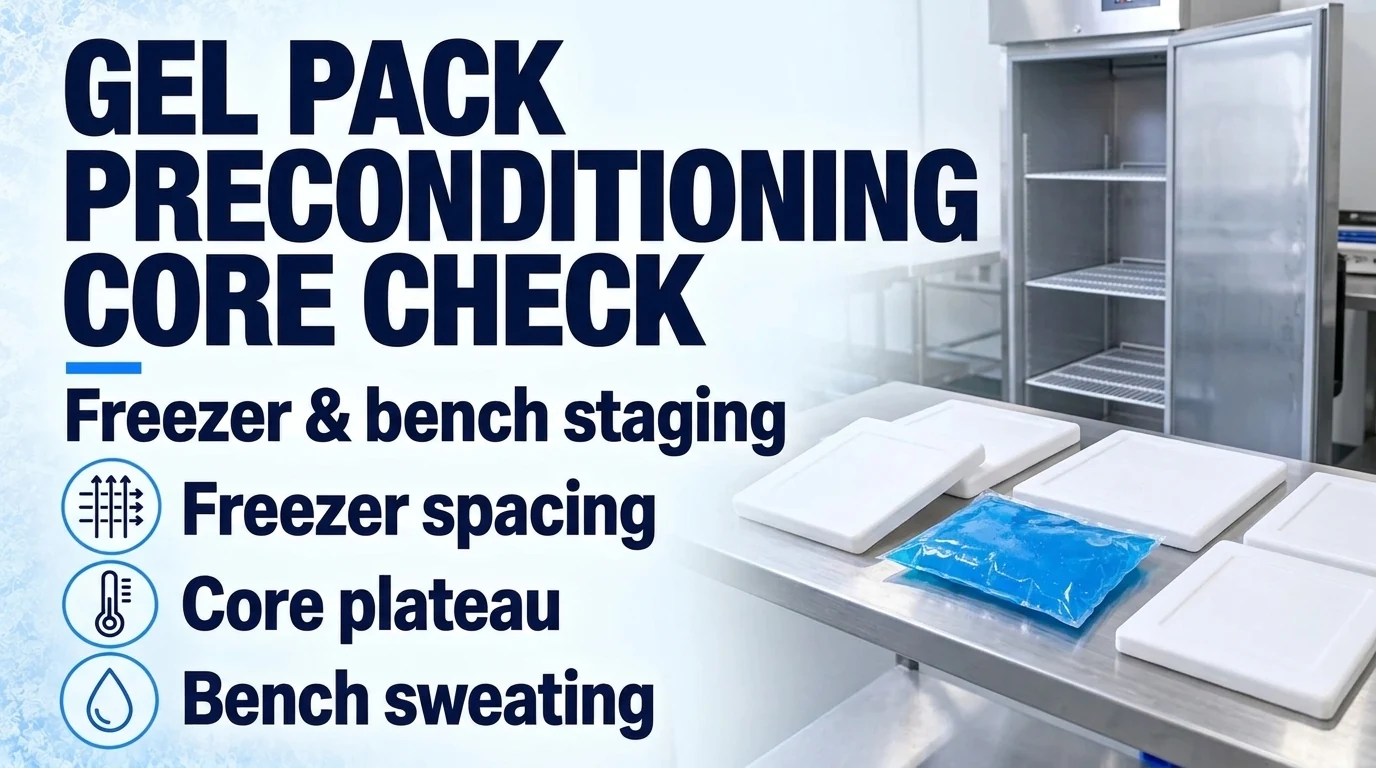
Even when a facility uses plain tap-water ice packs or phase-change panels designed for chilled transport, freezer-conditioned media exit the freezer well below the freezing threshold of liquid biologics. Engineering teams standardizing gel pack preconditioning time and core temperature protocols must enforce bench-conditioning holds, dual-stage refrigerator transfers, or infrared surface temperature gates before releasing coolants to a refrigerated packout bench.
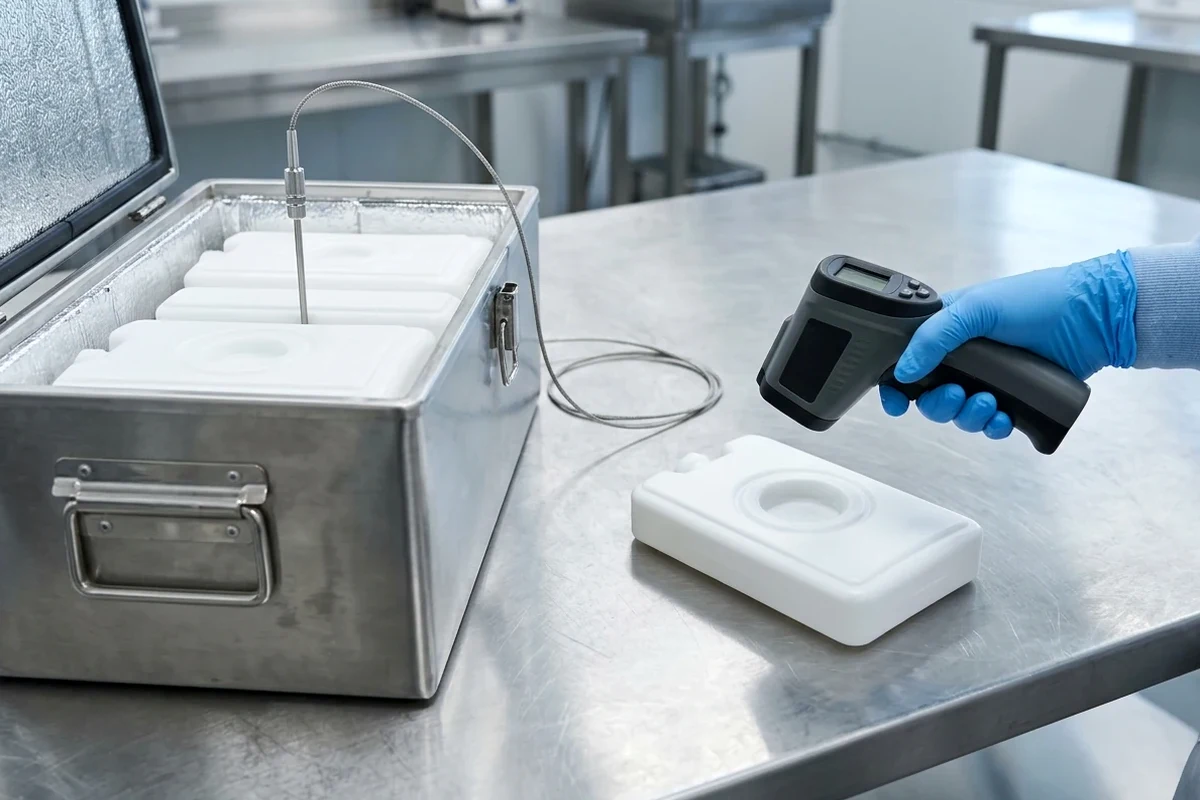
Public-health vaccine transport guidelines and WHO bench-conditioning procedures define strict rules for water-packs and phase-change coolants:
- Phase change materials (PCMs) between 4°C and 5°C (39°F and 41°F) can be used to maintain proper temperatures and reduce the risk of freezing vaccines during transport, whereas frozen gel packs or coolant packs from original vaccine shipments must not be used to pack refrigerated vaccines because they can still freeze vaccines even if they are conditioned or appear to be ‘sweating.’
- Ice packs come out of the freezer at a temperature of about -20°C and must be kept at room temperature to allow the ice at the core to rise to 0°C—a conditioning process that takes up to one hour at +20°C and prevents freezing of freeze-sensitive vaccines (such as Hep B and T series) that can be damaged by direct contact with frozen ice packs.
- During ice-pack conditioning, frozen ice packs taken from the freezer are laid out on a table leaving a 5 cm space all round each ice pack, preferably in single rows but never in more than two rows, and shaken every few minutes until there is a small amount of liquid water inside and the ice begins to move about slightly inside its container.
For reusable thermal isolation chamber shippers, conditioning procedures differ sharply between the refrigerated assembly and the deep-frozen assembly. When operators follow a structured cold chain packaging process checklist, verifying the exact conditioning option, infrared stand-off reading, and payload pre-conditioning band prevents cross-series errors:
- Thermal Isolation Chamber (TIC) panels with integrated +5˚C phase-change material surround the payload, and under Option 1 (Freezer to Room Temperature) operators place the TIC system flat in a -18˚C freezer, or below, for a minimum of 24 hours and shake the panels to verify no liquid can be heard.
- After removal from a -18°C freezer at a room temperature of +22°C with panels unstacked, the Series 4 TIC panel is ready to load when an infrared thermometer pointed at the edge of the center stand-off reads between +3°C and +4.5°C, or when a visible check mark appears on the TIC Smart Indicator.
- Under Option 2 (Freezer to Refrigerator Processing), after freezing at -18˚C or below for a minimum of 24 hours, the TIC system is rotated into a refrigerated (+2°C to +8°C) environment to reach a minimum usable temperature of +2°C (and can be held indefinitely at +3°C ±1°C without melting), whereas Option 3 (for journeys at +2°C or colder for 50% or more of transit) conditions the TIC system in a +5°C (±3°C) refrigerator for between 6 and 12 hours until fully liquid and never places the TICs into a freezer.
- For Crēdo Series 4 packout, the payload must be conditioned at +5°C (±3˚C) before loading into the five (5) TIC panel assembly, and during Refrigerated Hold an ambient environment between +2°C and +4°C results in no positive heat flow into the container and no performance degradation, whereas temperatures above +4°C establish heat flow that slowly melts the Series 4 PCM.
- In the Crēdo Cube Series 20M shipper, Thermal Isolation Chamber (TIC) panels with integrated -21˚C phase-change material surround the payload, and the PCM TICs must be placed flat into a ‐40°C (±3°C) freezer or below for a minimum of 24 hours (or conditioned in a freezer as warm as -30°C [±3°C] with increased conditioning time).
- For Crēdo Series 20M packout, the payload must be conditioned between -15°C and -25°C before loading into the five (5) TIC panel assembly, and during Freezer Hold an ambient freezer environment between -25° C and -21° C produces no positive heat flow into the container and no performance degradation, whereas temperatures above -21° C establish heat flow that slowly melts the Series 20M PCM.
Buffer-Layer Architecture and Sensor Placement Inside Chilled Shippers
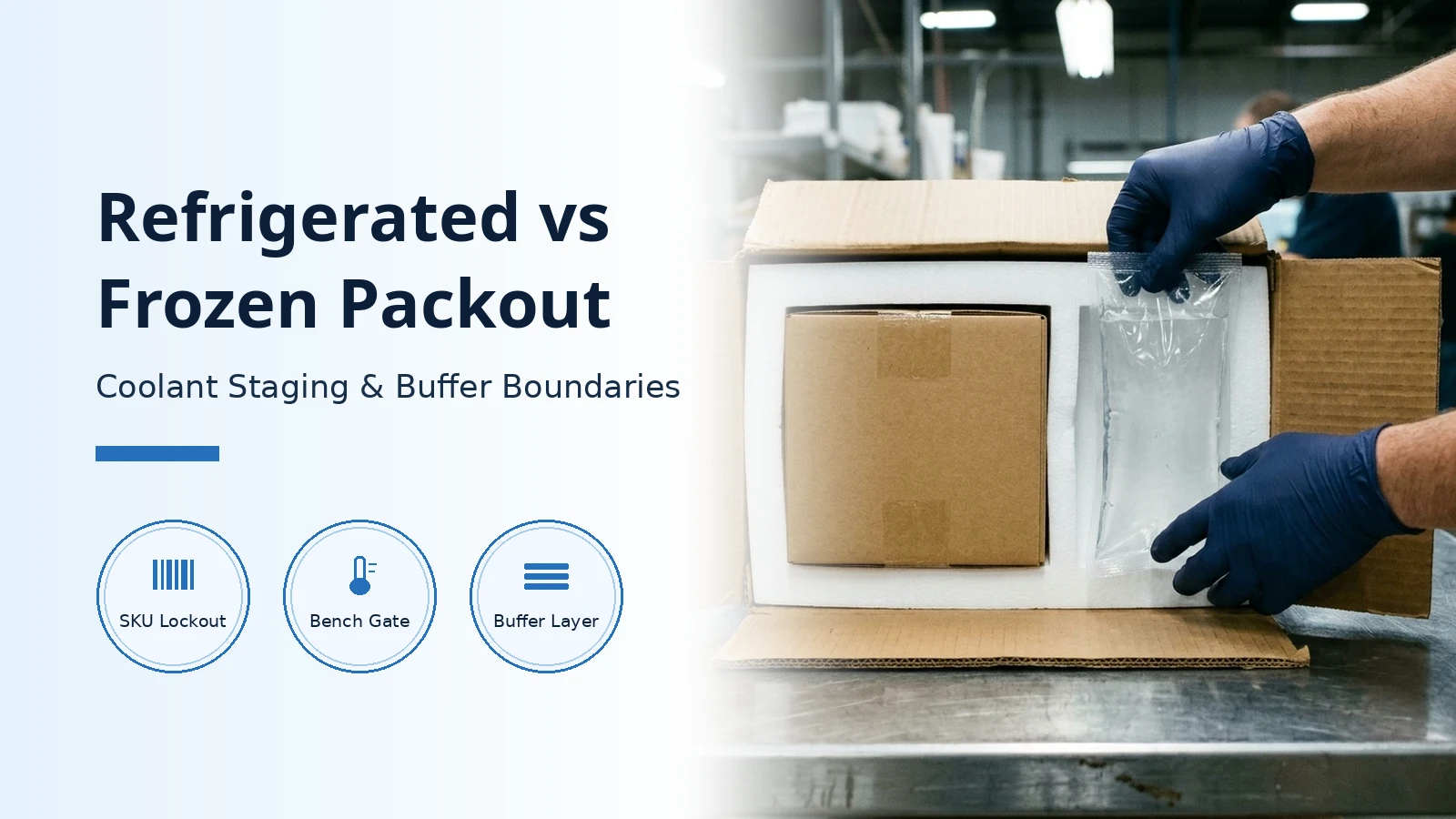
Preventing gel pack freeze damage in 2-8c shippers requires both thermal preconditioning and a physical insulating barrier between the coolant face and the primary payload carton. Even when water-packs have been conditioned until liquid water moves inside, direct contact with a cold container wall or ice pack can freeze adjacent vials.
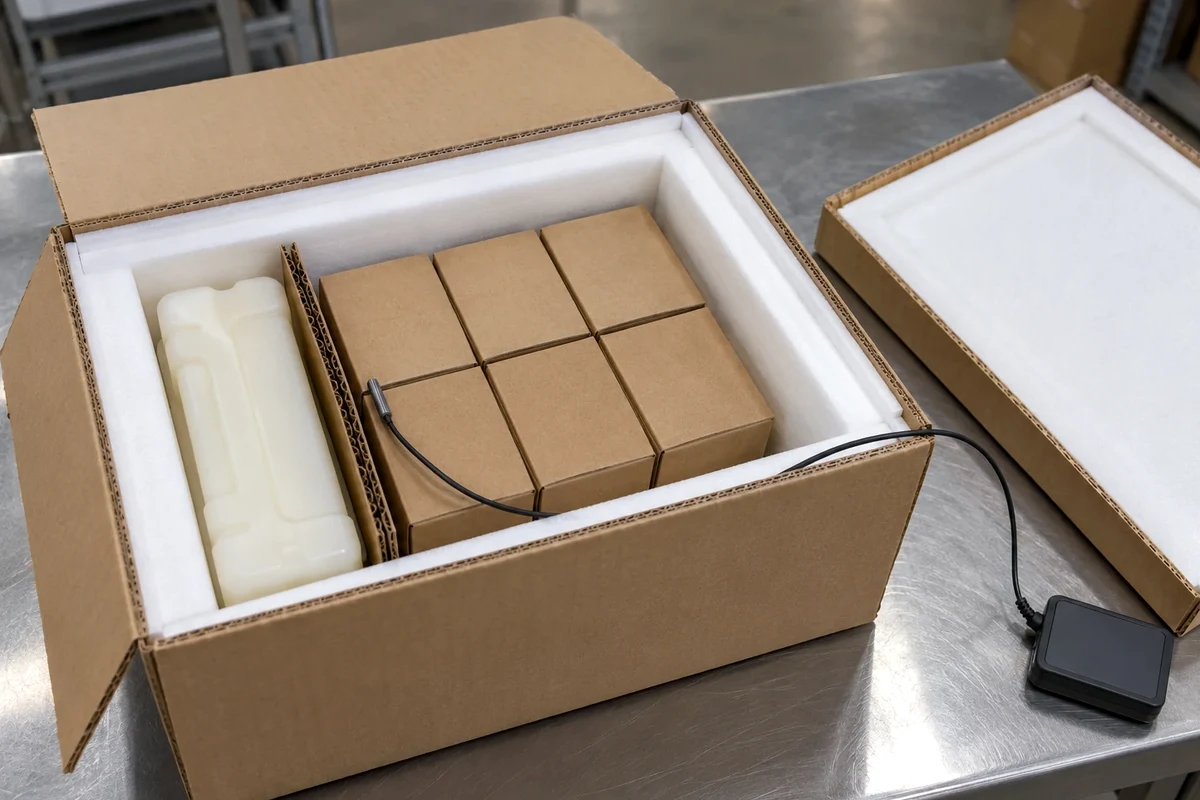
CDC and WHO packout assembly rules specify exact dunnage layering, diluent isolation, and buffered probe placement inside transport coolers, cold boxes, and vaccine carriers:
- Appropriate vaccine transport materials include PCMs conditioned between 4°C and 5°C (39°F and 41°F), conditioned frozen 16.9- or 8-ounce water bottles, insulating materials such as bubble wrap and corrugated cardboard—enough to form two layers per container—and a TMD or DDL with an accuracy of ±0.5°C (±1°F) with its buffered temperature probe placed directly with the vaccines.
- If diluents stored at room temperature (20°C to 25°C [68°F to 77°F]) are transported with refrigerated vaccines, they should be refrigerated in advance so they do not raise container temperature, diluents must never be frozen during transport, and an insulating barrier like bubble wrap must be placed between diluents and conditioned water bottles or phase change materials.
- Vaccines must not be transported by reusing original shipping materials from the distributor or manufacturer—even though commercial distributors and manufacturers use validated packouts with materials conditioned to certain temperatures and specifically designed placement, reusing them can compromise the cold chain and jeopardize vaccine viability.
- When packing a cold box, conditioned ice packs are placed at the bottom and sides, vaccines are loaded in cardboard cartons or polythene bags, freeze-sensitive vaccines are never placed in direct contact with the ice packs (surrounding them with OPV/BCG/JE vaccines), and two rows of conditioned ice packs covered by a plastic sheet are placed above the vaccine vials.
- When packing a vaccine carrier, four conditioned ice packs are placed along the sides, vaccine vials and ampoules are wrapped in thick paper before putting them in a polythene bag in the centre away from the ice packs, packing material is placed between ‘T’ series vaccine and the ice packs to prevent touching, and a foam pad is placed on top of the ice packs.
To eliminate operator conditioning errors altogether in field transport, WHO/PQS freeze-preventive cold boxes and vaccine carriers incorporate internal thermal buffers between the sub-zero ice-pack cavity and the payload chamber. Teams reviewing cold chain monitoring data loggers and packout integration can align sensor positioning with these container qualification boundaries:
- An ice-pack is defined as a water-containing coolant-pack frozen to a temperature between -5°C and -25°C before use to the point where there is no remaining liquid water, whereas a warm water-pack is a coolant-pack typically stabilized at room temperature up to a recommended maximum of +24°C for the transport of freeze-sensitive vaccines during exposure to sub-zero ambient temperatures.
- For WHO/PQS/E004/VC02.1 freeze-preventive vaccine carriers, freeze protection classification is based on the number of user-interventions required: Grade A (user-independent freeze protection, UIFP) requires no intervention by the user within its nominated temperature range (+43°C and minimum rated ambient temperature) to ensure vaccines are not exposed below 0°C, whereas Grade B (user-dependent freeze protection, UDFP) requires one level of intervention (such as adding a liner).
- For WHO/PQS/E004/VC02.1 freeze-preventive vaccine carriers, the temperature inside the vaccine storage compartment must remain above 0°C during the cold life test at +43°C and during the minimum rated ambient temperature test at +15°C, with a minimum cold life of 15 hours for short range and 30 hours for long range, and cooldown must not exceed 8 hours.
- For WHO/PQS/E004/VC02.1 freeze-preventive vaccine carriers, cooling of the container must be achieved using fully frozen ice-packs taken directly from a freezer room or freezer at -25°C; integrated water-based buffers or PCM-based buffers (complying with WHO/PQS/ E005/PCMC0.1) and/or container configuration may be used to prevent freezing temperatures from propagating to the vaccine storage compartment, and the design must eliminate the possibility of vaccine packages being exposed to air temperatures reaching 0°C or contacting surfaces with a temperature of 0°C or less.
- For WHO/PQS/E004/VC02.1 freeze-preventive vaccine carriers, the container must be provided with one full set of coolant-packs complying with PQS/E005/IP01, Type 2 (0.3 litre), Type 3 (0.4 litre), or Type 4 (0.6 litre), and only one of these types may be used—a mix of the sizes is not acceptable.
Thermal Qualification Tolerances and Dry Ice Air-Transport Boundaries
Qualifying a passive shipping system across refrigerated and frozen lanes requires multi-profile chamber verification, calibrated thermocouple instrumentation, and strict adherence to dangerous-goods venting rules whenever dry ice is used on deep-frozen lanes:
- Design qualification tests at least four packaging configurations (one heat profile with maximum product load, one heat profile with minimum product load, one cold profile with maximum product load, and one cold profile with minimum product load, though products that can safely be shipped frozen do not need cold profile testing), and if a prequalified shipping system OQ report is relied upon, no substitutions or modifications to the design or packaging can be made, with OQ tests carried out in triplicate.
- Thermal test chambers and conditioning equipment for payloads (such as +2 °C to +8 °C for 24 hours) and temperature stabilizing media must maintain the temperature set point within a tolerance of ±3 °C, while multi-channel thermocouple data loggers require an operating tolerance of ±0.5 °C for temperatures > −18 °C and ±0.8 °C for temperatures ≤ −18 °C; for EDLMs that use thermistors, wider tolerances are acceptable outside their operating range (e.g. ±2 °C for temperatures below −40 °C in dry ice shipments).
- Dry ice is solid carbon dioxide with a temperature of –109.3 °F (–78.5 °C) at 1 atmosphere and a triple point of –69.9 °F (–56.6 °C) at 60.4 psig (416 kPa), and it must never be stored or transported in airtight containers.
- Under § 173.217 of the HMR for air transport of dry ice (UN1845), any packaging used must be designed to permit the release of carbon dioxide gas to prevent pressure build-up that could cause the package to rupture; packages with net dry ice weight not exceeding 2.5 kg (5.5 lbs.) must be marked with ‘Carbon Dioxide, solid’ or ‘Dry Ice,’ the contents being cooled, and the net weight, while quantities exceeding 2.5 kg (5.5 lbs.) are fully regulated as dangerous goods requiring hazmat employee training.
Sources
- Centers for Disease Control and Prevention — Vaccine Storage and Handling Toolkit
- World Health Organization — Immunization handbook for Medical Officers, Part 2
- World Health Organization — Performance, Quality and Safety Specifications for Freeze-Preventive Cold Boxes, Vaccine Carriers, Water-Packs, and Water-Pack Freezers
- World Health Organization — Technical Supplement on Qualification of Shipping Containers
- Sonoco ThermoSafe — PolarPack, MoistureGuard, PCM Brick, U-tek, ChillTech, and Envoy Global Technical Documentation
- Peli BioThermal — Crēdo Cube Conditioning and Assembly Operating Instructions
- Cold Chain Technologies — Koolit Refrigerant Technical Documentation
- Packaging Europe — Hydropac HydroPure and HydroFreeze Phase-Change Ice Pack Coverage
- Federal Aviation Administration and Pipeline and Hazardous Materials Safety Administration — Air Transport of Dry Ice Packaging Guidance