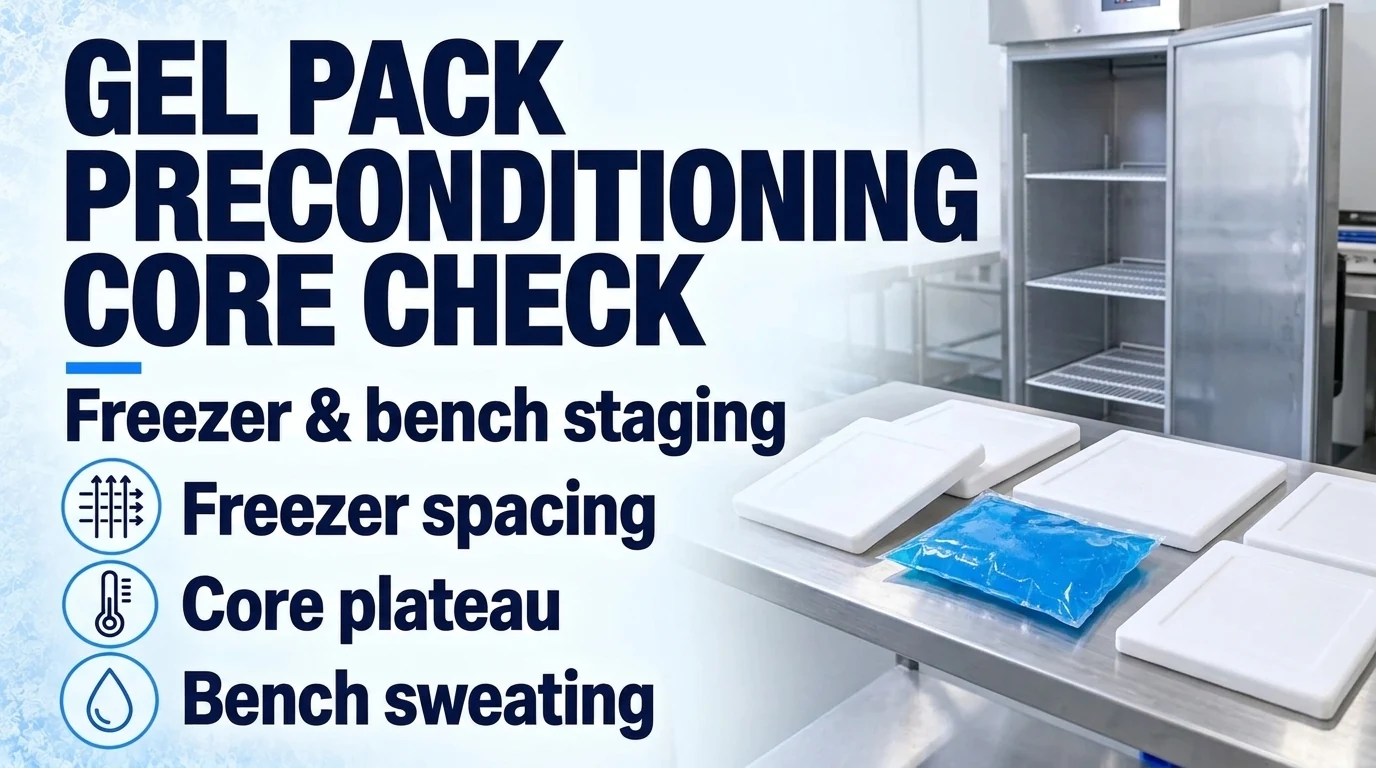
In packout automation, gel pack preconditioning time procedures check freezer loading, core phase state, and bench conditioning to prevent packout failure modes.
For rigid bricks, freezer loading and airflow matter because a brick with a cold surface and a warm core may look ready but perform inconsistently.
Conversely, frozen solid gel packs are taken directly from the freezer and generally frozen between 20 degrees Celsius and minus-25 degrees Celsius; when added to a passive container, the container’s temperature will drop to well below 0 degrees Celsius and remain there for several hours.
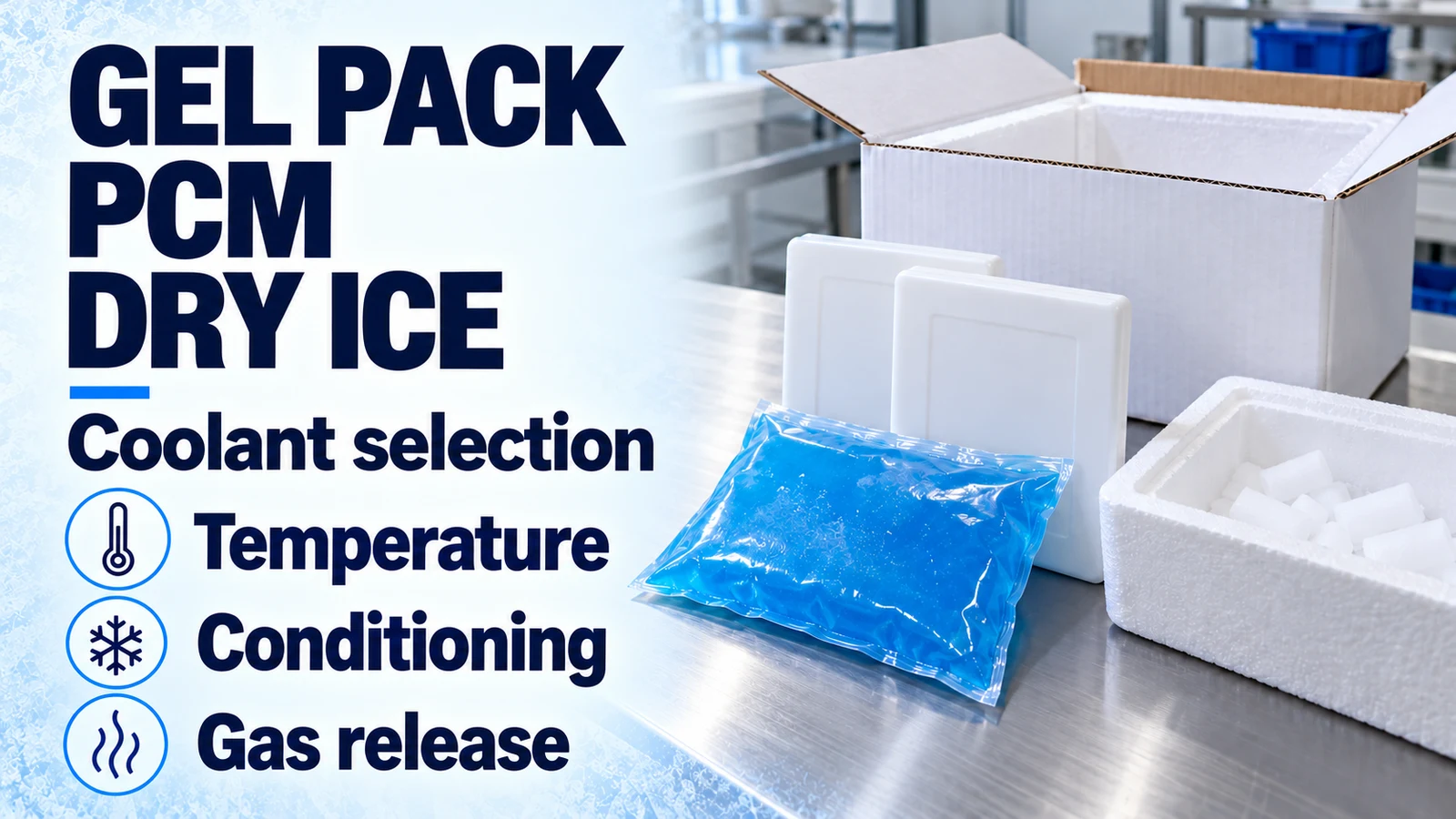
Use the upstream coolant selection guide to match refrigerant formulations to cargo temperature bands, and connect verified coolant batches to the cold-chain packout process checklist at the packing bench.
Why Freezer Air Setpoint Does Not Equal Core Readiness
- Under the World Health Organization transport packaging qualification glossary, advanced phase change materials (PCMs) are chemically engineered so that their latent heat of fusion occurs at a temperature other than zero ° Celsius, phasing from liquid to solid at a pre-formulated temperature.
- Under the WHO PQS vaccine carrier specification, an ice-pack is defined as a water-containing coolant-pack frozen to a temperature between -5°C and -25°C before use, to the point where there is no remaining liquid water.
Representative catalog items from Sonoco ThermoSafe are listed below by format, case pack, phase temperature, and dimensions:
| Coolant SKU and format | Case pack and fill reference | Listed phase temperature | Listed dimensions |
|---|---|---|---|
| Standard PolarPack PP6 | Case pack of 96 | 0°C (+32°F) | 5.50 x 3.50 x 0.80 in / 140 x 89 x 19 mm |
| PCM Brick TPB3020A | Fill of 47 and case pack of 12 | +4°C (+39°F) | 10.80 x 9.30 x 1.00 in / 273 x 235 x 25 mm |
| U-tek Gel Pack | 36 case pack | -1°C (+30°F) | 6.00 x 4.00 x 0.80 in / 152 x 102 x 19 mm |
| U-tek Gel Pack | 48 fill and 6 case pack | -23°C (-10°F) | 10.50 x 7.80 x 1.20 in / 267 x 197 x 30 mm |
Under the World Health Organization transport packaging qualification guidance, the temperature stabilizing medium must be conditioned in accordance with an approved SOP or according to the container manufacturer’s instructions, and the conditioning equipment being used should be able to maintain the temperature set point within ±3 °C.
For complete-container chamber qualification, thermal test chambers used for DQ and OQ must be capable of simulating ambient temperatures within the required ambient temperature profile ranges and able to condition components, both within a tolerance of ±3 °C.
See the temperature-controlled packaging qualification guide for chamber qualification boundaries.
Freezer Staging Spacing and Loading Orientation
Documented protocols for pcm brick freezer staging spacing and water-pack loading specify batch mass, pack orientation, and air-circulation gaps inside the freezer compartment.
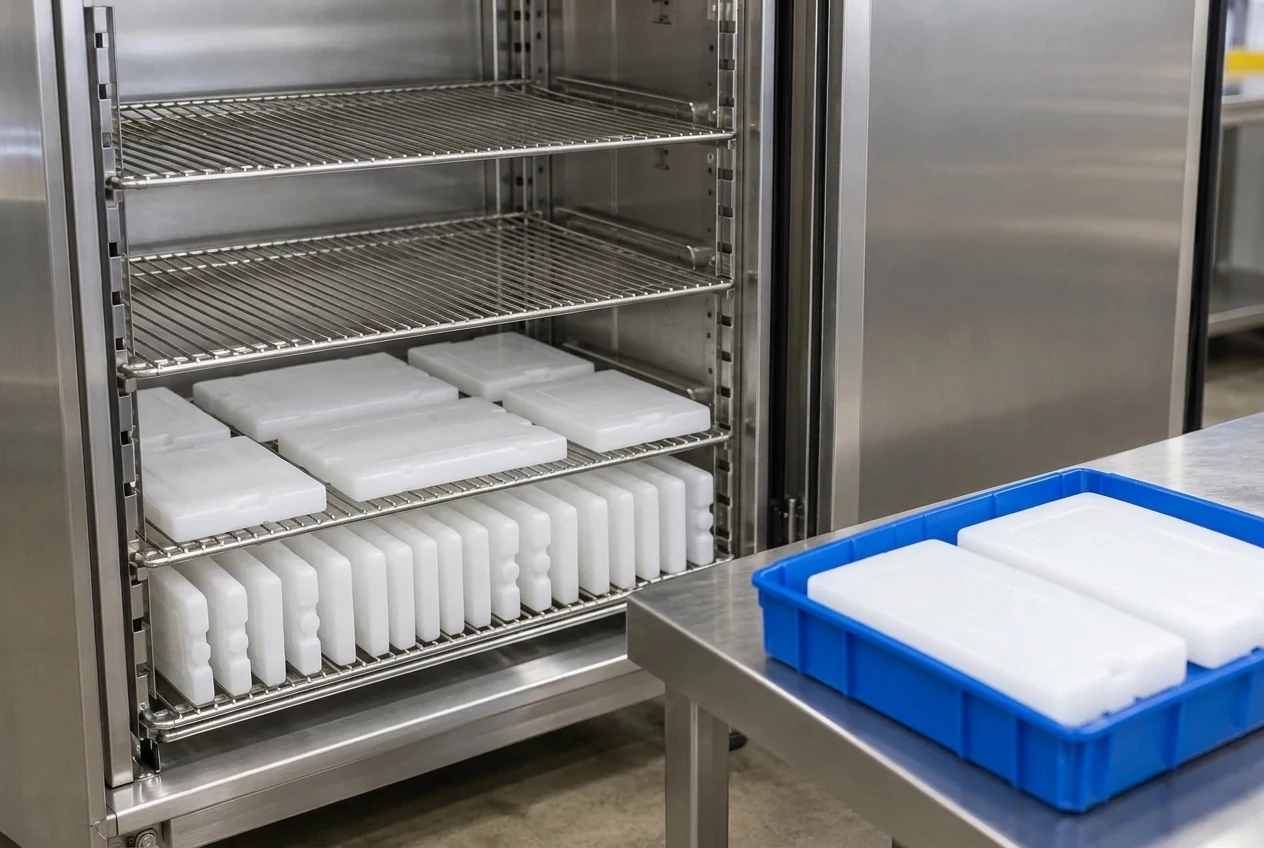
In the WHO PQS water-pack freezer testing protocol, water-pack freezing capacity is defined as the maximum weight of water-packs which can be frozen in one batch during a 24-hour freezing cycle, during which the temperature of the water-pack freezing compartment must remain below -3ºC except during the actual freezing process after unfrozen water-packs have been loaded.
When loading the freezing compartment with water-packs in Step 4, the number is subject to a minimum of four 0.6 litre water-packs per 50 litre gross volume, loaded in a row and with the edges perpendicular to the evaporator surface, or in accordance with the manufacturer’s recommendations.
In Step 5 and Step 6, water-pack load temperatures are recorded every minute for the following 24 hours and checked at the end of the test period to verify that the water-packs are frozen solid, with an acceptance criterion that not less than 2.4 kg of water-packs must be frozen per 24 hours.
Under Clause 4.2.4 (Water-pack freezing) of the WHO PQS freezer performance specification, minimum 24-hour water-pack freezing capacity is based on gross freezer volume: a minimum of 1.6 kg for gross freezer volume less than 50 litres, and a minimum of 2.4 kg per each 50 litres of gross storage volume for gross freezer volume equal to or greater than 50 litres.
Under water-pack storage compartment capacity requirements, the freezer compartment is required to hold a minimum of 3.2 kg of water-packs and at least twice the daily water-pack freezing capacity determined by E003/FZ03 VP.1, with water-packs complying with E005/IP01.
Field deep-freezer loading and rigid-panel systems specify the following orientation rules:
- In the large compartment of a deep freezer under the WHO SEARO immunization handbook, operators wipe dry and arrange 20-25 unfrozen icepacks horizontally (never flat) in a crisscross pattern with space for air circulation.
- Operators are instructed to keep ice packs horizontally (not flat) in a criss-cross manner in the DF (brick layered pattern see Fig 4.7) and keep a gap/breathing space between ice packs for freezing to be faster and uniform.
- In Option 1 (Freezer to Room Temperature) of the Peli BioThermal Crēdo Cube user guide, operators place the TIC system in a -18˚C freezer, or below, for a minimum of 24 hours, ensure that the TICs lay flat, and shake the panels to verify no liquid can be heard.
- In the Peli BioThermal Crēdo Cube deep-frozen user guide, operators place the PCM TICs flat into a -40°C (±3°C) freezer or below for a minimum of 24 hours; the PCM TICs may be conditioned in a freezer as warm as -30°C (±3°C), but the conditioning time must be increased.
Water-pack testing protocols specify the following thickness, adhesion, and lateral pressure checks:
- In Test 3 (Frozen water-pack thickness and adhesion test) of the WHO PQS water-pack protocol, Step 1 stacks water-packs on top of one another in a freezer at -20°C (±5°C) for 24 hours, Step 2 records whether they adhere to one another, and Step 3 measures the thickness of the frozen water-packs (±1.0mm).
- Under the frozen water-pack thickness and adhesion acceptance criteria, the increase in sample thickness due to swelling does not exceed the measured dimensions from Test 2 by more than 25% for any sample, the thickness of each thawed sample equals the measured thickness from Test 2 (±1.0mm), and water-packs do not adhere to one another significantly when frozen.
- In Test 6 (Lateral pressure leakage test), Step 2 places water-packs in a refrigerator at +5°C (± 2°C) for 24 hours and Step 3 places an 80kg uniformly distributed load on the flat face of each water-pack for 30 seconds to check for leakage, with an acceptance criterion of no leakage from any of the samples.
Core Temperature Probe Check and Phase-State Verification
A gel pack core temperature probe check and bench release inspection use the instrumentation tolerances, probe placement clearances, and physical checks summarized below.
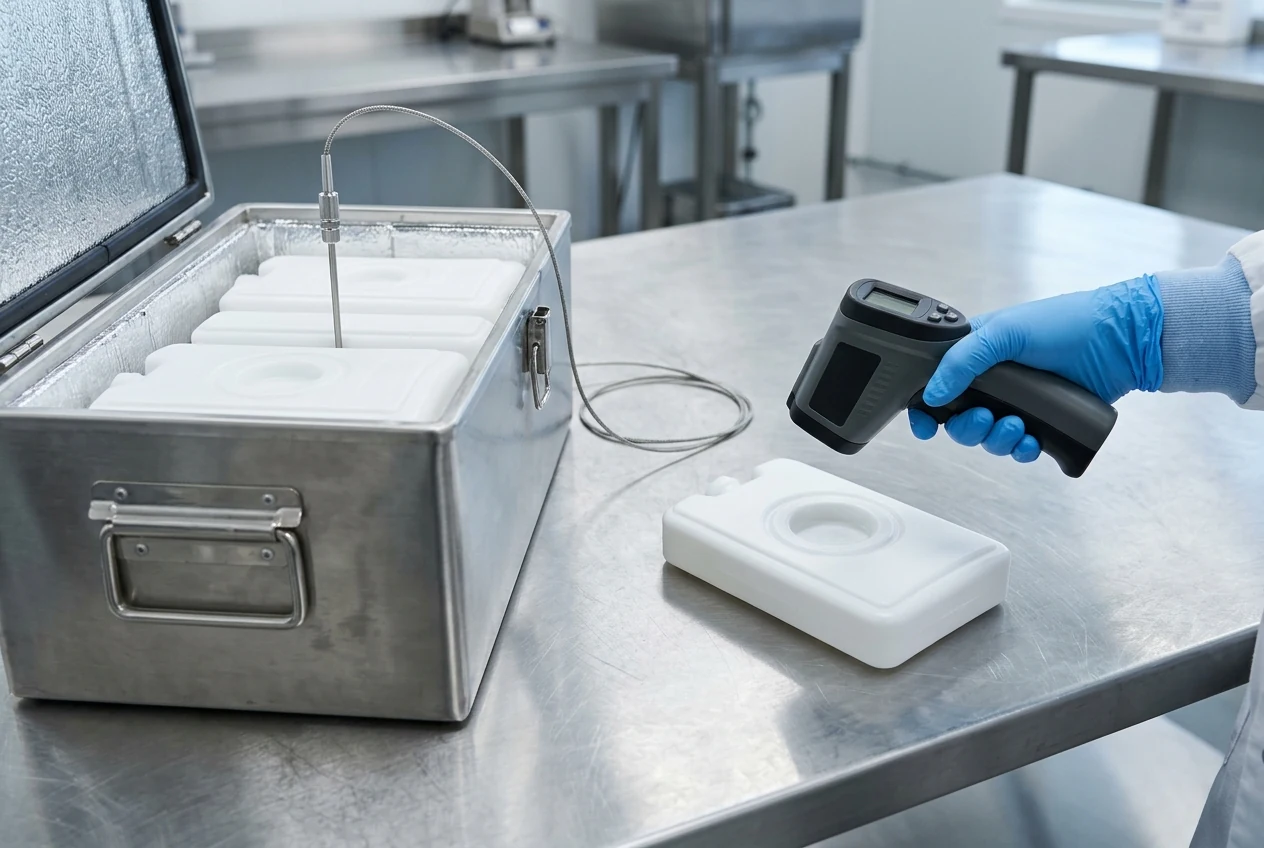
Compare the documented instrumentation tolerances and physical release checks below:
| Verification context | Instrument or check method | Documented accuracy, clearance, or release target |
|---|---|---|
| DQ and OQ thermocouple logging | Multi-channel temperature data logger with thermocouples | Acceptable operating tolerance of ±0.5 °C for temperatures > −18 °C and ±0.8 °C for temperatures ≤ −18 °C |
| PQ portable logger monitoring | NIST traceable portable EDLMs | Resolution of 0.1 °C or better and accuracy of ±0.5 °C over a temperature range approximately between −20 °C and +50 °C |
| Water-pack freezer load testing | Thermocouples installed centred as uniformly as possible between the loaded water-packs | Minimum distance between a thermocouple and the lid/door, wall or evaporator should be 30mm |
| External probe data logger | TempTale Ultra Probe sensor | Probe temperature measurement range of -30°C to + 70°C, accuracy of ± 0.5°C from -10°C to +45°C (and ± 1.0°C from -30°C to -10°C and +45°C to +70°C), and temperature resolution of 0.1°C |
| Probe logger memory and interval | TempTale Ultra Probe non-volatile 16K Flash memory | Data storage capacity of 16,000 data points (16K) and programmable data sampling interval from 30 seconds up to a maximum of 120 minutes |
| Conditioned water-pack check | Physical shake check every few minutes | Wait until there is a small amount of liquid water inside the ice packs; the ice is conditioned as soon as it begins to move about slightly inside its container |
| Peli Crēdo Cube surface check | Infrared temperature thermometer pointed at the edge of the center stand-off (center depression) of the TIC panel | Provides an accurate surface temperature reading, and the TIC is ready to load when the IR gun reads between +3°C and +4.5°C |
For container-level sensor placement after coolant release, see cold-chain monitoring data loggers and packout integration.
How to Condition Gel Packs Before Packout: Sweat-Time Limits and Rotational Staging
Procedures that condition gel packs before packout specify bench temperatures, row spacing, and staging durations across coolant types.
In the WHO PQS vaccine carrier specification, cold life is measured from the moment when the container lid is closed until the temperature of the warmest point in the vaccine storage compartment first reaches +10°C (after initially cooling to below +10°C during cooldown), at a constant ambient test temperature +43°C, while the vaccine storage compartment must remain above 0°C.
Conditioned gel packs are warmed or thawed at room temperature until melted and start to liquefy (this change usually occurs at around 0°C). If done correctly, this removes the initial freezing risk without significantly reducing cold life.
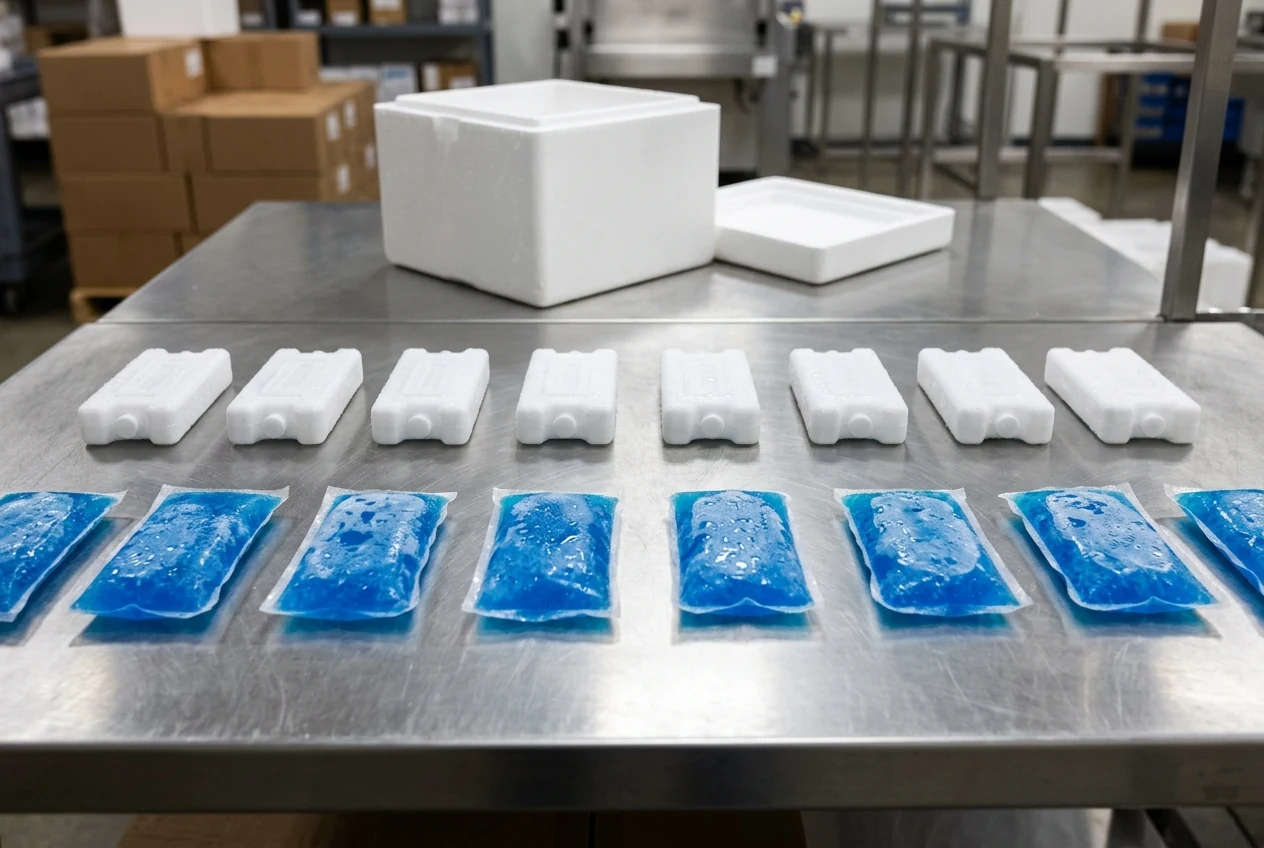
Under the WHO SEARO immunization handbook, ice packs come out of the freezer at a temperature of about -20°C and need to be kept at room temperature for a period of time to allow the ice at the core of the ice pack to rise to 0°C, which takes up to one hour at +20°C and rather less at higher temperatures.
When conditioning frozen ice packs removed from the freezer, operators lay them out on a table leaving a 5 cm space all round each ice pack, preferably in single rows but never in more than two rows.
For rigid phase-change panels in the Peli BioThermal Crēdo Cube user guide, staging times are based on a freezer temperature of -18°C and a room temperature of +22°C; panels are not stacked during the staging time, and ample air flow around all panel sides is required. The Staging-Time Reference Chart sets the following durations by unit size:
| Unit volume band | Listed unit sizes and TIC panel dimensions | Required staging time |
|---|---|---|
| Small and medium units | 3L (5x5), 4L (6x6), 8L (6.5 x 6.5 and 6.5 x 11), and 10L (8.5 x 8.5) | 35 Minutes for 3L (5x5), 25 Minutes for 4L (6x6), 30 Minutes for 8L (6.5 x 6.5 and 6.5 x 11), and 45 Minutes for 10L (8.5 x 8.5) |
| Larger units | 12L (9x9), 16L (10 x 10), 28L (12 x 12), 42L (12 x 18), 56L (15 x 15), and 96L (18 x 18) | 35 Minutes for 12L (9x9), 16L (10 x 10), and 28L (12 x 12), and 40 Minutes for 42L (12 x 18), 56L (15 x 15), and 96L (18 x 18) |
The Peli BioThermal Crēdo Cube user guide also lists two refrigerator-based conditioning options:
- In rotational conditioning, after the TICs have been frozen solid, the TIC system is placed inside a refrigerated (+2°C to +8°C) environment to reach a minimum usable temperature of +2°C; if a refrigerated temperature of +3°C (±1°C) can be maintained, the PCM will never melt and can be held indefinitely.
- For extreme cold ambient conditions of +2°C or colder for 50% or more of the intended journey duration, operators place the TIC system flat into a +5°C refrigerator for between 6 and 12 hours until fully liquid, and never place the TICs into a freezer (using only +5°C ±3°C refrigerators).
To protect products from moisture damage, Sonoco ThermoSafe MoistureGuard PolarPacks (MG) feature a multi-layered exterior that minimizes surface condensation and an outer film layer that absorbs condensation.
Under the CDC Vaccine Storage and Handling Toolkit, PCMs between 4°C and 5°C (39°F and 41°F) can be purchased to maintain proper temperatures; users must follow the manufacturer’s instructions for use and must not use frozen gel packs or coolant packs from original vaccine shipments to pack refrigerated vaccines because they can still freeze vaccines even if they are conditioned or appear to be sweating.
Payload Conditioning and Packout Release Records
Payload conditioning and packout documentation requirements include the following:
- Under the World Health Organization transport packaging qualification guidance, before conducting each test, the payload should be conditioned at its standard storage temperature for the minimum time needed to achieve a uniform temperature throughout the payload (for example, +2 °C to +8 °C for 24 hours), using conditioning equipment able to maintain the temperature set point within ±3 °C.
- Under the Peli BioThermal Crēdo Cube deep-frozen user guide, before loading into the five (5) TIC panel assembly, the payload must be conditioned between -15°C and -25°C.
- Under the CDC Vaccine Storage and Handling Toolkit, if frozen vaccines must be transported, a portable vaccine freezer unit or qualified container and packout that maintains temperatures between -50°C and -15°C (-58°F and +5°F) or between -90°C and -60°C (-130°F and -76°F) for ultra-cold transport must be used, with a TMD (preferably with a buffered probe) placed in the container as close as possible to the vaccines.
- Under the World Health Organization transport packaging qualification guidance, a PQ worksheet should be completed for each individual container system to document the preconditioned refrigerant and product loads, the time at which the container system was fully packed and sealed, the serial number of the EDLM(s), the package weight (net and gross), and the shipment tracking number.
When reviewing a preconditioning station for your packout automation workflow, record three parameters from your system documentation: the coolant phase-change temperature, the freezer or conditioning cabinet temperature setpoint, and the probe or physical check used before packout.
Sources
- World Health Organization — Qualification of Temperature-Controlled Transport Packaging
- World Health Organization PQS — Water-Pack Independent Type-Testing Protocol
- World Health Organization PQS — Water-Pack Freezers Independent Type-Testing Protocol
- World Health Organization PQS — Water-Pack Freezer Performance Specification
- World Health Organization PQS — Vaccine Carrier with Freeze-Prevention Technology Specification
- World Health Organization Regional Office for South-East Asia — Immunization Handbook for Medical Officers, Cold Chain and Logistics
- Centers for Disease Control and Prevention — Vaccine Storage and Handling Toolkit
- Sensitech — TempTale Ultra Probe and Dry Ice Probe Specifications
- Peli BioThermal — Crēdo Cube User Guides for Passive Thermal Packaging Systems
- Sonoco ThermoSafe — Gel Packs, Bottles, and Phase Change Materials Product Catalogs
- TempControlPack — How to Condition Gel Packs: A Practical Cold Chain Buyer Guide
- Tempaid — How to Properly Condition Gel Packs for Pharmaceutical and Vaccine Shipping