Eutectic plates are rigid, hermetically sealed cold accumulators filled with a fixed-ratio eutectic phase-change mixture that melts and solidifies congruently at one sharply defined temperature lower than any single constituent. Mounted in the upper rails of reusable insulated coolboxes, pre-frozen plates hold cargo temperatures isothermally for 24 hours or longer without active vehicle compressors, supporting repeatable packout automation.
What do eutectic plates mean in cold-chain transport?
In cold-chain logistics, eutectic plates—also called cold accumulators or eutectic PCM panels—are autonomous passive cooling inserts placed inside reusable insulated containers to hold fresh, frozen, or deep-frozen cargo at a fixed target temperature for 24 hours or longer without powered refrigeration units on the delivery vehicle.
Phase-change thermal storage media have served rail and road refrigerated transportation since the late 19th century, as documented in the Wikipedia overview of phase-change materials. Modern reusable insulated coolboxes with replaceable eutectic plates are widely deployed across short- to medium-distance distribution because they turn each individual cargo box into a self-sustaining cold zone.
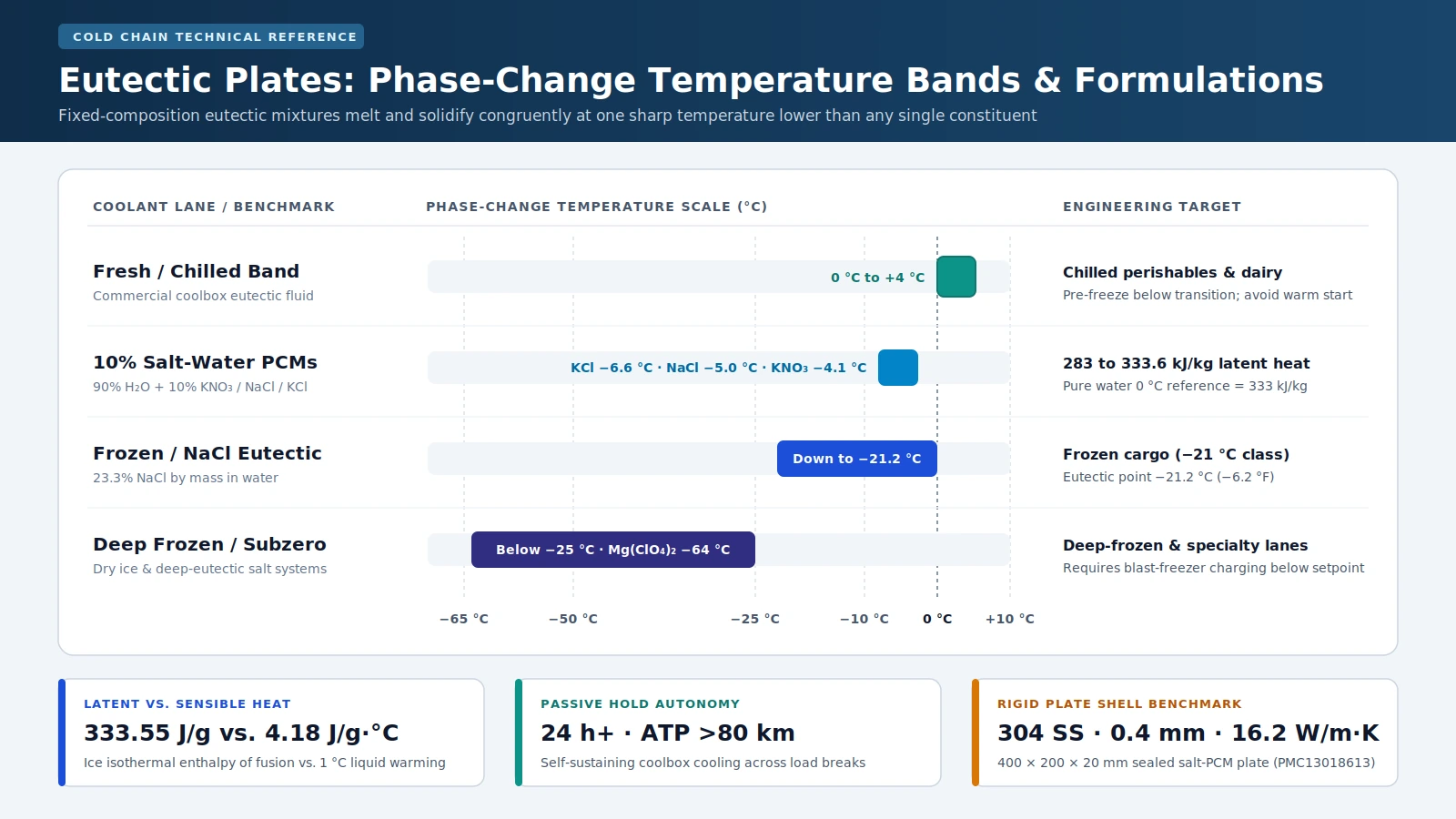
Commercial coolbox programs match the eutectic fluid formulation to the required transport temperature regime, as summarized in peer-reviewed insulated coolbox diagnostics research:
| Transport regime | Commercial eutectic fluid target band | Typical cold-chain role |
|---|---|---|
| Fresh products | 0 °C to +4 °C | Chilled meat, dairy, produce, and chilled retail replenishment |
| Frozen products | Down to −21 °C | Frozen foods and temperature-controlled subzero freight |
| Deep frozen / dry ice class | Below −25 °C | Deep-frozen cargo requiring subzero eutectic or dry-ice support |
For operations deciding horizontally across flexible gel pouches, engineered PCM bricks, and sublimating dry ice before standardizing on rigid plates, review our gel pack, PCM, and dry ice selection guide.
How does a eutectic phase-change mixture melt at one fixed temperature?
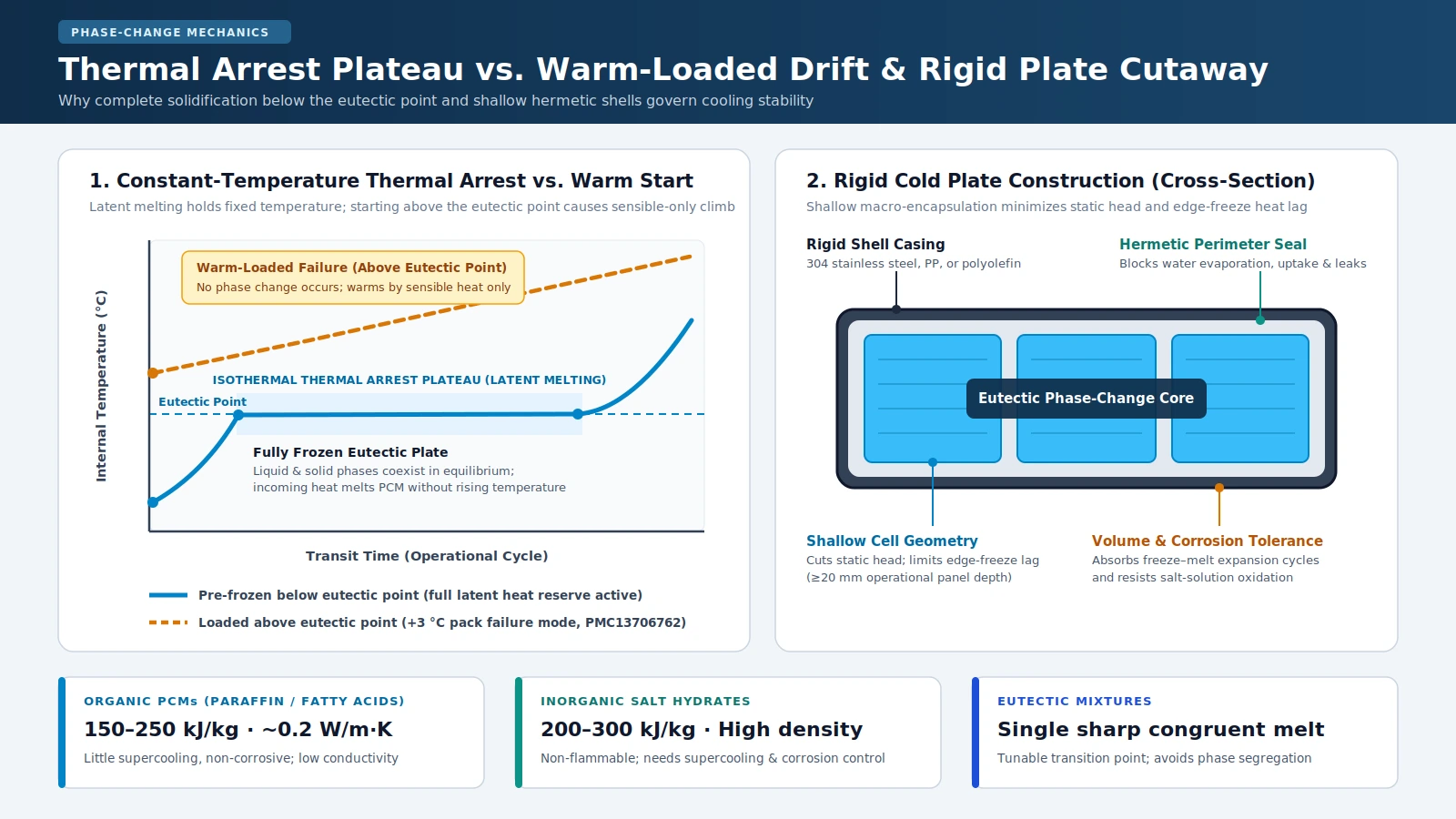
A eutectic phase-change mixture melts and freezes at one fixed temperature because its components are blended at the exact eutectic composition, where liquid and solid phases coexist in invariant thermal equilibrium and create a constant-temperature thermal arrest until the entire solid reserve melts.
Congruent thermal arrest versus non-eutectic slush ranges
As defined in the Wikipedia technical reference on eutectic systems, a eutectic system is a homogeneous mixture whose eutectic temperature represents the lowest possible melting point across all mixing ratios of its constituents—a behavior plotted as the eutectic point on a phase diagram. During solidification or melting at that invariant point, thermal equilibrium maintains a flat thermal arrest during which the mixture temperature does not change while heat is removed or absorbed.
Non-eutectic blends behave very differently. Because their individual components solidify and melt at separate temperatures, non-eutectic mixtures pass through a slush band bounded by an upper liquidus temperature and a lower solidus temperature rather than locking onto a single sharp setpoint.
Latent heat storage (LHS) delivers far greater thermal capacity than sensible warming alone. Any heat added during solid-to-liquid melting goes into the enthalpy of fusion without raising the material temperature: pure ice absorbs 333.55 J/g while melting at 0 °C, whereas liquid water warms by 1 °C with only 4.18 J/g of sensible heat. As long as a PCM panel remains partially frozen, it functions as a fixed-temperature boundary inside the insulated shipper.
Eutectic chemistry classes and salt-water benchmarks
Eutectic PCMs can be formulated from organic–organic, inorganic–inorganic, or organic–inorganic combinations to tune the melting point for a specific lane. Because eutectic mixtures melt congruently, they generally avoid the phase segregation issues observed in many single-component salt hydrates, though long-term cycling stability and container compatibility still require experimental verification.
Comparing the three main PCM families highlights why cold-chain plates balance latent heat, conductivity, supercooling, and shell compatibility:
| PCM class or aqueous formulation | Phase-change temperature | Latent heat of fusion | Key thermal and containment traits |
|---|---|---|---|
| Organic PCMs (paraffins, fatty acids) | 0 °C to 65 °C range | 150 to 250 kJ/kg | Little or no supercooling, non-corrosive; low thermal conductivity around 0.2 W/m·K; paraffins are flammable |
| Inorganic salt hydrates | Low- to medium-temp range | 200 to 300 kJ/kg | Non-flammable, higher conductivity and volumetric density; prone to supercooling, phase segregation, and metal corrosion |
| Pure water reference (100% H2O) | 0 °C | 333 kJ/kg | High latent heat baseline at freezing point; no subzero plateau |
| 90% H2O + 10% KNO3 aqueous PCM | −4.1 °C | 333.6 kJ/kg | Literature salt-water formulation below 0 °C |
| 90% H2O + 10% NaCl aqueous PCM | −5.0 °C | 289 kJ/kg | Subzero salt-water PCM reported in refrigerator trials |
| 90% H2O + 10% KCl aqueous PCM | −6.6 °C | 283 kJ/kg | Lower transition temperature aqueous salt PCM |
| Eutectic NaCl–water (23.3% salt by mass) | −21.2 °C (−6.2 °F) | Benchmark salt-water eutectic | Classic frozen-lane brine eutectic point |
| Magnesium perchlorate–water eutectic | −64 °C (−83 °F) | Benchmark deep-subzero eutectic | Demonstrates deep-frozen salt-water depression |
The 10% aqueous KNO3, NaCl, and KCl literature benchmarks come from peer-reviewed refrigerator PCM research in Scientific Reports, while the 23.3% NaCl and magnesium perchlorate eutectic points come from the Wikipedia eutectic system reference.
What is a cold plate and how is its rigid shell constructed?
A cold plate is a shallow, rigid macro-encapsulated container that seals a phase-change core inside a durable, leak-tight shell—such as stainless steel, polypropylene, or polyolefin—so the coolant transfers heat efficiently, retains its exact chemical ratio, and fits cleanly into container rails across repeated freeze–melt cycles.
Shell geometry is not merely mechanical packaging; it solves two physical failure modes documented in phase-change encapsulation engineering:
- Avoiding edge-solidification heat blocks: Early large-volume macro-encapsulation failed because poor PCM thermal conductivity caused material to solidify along outer container walls first, insulating the interior and impeding heat transfer. Dividing the coolant into shallow cells reduces static head and shortens the conductive path from shell wall to core.
- Preserving exact eutectic composition: All salt-based PCM solutions must be hermetically encapsulated so water neither evaporates out nor absorbs into hygroscopic salts, which would shift the mixture off its eutectic ratio.
- Surviving freeze–melt expansion and chemical contact: Container walls must withstand repeated volumetric changes during phase transitions while resisting leakage and salt-solution corrosion.
In experimental salt-PCM refrigerator testing, researchers housed aqueous NaCl, KCl, and KNO3 solutions inside a tightly sealed 304 stainless steel plate measuring 400 × 200 × 20 mm with a 0.4 mm wall thickness and 16.2 W/m·K thermal conductivity to prevent oxidation and leakage while fitting compactly inside the compartment. An operational passive ice panel maintains a thickness of at least 2 cm to hold sufficient frozen reserve for multi-hour routes.
How are eutectic freezer plates pre-frozen before route dispatch?
Eutectic freezer plates must be pre-frozen below their phase-change temperature until the entire interior core solidifies completely before loading; dispatching a plate at or slightly above its eutectic point eliminates the latent heat plateau and leaves cargo protected only by rapid sensible warming.
As emphasized in ATP perishable-transport thermal modeling, a PCM panel behaves as a constant-temperature sink only while partially frozen, and once an operational cycle ends, all PCM panels must be reloaded and cooled back down until frozen.
Climatic-chamber coolbox trials in Materials demonstrate exactly what happens when pre-freezing falls short:
- Zero latent plateau on warm-loaded packs: Fresh/chilled eutectic packs rated at a +3 °C eutectic temperature entered the 6-hour exposure test (+10 °C to +25 °C ambient) at an initial temperature slightly above +3 °C. Because the coolant had not crossed below its solidification threshold, no melting phase change occurred during the test—temperatures climbed steadily in sensible-heat warming from the start.
- Supercooling demands sub-transition margin: Supercooling occurs when a liquid PCM remains unfrozen even below its nominal freezing point until nucleation triggers crystallization. Salt-based formulations rely on nucleating agents, proper encapsulation, and sufficient freezer dwell below the eutectic temperature to guarantee full solidification.
- Pre-cooling failures drive transit excursions: Bayesian network analyses of cold-chain logistics identify transport and distribution as the most vulnerable stage, listing improper pre-cooling alongside equipment breakdowns, extreme weather, and handling errors as primary disruption causes.
At the packing bench, standardize pre-freezing verification and release checks using our gel pack preconditioning and core temperature guide so partially frozen plates never enter outbound lanes.
How does eutectic plate refrigeration differ from active compressor units?
Eutectic plate refrigeration cools passively by absorbing wall heat ingress into a pre-frozen latent reserve—eliminating vehicle compressors, fans, and fuel consumption for 24-hour distribution loops—whereas active vapor-compression units generate continuous mechanical cooling on demand and can pull down warm loads or counter unexpected ambient spikes.
Thermal modeling of ATP-regulated transport containers in Entropy clarifies how incoming heat behaves across passive, active, and hybrid configurations. When a container wall experiences 9.6 W/m² of inward heat flux, passive PCM panels intercept those losses instead of the cargo: for a 0 °C ice PCM panel, 9.6 W/m² corresponds to a thaw rate of 0.03 g/m²·s (slightly over 100 g/m²·h), or 1 kg/m² over 10 hours—melting a 1 mm layer compared against an operational panel thickness of at least 2 cm. Similarly, cited refrigeration experiments in Scientific Reports showed that a 7 mm-thick PCM layer sustained 720 minutes of compressor downtime while holding compartment temperatures between 4 °C and 6 °C for both water and a eutectic solution.
| Architecture | Cooling mechanism | Operational advantages | Engineering limitations |
|---|---|---|---|
| Passive eutectic plates in insulated coolboxes | Latent heat absorption by pre-frozen eutectic panels plus natural gravity convection | Eliminates vehicle compressors and fans; cuts fuel consumption and greenhouse gas emissions; sustains 24 h or longer autonomy across load breaks | Requires full refreezing and panel reloading after every cycle; fixed reserve cannot pull down warm cargo indefinitely |
| Active mechanical refrigeration (vapor compression) | Powered thermodynamic cycle with evaporators operating at −5 °C down to −20 °C | Actively cools chamber air and cargo load; adapts dynamically to extreme ambient spikes and long multi-day hauls | Continuous energy draw, mechanical wear, uneven trailer airflow, and refrigerant-inventory restrictions |
| Hybrid (insulation + PCM + active cooling) | Low-conductivity walls paired with PCM cold storage and an active thermodynamic cycle | PCM buffers compressor cycling and power interruptions (e.g., 720 min downtime hold with 7 mm PCM) while active cooling handles ambient surges | Higher equipment complexity and tare mass than standalone passive coolboxes |
For a broader decision framework comparing powered transport systems with passive thermal shippers, see our active versus passive cold-chain packaging guide.
Where do reusable insulated cargo containers use eutectic plates?
Reusable insulated cargo containers (coolboxes) deploy eutectic plates in ceiling slots or upper internal brackets across short- to medium-distance food, retail, and pharmaceutical distribution—including ATP-certified routes exceeding 80 km with multi-stop load breaks—so dense cooled air sinks naturally across the payload without mechanical fans.
Top-mounted slot geometry and natural gravitational convection
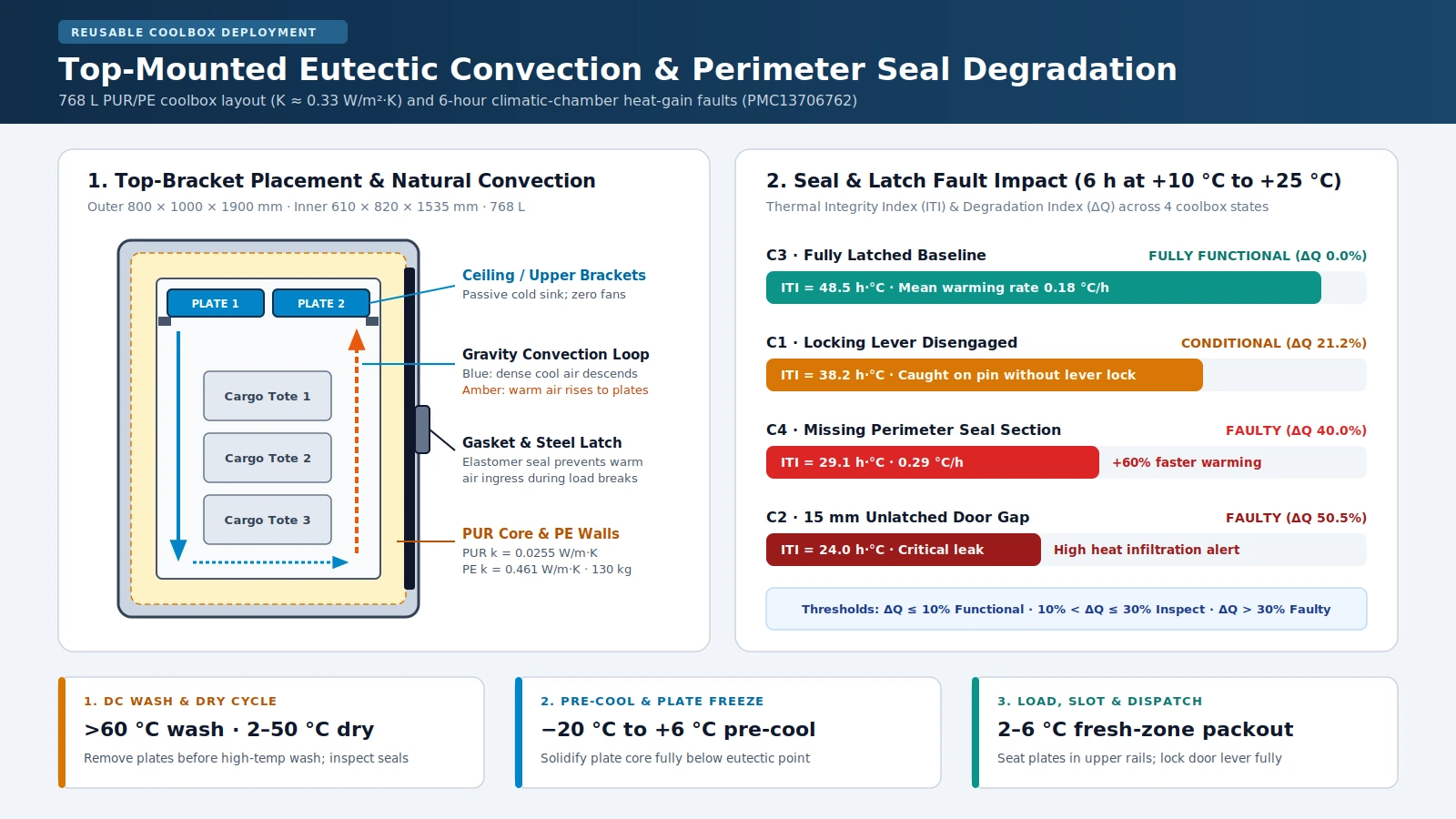
In full-scale reusable coolbox research, investigators tested ATP-certified upright insulated containers measuring 800 × 1000 × 1900 mm externally and 610 × 820 × 1535 mm internally (768 L inner volume, 130 kg unloaded weight). The container combines a seamlessly foamed CFC- and HCFC-free polyurethane (PUR) core (0.0255 W/m·K thermal conductivity, 43.2 kg/m³ density, 1280.0 J/kg·K specific heat) with a rotomolded double-walled food-grade polyethylene (PE) casing (0.461 W/m·K, 911 kg/m³, 1810.0 J/kg·K), steel structural hinges and recessed latches (15.1 W/m·K, 8055.0 kg/m³), and low-temperature elastomer perimeter gaskets (0.9 W/m·K, 1100.0 kg/m³).
That composite structure achieves an overall heat transfer coefficient of K ≈ 0.33 W/m²·K—comfortably inside the ATP Annex 1 heavily insulated threshold of K ≤ 0.40 W/m²·K (which also specifies side-walls of at least 45 mm for transport equipment wider than 2.50 m).
Mounting the rigid eutectic plates on the ceiling or upper brackets turns container geometry into a fanless circulation engine: air contacting the top plates cools, increases in density, and descends by gravity to the container floor, displacing warmer air upward back across the plates throughout the entire 768 L volume. Because the plates sit overhead in fixed slots rather than loose among cartons, loading crews must keep perimeter air channels unobstructed so gravity convection reaches lower totes.
Turnaround cycle controls and perimeter seal inspection
Even fully frozen eutectic plates cannot compensate for a leaking door seal or an unengaged latch. Across recurring distribution-center cycles, reusable coolboxes face high-pressure washing above 60 °C, drying at 2 °C to +50 °C, pre-cooling between −20 °C and +6 °C, and fresh-zone product loading and eutectic plate placement at 2 °C to +6 °C. Always pull eutectic plates before high-temperature washing cycles so thermal shock and wash chemicals do not stress the plates.
In controlled 6-hour climatic-chamber exposure trials (+10 °C to +25 °C) from the same coolbox diagnostics study, seal and latch defects sharply degraded container thermal integrity:
| Tested coolbox condition | Thermal Integrity Index (ITI) | Degradation Index (ΔQ) | Measured warming rate and diagnostic status |
|---|---|---|---|
| C3: Fully latched baseline (door lever locked) | 48.5 h·°C | 0.0% | 0.18 °C/h mean warming; Fully functional (ΔQ ≤ 10%) |
| C1: Door caught on pull-down pin without locking lever | 38.2 h·°C | 21.2% | Conditionally functional (10% < ΔQ ≤ 30%); inspect latch and gasket |
| C4: Perimeter rubber seal section missing | 29.1 h·°C | 40.0% | 0.29 °C/h warming (~60% faster heat infiltration); Faulty (ΔQ > 30%) |
| C2: Unlatched door with roughly 15 mm gap | 24.0 h·°C | 50.5% | Critical leak alert; Faulty (ΔQ > 30%) |
Pair these return-cycle checks with our reusable cold-chain packaging inspection guide to pull worn gaskets and warped doors before plate loading.
Packout readiness checklist: Before dispatching any eutectic-plate coolbox on your packout automation line, verify four controls in sequence: match the plate eutectic band (0 °C to +4 °C fresh, down to −21 °C frozen, or below −25 °C deep-frozen) to the cargo lane; confirm every plate exited the freezer solid below its phase-change point rather than above transition; seat plates squarely in the ceiling or upper brackets with unobstructed side airflow channels; and verify intact perimeter gaskets and full locking-lever engagement before handoff.