A temperature excursion is any storage or transport reading outside the temperature range specified in the manufacturer’s package insert, product labeling, or EUA factsheet. Both overheating and accidental freezing count as excursions and require immediate quarantine under proper storage, continuous logger documentation, and manufacturer viability review before any release, disposition, or packout automation rework.
What do temperature excursions mean in a cold chain?
In a pharmaceutical or vaccine cold chain, a temperature excursion is an accidental event in which a vaccine, biologic, or drug is exposed to temperatures outside the ranges designated for transport and storage, as defined in the CDC Vaccine Storage and Handling Toolkit and peer-reviewed vaccine transport research.
Excursions run in both directions. Keeping vaccines below their recommended lower limit can be as harmful as exposing them above the upper limit because most vaccines can be damaged by freezing. Each episode outside the recommended 2°C to 8°C band can reduce vaccine potency or destroy biological activity.
Across broader pharmaceutical supply chains, peer-reviewed MKT risk-assessment research identifies core quality attributes vulnerable to out-of-range thermal exposure:
- Potency (loss of assay): Accelerated degradation of active pharmaceutical ingredients reduces therapeutic effectiveness.
- Dissolution: Thermal stress can alter the release profile of solid dosage forms.
- Impurities: Elevated temperatures increase degradation products and impurity levels.
- Microbial contamination: Uncontrolled temperature conditions can permit microbial growth and visible discoloration.
Field evidence confirms that temperature breaches occur regularly across both transport lanes and clinical storage rather than as rare edge cases:
| Operational setting | Reported excursion finding | Dominant thermal risk |
|---|---|---|
| Global vaccine transport systematic review | 29 vaccine freezing cases across 45 studies | Drops below 2°C are more common than rises above 8°C |
| Cameroon transit trial (48 boxes, 10 vials each) | 83% of shipments hit -0.5°C to -23.8°C at least once | Accidental freezing during cold-chain transport |
| German general practice clinics | 44% of medication refrigerators reached above 8°C | Warm storage excursions in non-pharma units |
| South Australia vaccine providers | 597 cold-chain breach reports over 2 years | Recurring storage and handling breaches |
| Australian Capital Territory pharmacies | 50% reported 1 to 4 excursions in 12 months | Routine clinic and pharmacy storage deviations |
What is considered a temperature excursion during storage or transit?
Any temperature reading outside the specific range printed on the manufacturer’s package insert or EUA factsheet is considered a temperature excursion, regardless of whether the product sits inside a stationary storage unit or an insulated transit shipper.
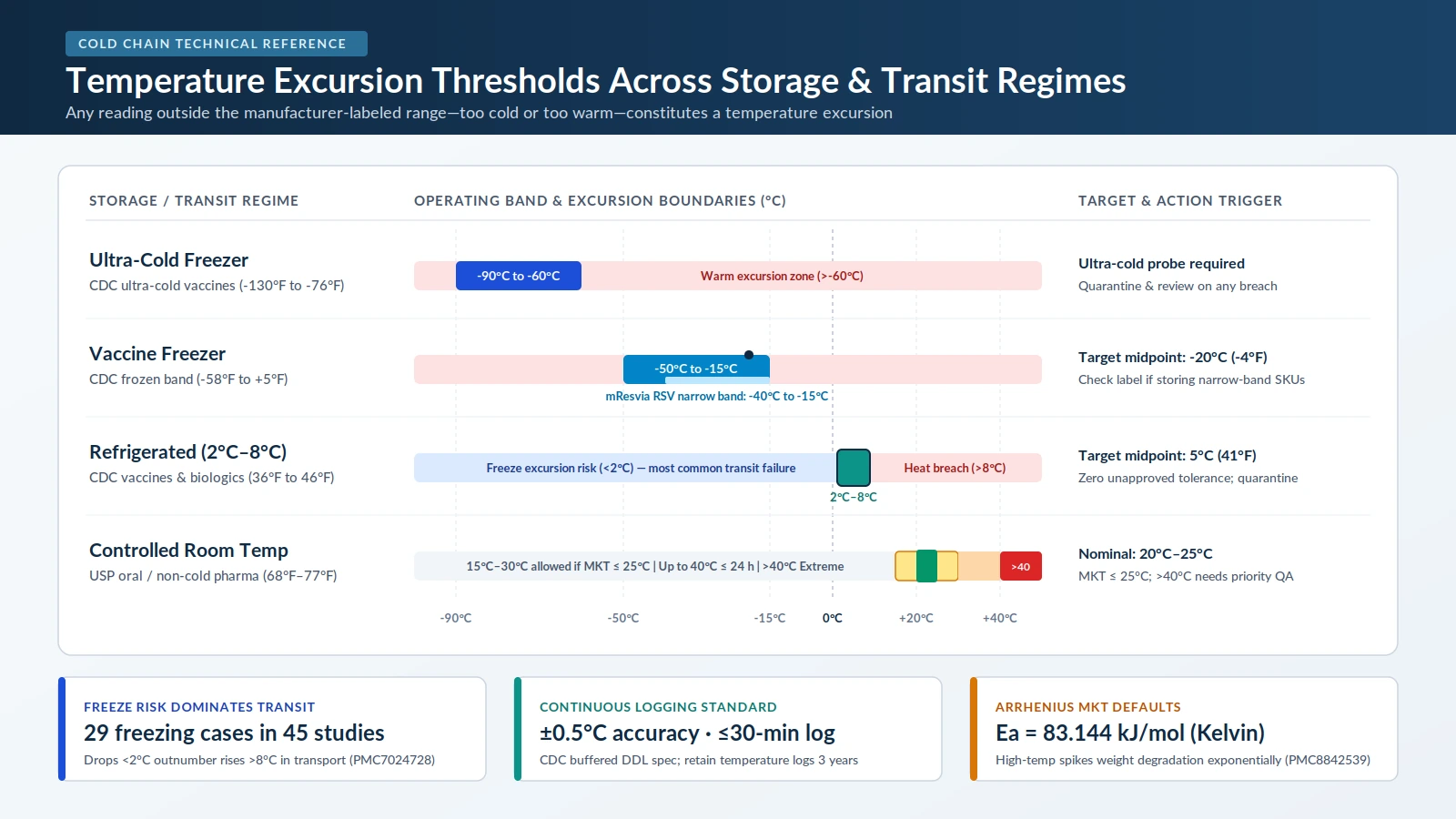
Standard cold-chain thresholds vary sharply by storage regime. Verify the individual product insert before setting alarm limits, because specialized biologics can carry narrower tolerances than general class bands—for example, frozen mResvia (an RSV vaccine) requires -40°C to -15°C (-40°F to 5°F) rather than the broader -50°C to -15°C freezer range. Setting thermostats at the midpoint—such as 5°C (41°F) for refrigerators or -20°C (-4°F) for freezers—buffers routine cycling against excursions.
| Storage or transit regime | Standard operating band | Excursion boundary and action rule |
|---|---|---|
| CDC vaccine refrigerator | 2°C to 8°C (36°F to 46°F) | Any reading below 2°C or above 8°C triggers quarantine; target 5°C (41°F) midpoint |
| CDC standard vaccine freezer | -50°C to -15°C (-58°F to +5°F) | Any reading below -50°C or above -15°C triggers quarantine; target -20°C (-4°F) midpoint |
| Narrow-band frozen RSV vaccine (mResvia) | -40°C to -15°C (-40°F to 5°F) | Do not allow freezer temperatures below -40°C when co-stored with other frozen stock |
| CDC ultra-cold vaccine freezer | -90°C to -60°C (-130°F to -76°F) | Any reading outside -90°C to -60°C triggers excursion protocol; use ultra-cold probe |
| USP controlled room temperature (CRT) | 20°C to 25°C (68°F to 77°F) | Excursions of 15°C to 30°C (59°F to 86°F) allowed if MKT remains at or below 25°C; spikes up to 40°C limited to 24 hours without manufacturer consultation |
| Extreme warm pharmaceutical exposure | Above 40°C | Classified as an extreme temperature excursion requiring prioritized quality assurance or manufacturer review |
How should teams handle temperature excursions when an alarm triggers?
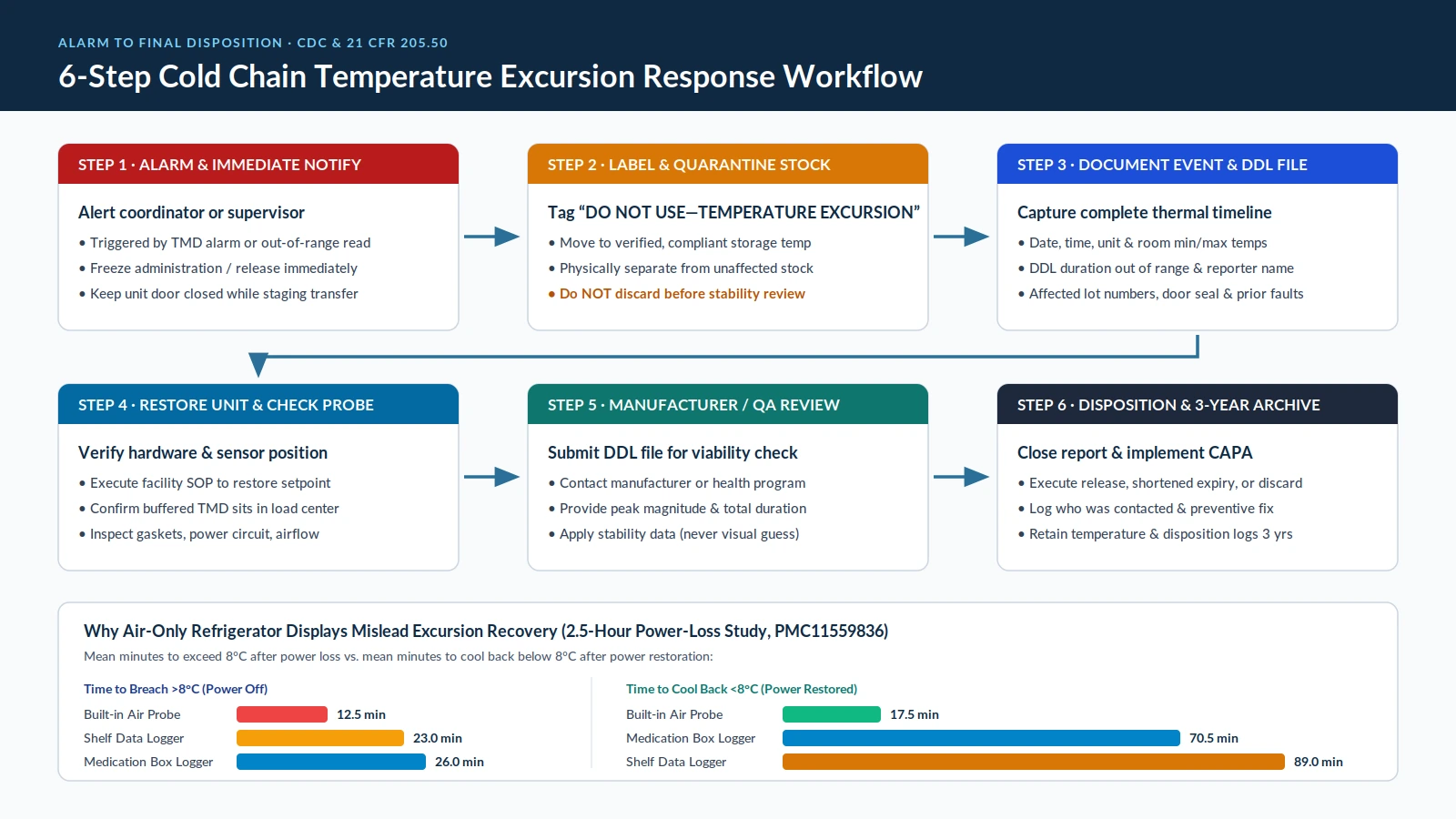
When a temperature monitoring alarm sounds or an out-of-range reading appears, staff must immediately notify the coordinator, label exposed stock “DO NOT USE—TEMPERATURE EXCURSION”, relocate it to compliant storage physically separated from unaffected inventory without discarding it, document the complete timeline, and wait for written manufacturer or quality-assurance guidance before administration or disposal.
Immediate containment and manufacturer review
Premature disposal wastes viable inventory, while unapproved release risks delivering compromised product. Vaccines stored at inappropriate temperatures must not be administered unless the manufacturer confirms that safety and effectiveness have not been compromised. Likewise, U.S. federal prescription drug storage regulations require damaged, deteriorated, outdated, misbranded, or adulterated prescription drugs to be quarantined and physically separated from good stock until destroyed or returned to the supplier.
Follow the CDC alarm response sequence in order:
- Notify immediately: Any staff member who hears an alarm or spots an out-of-range TMD display notifies the primary or backup vaccine coordinator or supervisor.
- Label and quarantine without discarding: Mark exposed stock “DO NOT USE—TEMPERATURE EXCURSION”, transfer it to verified compliant storage conditions in a separate container apart from unaffected inventory, and hold it pending review.
- Log event parameters and export DDL data: Record the event timeline, temperatures, affected lots, and continuous logger file before resetting alarms.
- Restore equipment and check probe placement: Follow facility SOPs to return the storage unit to its approved range and verify that the TMD probe sits in the center of the vaccine load.
- Escalate to manufacturer or health program: Contact the state or local immunization program or product manufacturer with complete temperature logs so specialists can evaluate excursion magnitude, total out-of-range duration, and product-specific stability data.
- Execute and log final disposition: Record the written instruction—release, shortened expiration date, return, or discard—along with preventive actions taken.
Cold chain indicators, buffered probes, and recovery lag
Accurate excursion triage depends on what type of cold chain indicators or monitoring devices recorded the event. Simple minimum/maximum thermometers only capture peak extremes without showing how long temperatures stayed out of range. By contrast, a digital data logger (DDL) continuously logs temperatures at preset intervals—CDC specifies at least every 30 minutes with a recommended uncertainty of ±0.5°C (±1°F)—and pairs with a detachable buffered temperature probe immersed in glycol, glass beads, sand, or Teflon to prevent false excursion alarms during brief door openings. Single-use cold chain monitors (CCMs) ride inside a separate compartment of a shipping container to flag transit exposure and are discarded after inspection.
Relying on an inbuilt ambient-air refrigerator display alone can severely underestimate how long product remains warm after a power restoration. In a hospital pharmacy refrigerator power-loss simulation, continuous loggers placed on the shelf and inside a medication box responded far more slowly than the built-in air probe—both entering and exiting the excursion zone:
| Monitoring sensor position | Mean time to exceed 8°C after power loss | Mean time to cool back below 8°C after power restored | Operational implication |
|---|---|---|---|
| Built-in refrigerator ambient-air probe | 12.5 minutes | 17.5 minutes | Alarms fastest on air warming, then clears prematurely before load cools |
| Shelf data logger | 23 minutes | 89 minutes | Reveals prolonged thermal recovery across interior shelving |
| Medication-box data logger | 26 minutes | 70.5 minutes | Tracks actual boxed product thermal lag during warm recovery |
For probe routing and start-up delay controls during packing, follow the cold-chain monitoring data logger integration guide.
What documentation is required when a temperature excursion occurs?
Complete excursion documentation captures both the thermal event profile and the final quality disposition—including date and time, unit and room min/max readings, continuous DDL duration out of range, affected inventory and lot numbers, contributing physical conditions, actions taken, manufacturer instructions, and final disposition—and must be archived for 3 years.
Under federal wholesale drug distribution rules, facilities must maintain manual, electromechanical, or electronic temperature and humidity recording devices or logs and keep transaction and disposition records available for authorized inspection for 3 years after creation. The CDC toolkit sets the same 3-year retention horizon for temperature logs to identify recurring unit failures.
| Documentation stage | Required fields to record | Why quality reviewers require it |
|---|---|---|
| Event identification | Date and time of excursion; name of staff member completing the report | Establishes audit trail and shift handoff accountability |
| Thermal profile | Storage unit and room temperatures (including min/max readings) and total out-of-range duration from the DDL | Manufacturers evaluate peak magnitude and cumulative duration to determine viability |
| Affected inventory | Complete list of impacted products, lot numbers, and public (e.g., VFC) versus private funding status | Isolates exact lots under quarantine and supports regulatory reporting |
| Unit and environment context | General description of what happened; other items inside the unit (such as water bottles or frozen cooler packs); prior unit problems; physical causes like a cracked door seal or room temperature fluctuations | Distinguishes hardware breakdown, door-seal wear, and loading errors during root-cause review |
| Action taken | What happened to affected stock, elapsed time before action, who was contacted, instructions received, and preventive measures implemented | Demonstrates timely containment and corrective action closure |
| Final results | Final disposition (release, shortened expiration date per manufacturer, discarded, or returned) retained for 3 years | Prevents accidental administration of expired or rejected stock and satisfies audits |
How is mean kinetic temperature (MKT) calculated in an evaluation?
Mean kinetic temperature (MKT) is a single calculated isothermal temperature whose cumulative thermal degradation over a time period equals the total degradation produced by a series of fluctuating temperatures across that same period, as detailed in peer-reviewed MKT excursion modeling.
Unlike a simple arithmetic average, MKT is grounded in the Arrhenius equation for reaction kinetics, where chemical degradation rates increase exponentially rather than linearly as temperature rises. Because high-temperature spikes accelerate degradation disproportionately, MKT weights warm excursions much more heavily than an average temperature reading.
When manufacturer-specific activation energy data are unavailable, standard MKT evaluations compute across equal-interval absolute temperature readings in Kelvin using two default kinetic constants:
- Default activation energy: 83.144 kJ/mol.
- Universal gas constant: 0.0083144 kJ/mol·K.
- Temperature scale: Every logged reading is converted to absolute Kelvin across equal time intervals (such as hourly or daily points) before calculating the exponential terms and taking the natural logarithm of their mean.
The same simulated excursion modeling highlights two practical operational lessons for excursion evaluations:
- Thermal headroom protects shelf-life: Products held continuously at their maximum label storage temperature experience immediate shelf-life loss when an excursion occurs, whereas inventory stored below its upper limit can absorb longer excursions before measurable shelf-life loss begins.
- Point-in-time lab testing is not enough: Testing a product after an excursion confirms whether it meets specifications at that single moment, but does not establish how much shelf-life remains afterward.
MKT also carries strict operational boundaries. Under USP controlled room temperature guidelines, excursions between 15°C and 30°C are acceptable only when MKT stays at or below 25°C, spikes up to 40°C cannot exceed 24 hours without manufacturer consultation, and excursions above 40°C require prioritized quality review. For vaccines and biologics subject to irreversible freeze damage or narrow 2°C to 8°C stability profiles, MKT cannot override manufacturer guidance or clear frozen stock.
How do packout controls prevent temperature excursions in pharma and vaccines?
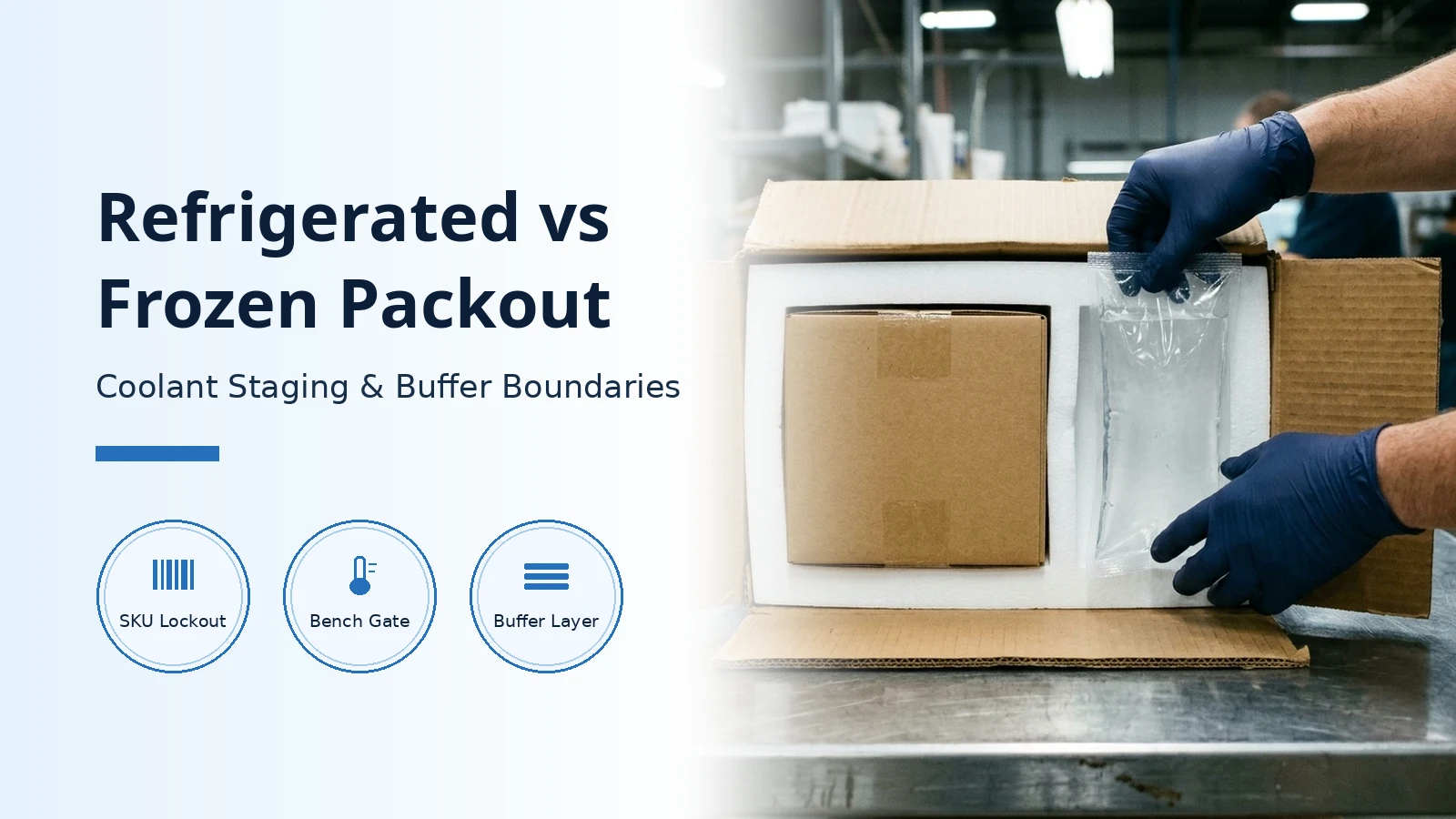
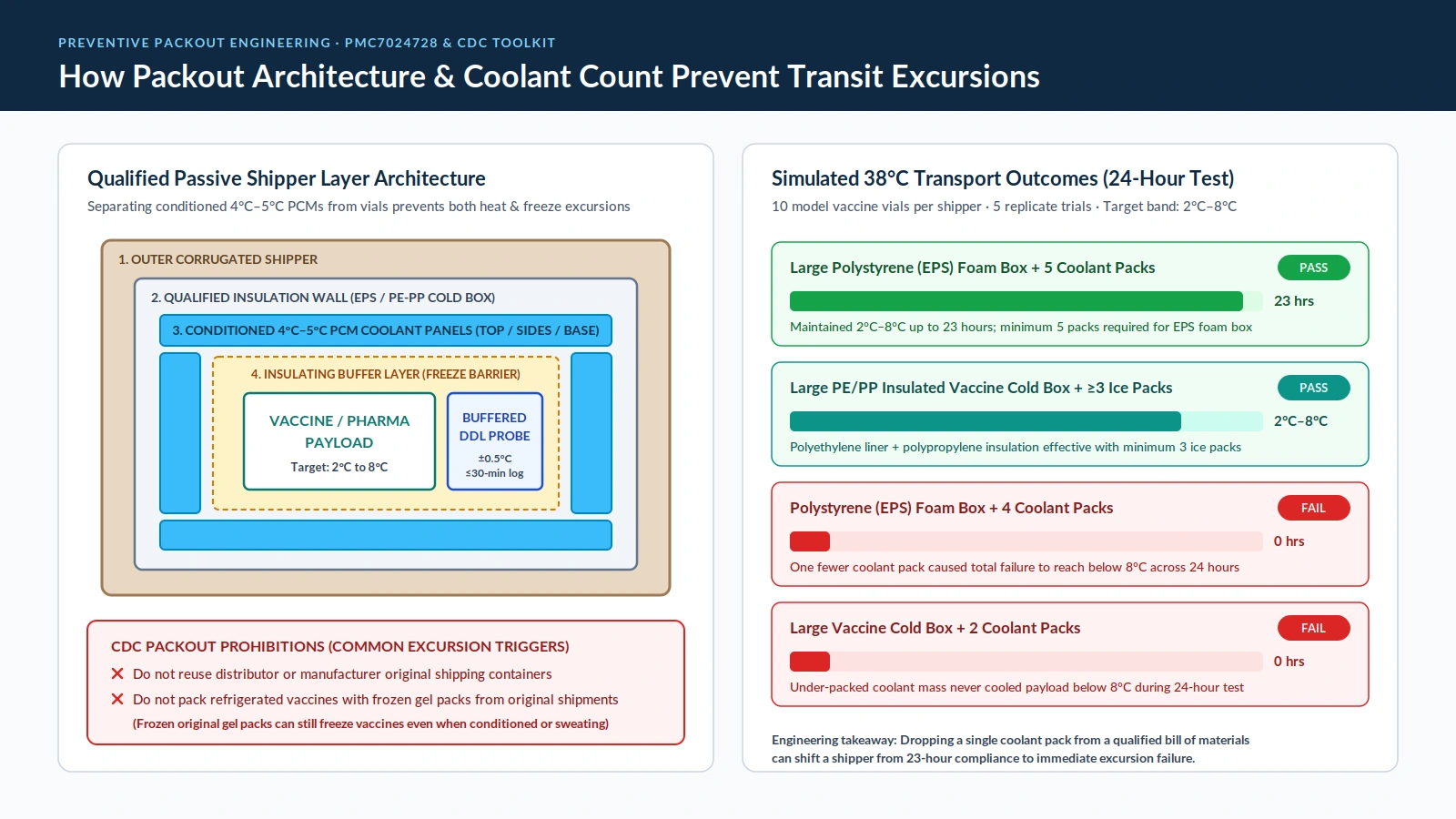
Preventing transit excursions starts at the packing bench: qualified passive containers, verified coolant counts, conditioned 4°C to 5°C phase change materials (PCMs), physical freeze barriers, and strict bans on reusing distributor shipping materials reduce transport excursion risk.
Simulated 38°C transport performance by container and coolant count
Improper packing for transport is as risky for vaccines as a failed storage unit. Experimental data from simulated vaccine transport testing show how sharply container construction and coolant count govern hold time. When researchers tested 10 model vaccine vials across six passive packaging configurations held in a 38°C incubator for 24 hours, only four of the six configurations maintained the 2°C to 8°C target band:
| Passive packaging configuration (38°C ambient, 24-hour test) | Observed 2°C to 8°C performance | Packout engineering control |
|---|---|---|
| Larger polystyrene foam box + 5 coolant-packs | Held 2°C to 8°C for up to 23 hours | Polystyrene foam boxes require at least 5 ice packs for reliable thermal hold |
| Large vaccine cold box (PE liner, PP insulation) + 3 or more ice packs | Maintained 2°C to 8°C target band | Minimum 3 ice packs required for large insulated vaccine cold boxes |
| Polystyrene foam box + 4 coolant-packs | Failed to reach below 8°C across 24 hours | Dropping a single coolant pack below qualified BOM causes immediate heat excursion |
| Large vaccine cold box + 2 coolant-packs | Failed to reach below 8°C across 24 hours | Under-packed coolant mass cannot overcome warm ambient heat gain |
Bench-level packout rules for refrigerated lanes
To close both freeze and heat failure modes at the packing station, enforce four bench controls from the CDC toolkit:
- Use qualified containers and packouts: Rely on portable vaccine refrigerators or laboratory-qualified passive packouts rather than reusing original distributor or manufacturer shipping boxes, whose coolant conditioning and placement are engineered strictly for the outbound factory leg.
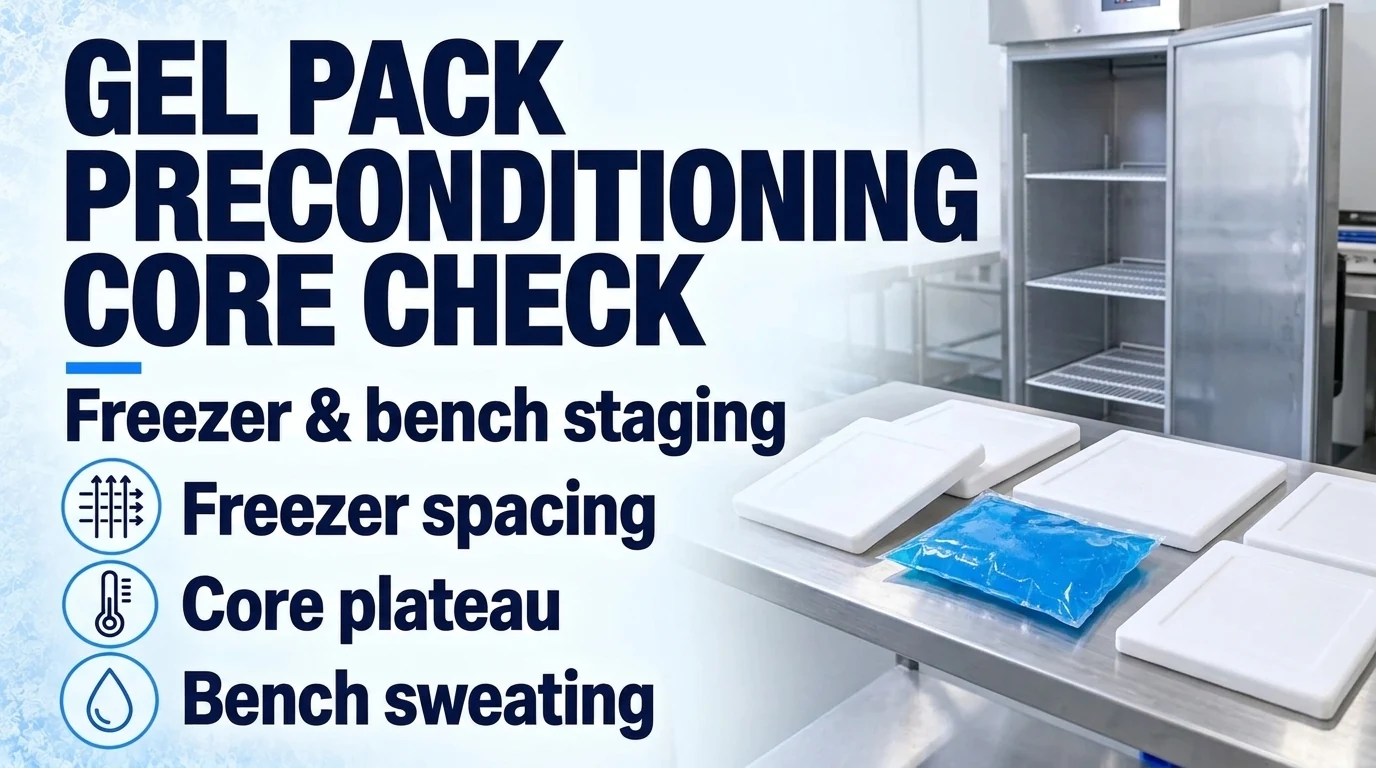
- Eliminate frozen original gel packs on 2°C to 8°C lanes: Do not use frozen gel packs or coolant packs from original vaccine shipments to pack refrigerated vaccines; CDC notes they can still freeze vaccines even when conditioned or visibly sweating.
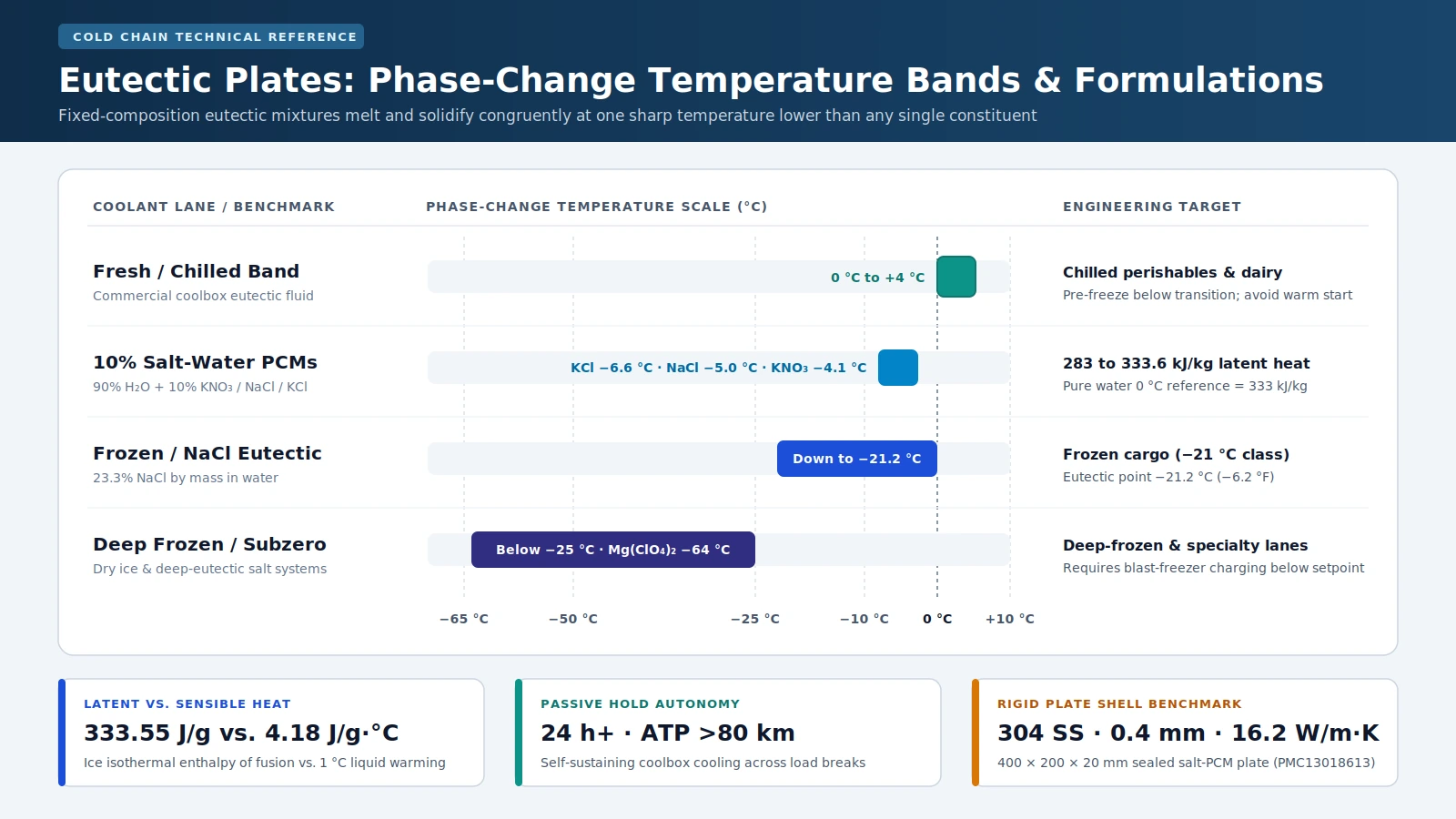
- Specify 4°C to 5°C (39°F to 41°F) phase change materials: Conditioned PCMs engineered for refrigerated lanes stabilize internal temperatures without dragging payload surfaces below freezing. Verify bench conditioning using our gel pack preconditioning and core temperature guide.
- Audit assembly deviations before sealing: When a lane experiences an excursion, preserve the logger file, carton layout, and coolant orientation before altering the bill of materials using our cold-chain packout failure investigation checklist.
Station readiness takeaway: Build one standard excursion kit and SOP binder for every packout automation and cold-storage zone containing pre-printed “DO NOT USE—TEMPERATURE EXCURSION” quarantine labels, a 3-year excursion log template covering all required CDC event and disposition fields, calibrated buffered DDLs set to 30-minute or shorter intervals, and a signed root-cause review checklist linking unit maintenance back to packout bill-of-materials verification.