Dry ice sublimates directly from solid carbon dioxide to gas at −78.5 °C, losing 5 to 10 pounds (2.27 to 4.54 kg) every 24 hours in typical insulated shipping containers. Measured loss doubles from 1% per hour for 100 lb solid blocks to 2.0 plus or minus 0.3% per hour for 5 lb pelletized shippers.
Understanding those variables lets cold-chain packout teams size dry ice weight accurately without risking late-lane warming or sealing containers airtight. Before committing to dry ice over chilled or frozen phase-change materials, confirm payload cold tolerance with our gel pack, PCM, and dry ice selection guide.
Why does dry ice sublimate directly into gas instead of melting?
Dry ice skips the liquid state because carbon dioxide cannot exist as a liquid below its triple point of 5.13 atmospheres and −56.4 °C (−69.5 °F). At normal atmospheric pressure, absorbed heat converts solid carbon dioxide straight into gas through sublimation, leaving zero liquid residue apart from incidental atmospheric frost.
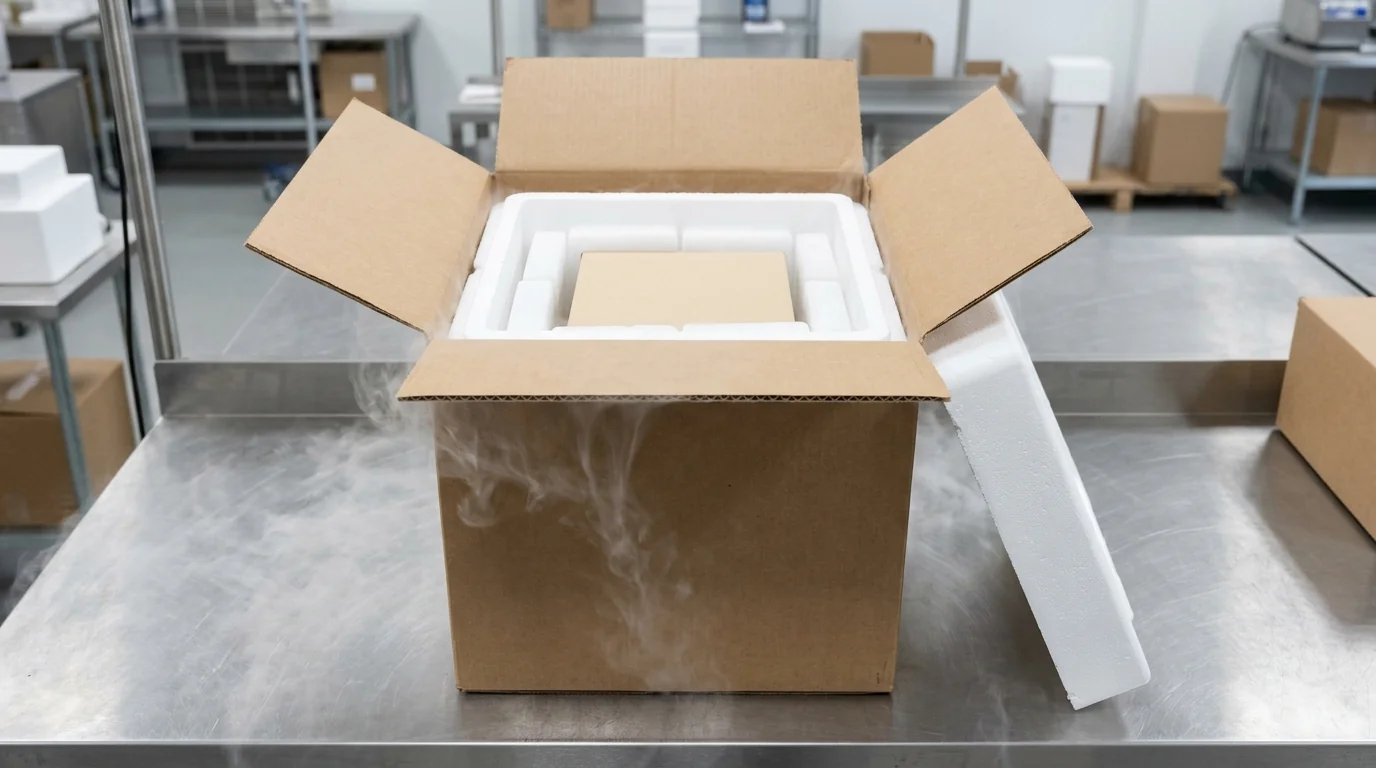
According to the USGS Water Science School, sublimation is the direct conversion between the solid and gaseous phases of matter with no intermediate liquid stage. The white fog visible around an open shipper is not pure carbon dioxide vapor; it is a mixture of cold carbon dioxide gas and cold, humid air condensing atmospheric moisture.
Because carbon dioxide is a non-polar molecule with a zero dipole moment, solid dry ice exhibits low thermal and electrical conductivity. Once packed inside an insulated shipper, sublimation continues steadily as external heat conducts through the container walls and internal air circulates across exposed dry ice surfaces.
At what temperature does dry ice sublimate and how much heat does it absorb?
At Earth atmospheric pressure, solid carbon dioxide sublimates at 194.7 K (−78.5 °C, or −109.2 °F to −109.3 °F) while absorbing 571 kJ/kg (136.5 cal/g, or 25.2 kJ/mol) in enthalpy of sublimation. That deep-frozen phase-change plateau gives dry ice high cooling capacity per kilogram without pooling meltwater inside corrugated packaging.
Solid dry ice density increases as temperature drops, ranging between 1.55 and 1.7 g per cubic centimeter (97 to 106 lb per cubic foot) below 195 K (−78 °C). That combination of high latent heat and dense solid mass makes dry ice effective for deep-frozen shipments when mechanical refrigeration is unavailable.
| Thermophysical property | Reference value | Packaging and sizing meaning |
|---|---|---|
| Sublimation temperature at 1 atm | 194.7 K (−78.5 °C; −109.2 °F to −109.3 °F) | Establishes the steep thermal gradient driving heat ingress across shipper walls |
| Carbon dioxide triple point | 5.13 atm and −56.4 °C (216.8 K; −69.5 °F) | Explains why solid dry ice never melts into liquid at atmospheric shipping pressures |
| Enthalpy of sublimation | 571 kJ/kg (25.2 kJ/mol; 136.5 cal/g) | Latent cooling energy absorbed for every kilogram of solid carbon dioxide that vaporizes |
| Solid block density (below 195 K) | 1.55 to 1.7 g per cubic centimeter (97 to 106 lb per cubic foot) | High mass per unit cavity volume compared with loose pellets |
| Pellet bulk density relative to blocks | 60% to 70% of solid block density | Pellets pack less total cooling mass into the same insulated box cavity |
| Gas expansion volume | 8.8 cubic feet of carbon dioxide gas per 1 lb of dry ice | Drives mandatory package venting and enclosed-space ventilation limits |
How fast does dry ice sublimate in insulated containers: blocks vs pellets?
Standard shipping guidance allocates 5 to 10 pounds (2.27 to 4.54 kg) of dry ice per 24 hours, refined against manufacturer container data. Measured hourly fractional loss doubles with smaller pellet charges: 1% per hour for 100 lb solid blocks versus 2.0 plus or minus 0.3% per hour for ~5 lb pelletized shippers.
In FAA Advisory Circular AC 91-76A, the Federal Aviation Administration notes that the conversion rate of dry ice to gas varies with package insulation, dry ice particle size, surrounding temperature, and cabin pressure. Historical 1963 Pan American Airlines testing using a single large 100 lb package established the legacy 1% per hour (1 lb per 100 lb per hour) baseline rate.
Because modern parcel and biological shipments use smaller pelletized loads, the FAA Civil Aerospace Medical Institute conducted Technical Report DOT/FAA/AM-06/19. Researchers added approximately 5 lb of pelletized dry ice (4.6 to 5.3 lb across the test series) into each of 20 pre-weighed ThermoSafe insulated shipping containers and ran a 6-hour altitude-chamber test depressurized to 8,000 ft at 1,000 ft per minute. Weight loss measurements established an average sublimation rate of 2.0 plus or minus 0.3% per hour—double the legacy large-block benchmark.
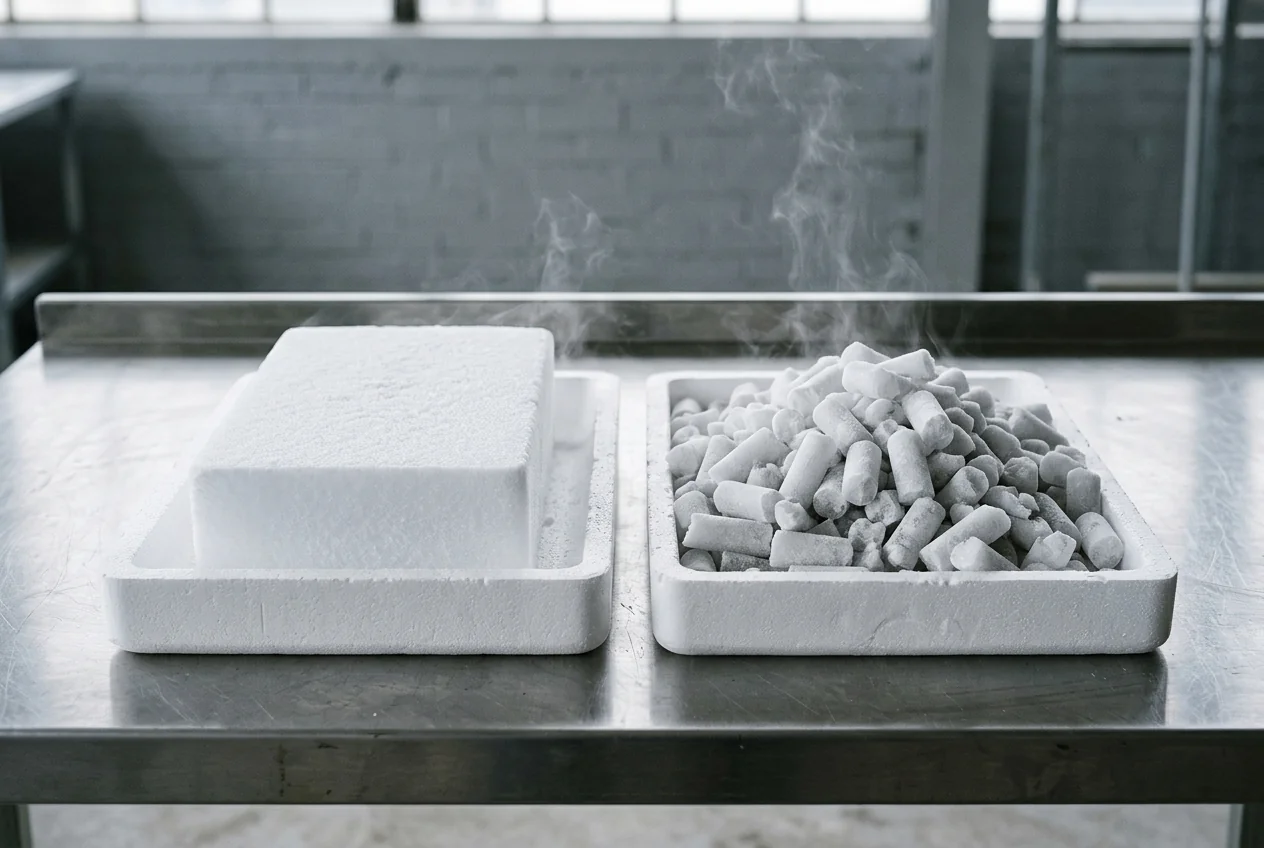
Why dry ice form factor shifts hourly loss
Dry ice is produced commercially in three standard geometries: large blocks (commonly around 30 kg or 66 lb wrapped in paper), cylindrical pellets measuring 13 mm or 16 mm in diameter, and tiny 3.2 mm high-surface-to-volume pellets designed for blasting or rapid cooling. Solid blocks sublimate relatively slowly because they expose a low surface-area-to-volume ratio to cavity air.
Extruded pellets pack at only 60% to 70% of the bulk density of solid blocks while introducing air channels between every piece. That extra exposed surface area accelerates cooling transfer around irregular payloads, yet it also leaves less mass per liter of cavity space and raises the percentage lost every hour.
| Dry ice benchmark or form | Charge size / geometry | Measured or recommended sublimation benchmark | Operational takeaway for packout teams |
|---|---|---|---|
| Large solid shipping block | 100 lb single package (1963 Pan Am test); commercial blocks ~30 kg (66 lb) | 1% per hour (1 lb per 100 lb per hour) | Lowest surface-area-to-volume ratio; suited to bulk hold times where cavity fit permits blocks |
| Small pelletized parcel shipper | 4.6 to 5.3 lb (~5 lb) pellets in small insulated boxes (FAA CAMI test) | 2.0 plus or minus 0.3% per hour (2% per hour FAA design baseline) | Higher surface exposure and smaller thermal mass double fractional hourly loss compared with 100 lb blocks |
| General cold-chain daily rule | Standard insulated shipping containers (University of Oregon EHS) | 5 to 10 lb (2.27 to 4.54 kg) per 24 hours | Baseline planning range; refer to container manufacturer recommendations and delay buffers |
| Cylindrical pellets (13 mm or 16 mm) vs tiny pellets (3.2 mm) | 60% to 70% of block bulk density | Higher relative loss than solid blocks | Easier to pour around irregular vials or cartons, but requires larger volume allowance for equal mass |
How do EPS, polyurethane, and VIP walls affect dry ice loss?
Because heat entering the container directly drives sublimation, lowering the insulation wall thermal conductivity (k-value) cuts daily dry ice consumption. Expanded polystyrene (EPS) ranges from 0.033 to 0.046 W/(m·K), rigid polyurethane foam sits around 0.024 to 0.03 W/(m·K), and Vacuum Insulated Panels (VIPs) drop to 0.006 to 0.008 W/(m·K) overall.
Creating a vacuum inside a VIP practically eliminates gaseous convection because convection relies on gas molecules transferring heat by bulk movement. Commercially available VIPs achieve 0.004 W/(m·K) across the center of the panel and 0.006 to 0.008 W/(m·K) overall after accounting for edge thermal bridging and gradual vacuum loss over time.
At a typical overall k-value of 0.007 W/(m·K), a 25 mm (1 in) VIP delivers an R-value of 3.5 m²·K/W (20 h·ft²·°F/BTU). Achieving that same thermal resistance requires 84 mm (3 in) of rigid polyurethane foam or 154 mm (6 in) of rockwool—meaning VIP shippers cut external box bulk while slowing conductive heat leak into the dry ice cavity. For detailed six-sided heat-load geometry and payload cube calculations, see our payload and insulation sizing guide.
| Wall insulation material | Thermal conductivity (k-value) | Equivalent thickness for R = 3.5 m²·K/W | Packout handling constraints |
|---|---|---|---|
| Expanded polystyrene (EPS) | 0.033 to 0.046 W/(m·K) | Thick molded walls required for multi-day holds | Inspect every reused shipper; reject boxes with cracked or broken foam |
| Rigid polyurethane foam (PUR) | 0.024 W/(m·K) (panels) to 0.03 W/(m·K) at 298 K | 84 mm (3 in) at 0.024 W/(m·K) reference | Lower conductivity than EPS; protect against water absorption |
| Vacuum Insulated Panel (VIP) | 0.004 W/(m·K) center; 0.006 to 0.008 W/(m·K) overall | 25 mm (1 in) at 0.007 W/(m·K) typical | Cannot be cut to fit; puncturing the barrier membrane destroys the vacuum |
Wall integrity matters as much as nominal material rating. Under the University of Oregon EHS Dry Ice Shipping Guide, operators should avoid plastics that become brittle or permeable at dry ice temperatures and must never reuse a box if it is torn, cut, stained, or has cracked or broken insulation. VIP panels likewise cannot be trimmed at the packing bench because cutting the membrane destroys the vacuum.
How do you estimate dry ice weight and CO2 ventilation limits?
Estimate shipment dry ice weight by pairing the 5 to 10 lb (2.27 to 4.54 kg) per 24-hour allowance—or the FAA 2% per hour conservative rate for packages under 100 lb—with total transit duration plus holiday or carrier-delay contingency. Then check hourly carbon dioxide gas output at 8.8 cubic feet per pound against enclosed-space ventilation limits.
Sizing dry ice weight for transit time and delays
Start with your container manufacturer’s validated sublimation specification rather than relying on a single generic multiplier. Where validated lane data are not yet available, FAA AC 91-76A recommends applying the 2% per hour sublimation rate for packages holding less than 100 lb of dry ice or conducting package-specific weight-loss evaluations.
Always build schedule contingency into the dry ice mass calculation before sealing the carton. Confirm with the consignee that the shipment will be received on the planned delivery date, and factor in local holidays or facility closings that could hold the package an extra day in an unconditioned warehouse.
Checking gas expansion and enclosed ventilation limits
Every pound of dry ice sublimates into 8.8 cubic feet of carbon dioxide gas. Consequently, 100 lb of dry ice sublimating at 1% per hour releases 8.8 cubic feet of gas per hour, whereas 100 lb split across twenty 5 lb packages sublimating at 2% per hour releases 17.6 cubic feet of gas per hour.
FAA AC 91-76A provides a loading equation to keep enclosed cabin or cargo-hold concentrations below the 0.5% (5,000 ppm) ceiling—the same 5,000 ppm concentration used by OSHA as an 8-hour Time Weighted Average Permissible Exposure Limit (PEL) in general industry. The allowable dry ice mass equals the allowable gas concentration (0.005) multiplied by enclosed volume in cubic feet and complete fresh air exchanges per hour, divided by the sublimation gas factor (0.088 cubic feet per pound per hour at 1% per hour, or 0.176 at 2% per hour).
| FAA AC 91-76A worked scenario | Enclosed volume | Complete fresh air exchanges per hour | Sublimation rate and gas factor | Allowable dry ice load at 0.5% (0.005) limit |
|---|---|---|---|---|
| Example 1a: Large packages, moderate ventilation | 5,000 cubic feet | 10 per hour | 1% per hour (0.088) | 2,841 lb |
| Example 1b: Large packages, high ventilation | 5,000 cubic feet | 20 per hour | 1% per hour (0.088) | 5,682 lb |
| Example 2: Small 5 lb packages, high ventilation | 5,000 cubic feet | 20 per hour | 2% per hour (0.176) | 2,841 lb |
Notice how switching from large 100 lb blocks to small 5 lb packages in Example 2 cuts allowable dry ice loading in half (from 5,682 lb down to 2,841 lb) even with 20 complete fresh air exchanges per hour. Maintaining fresh-air circulation in packing rooms, delivery vans, and cargo holds is critical because elevated carbon dioxide creates rapid physiological hazards: approaching 2% increases lung air intake per breath by up to 30%, 4.5% to 5% makes breathing extremely labored, 7% to 9% is the highest concentration tolerated, and concentrations above 10% can cause loss of muscle control and unconsciousness.
How can shippers slow dry ice sublimation without blocking gas vents?
Slow sublimation inside the package by eliminating dead air space with crumpled paper or packing peanuts, wedging payloads tightly with cardboard or foam so they cannot shift as solid dry ice shrinks, and inspecting insulation seams—while always keeping an unsealed carbon dioxide vent path open.
The single most dangerous packout error is taping the inner foam lid or outer plastic liner airtight in an attempt to slow dry ice loss. Under 49 CFR 173.217 and IATA Packaging Instruction 954, packagings containing solid carbon dioxide for air or water transport must be designed and constructed to permit the release of carbon dioxide gas to prevent a buildup of pressure that could rupture the packaging. Dry ice must never be placed inside an airtight container such as a threaded lid or a sealed plastic bag.

Ground versus air regulatory checkpoints at the packout bench
According to the FAA Dry Ice Fact Sheet, dry ice is not regulated as dangerous goods for ground shipments, but any package handed to an air carrier—including expedited parcel services that interline onto aircraft—must fully comply with air shipping rules. Under 49 CFR 173.217(c)(5), packages holding 2.5 kg (5.5 pounds) or less of dry ice used as a refrigerant are excepted from other Hazardous Materials Regulations requirements when proper venting and basic package markings are met. Larger air shipments are regulated as Hazard Class 9, UN 1845, require net dry ice weight in kilograms marked on the outer box, and are capped at a maximum allowable net quantity of 200 kg per package under IATA Packaging Instruction 954.
Packout station verification checklist
Integrate these checks directly into your packout automation workflow and cold-chain packaging process checklist before releasing any dry ice shipment:
| Station check | Required action | Failure mode prevented |
|---|---|---|
| Insulation integrity check | Reject reused cartons that are torn, stained, or have cracked foam walls; never cut VIP panels | Accelerated heat ingress and unexpected sublimation spikes |
| Cold-compatible materials | Avoid plastics that become brittle or permeable at −78.5 °C | Liner cracking, broken secondary containment, and sample exposure |
| Void-space minimization | Fill all empty internal headspace with crumpled paper or packing peanuts | Excess internal air circulation accelerating sublimation |
| Payload stabilization | Wedge inner cartons or vials securely with cardboard or styrofoam | Samples shifting or colliding as solid dry ice shrinks during transit |
| Unobstructed gas vent path | Never use threaded airtight lids, sealed plastic bags, or full-perimeter tape across the foam lid seam | Pressure buildup and catastrophic container rupture under 49 CFR 173.217(a) |
| Transit buffer and mode check | Verify consignee availability, holiday delays, and 2.5 kg (5.5 lb) / UN 1845 air thresholds | Late-lane dry ice depletion or rejected air-interline cargo |
Before finalizing your next dry ice packout specification, document four baseline inputs together on the station worksheet: planned transit hours plus delay buffer, insulation wall material and thickness, dry ice form (block versus pellet) and starting net mass, and the documented gas-venting closure method. Keeping those four parameters tied to each lane record lets operations teams trace sublimation variance and refine dry ice charge weights without compromising venting safety.