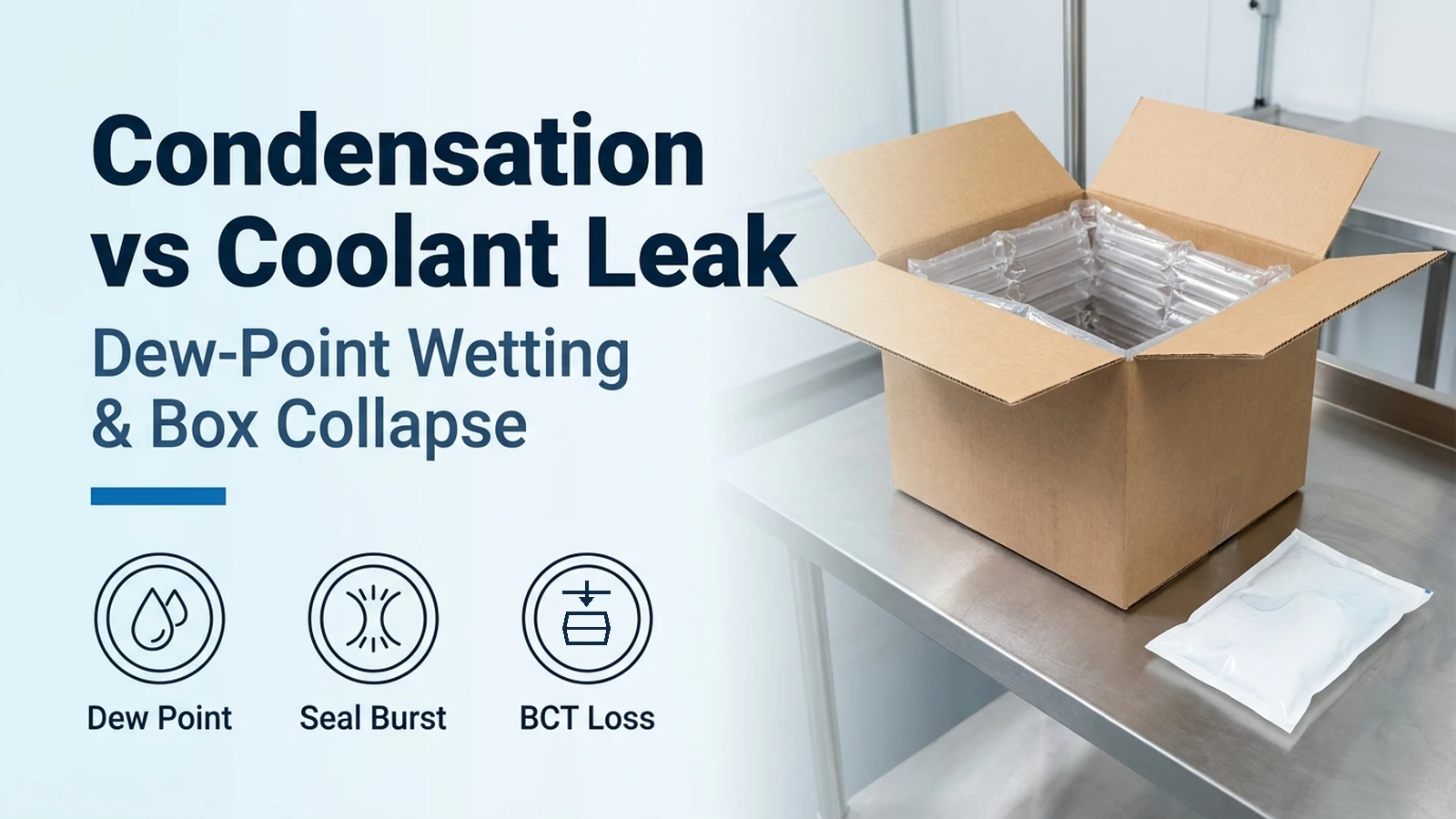
In passive thermal distribution, a corrugate condensation cold pack investigation begins by separating atmospheric dew-point sweating from an internal coolant leak shipper failure before replacing linerboard grades or pouch films. Dew is moisture that has condensed on objects near the ground, whose temperatures have fallen below the dewpoint temperature, and Dew Point (DWPT) is the temperature to which air must be cooled in order to reach saturation (assuming air pressure and moisture content are constant). Under CTU Code section 15.1, condensation damage in a CTU from internal humidity may materialize in the form of corrosion, mildew, rot, fermentation, breakdown of cardboard packaging, leakage, and staining.
When a damp or crushed shipper arrives at receiving, pairing a controlled teardown from our cold-chain packaging problems and solutions workflow with quantitative seal-burst and containerboard moisture checks prevents misdirected corrective actions.
| Diagnostic Dimension | Dew-Point Condensation Pathway | Coolant-Pouch Leak or Seam-Burst Pathway | Structural Impact on the Outer Corrugated Case |
|---|---|---|---|
| Moisture source and fluid chemistry | The dew point is the temperature the air needs to be cooled to at constant pressure to achieve a relative humidity (RH) of 100%, where the air cannot hold more water in the gas form and further cooling forces water vapor out in the liquid form | Gel-based ice packs often contain polymer derivatives including sodium polyacrylate (the substance used in nappies), which does not break down naturally, can clog drains when disposed of incorrectly, and can contaminate food during transit when leaking | Under CTU Code section 2.2, hygroscopic cargoes have variable water content: in ambient air of high relative humidity they absorb water vapour, while in ambient air of low relative humidity they release water vapour |
| Pouch stress and seal-failure mechanics | Under the WHO SEARO Immunization Handbook, ice packs come out of the freezer at about -20°C and need to be kept at room temperature for a period of time to allow the ice at the core of the ice pack to rise to 0°C; this takes up to one hour at +20°C | Under Test Methods F1140, stresses are not distributed uniformly to all areas of the package seal: under unrestrained conditions the stress on the package is highest at the middle of the pouch where it inflates to the package’s maximum diameter, so Test Methods F1140 may not reliably detect the weakest area of the seal | The CFIA transit packaging guidelines state that palletisation and stacking heights of the cases should be specified to minimize the risk of compressing the pouch contents and thereby stressing the seals, and warn that at low temperatures there may be a danger of reduced flex-crack resistance |
| Surface absorption and starch bond failure | The Cobb test measures containerboard surface water absorption over 120 seconds in g/m²: Under 20 g/m² is rated Excellent (high moisture resistance), 20-30 g/m² is Good (standard kraft performance), 30-45 g/m² is Adequate (typical recycled linerboard), and >45 g/m² is Poor (not suitable for moist environments) | In the WHO PQS lateral pressure leakage test, Step 2 places water-packs in a refrigerator at +5°C (± 2°C) for 24 hours, and Step 3 places an 80kg uniformly distributed load on the flat face of each water-pack for 30 seconds, requiring no leakage from any sample | In the Pin Adhesion Test, liner-to-medium bond strength >100 lbs/ft is Excellent (paper tears before bond fails), 60-100 lbs/ft is Good, 40-60 lbs/ft is Acceptable, and Under 40 lbs/ft is Failure where the adhesive bond will fail in service |
| Compression loss and collapse geometry | According to Fibre Box Association relative humidity multipliers under load, corrugated compression loss is 0 percent at 50 % RH (1.00), 10 percent at 60 % RH (0.90), 20 percent at 70 % RH (0.80), 32 percent at 80 % RH (0.68), and 52 percent at 90 % RH (0.48) | Under Note 2 (5), fixed-platen compression machines generally cause corrugated box specimens to fail at their strongest point, whereas swivel-platen machines allow the platen to move to the weakest point of the container | Under Hyster-Yale Supplier Packaging Guidelines Clause 2.1.2.6, two-thirds of the stacking strength of a corrugated carton is concentrated at the corners, and misaligned carton corners can reduce stacking strength by up to 30% |
Field Triage at Unpacking: Dew-Point Condensation vs Coolant-Pouch Leakage
When a receiving dock logs a damp or softened shipper, operators must preserve the moisture trail before lifting out the payload or discarding the refrigerant packs. Opening the container in a documented top-to-bottom sequence separates exterior ambient sweating from internal pouch failure:
- In Coldpack System’s packout failure guide, a wet or weakened outer case requires retrieving unopened-pack photos and inspecting for leaking coolant, moisture path, and carton condition by photographing the top arrangement, lifting components without mixing them, and then inspecting the bottom and corners.
- The dew point is the temperature the air needs to be cooled to at constant pressure to achieve a relative humidity (RH) of 100%, where the air cannot hold more water in the gas form and further cooling forces water vapor out in the liquid form.
- A temperature of 30 and a dew point of 30 produce a relative humidity of 100%, whereas a temperature of 80 and a dew point of 60 produce a relative humidity of 50%.
- Dew is moisture that has condensed on objects near the ground, whose temperatures have fallen below the dewpoint temperature, and Dew Point (DWPT) is the temperature to which air must be cooled in order to reach saturation (assuming air pressure and moisture content are constant).
- Under CTU Code section 2.2, hygroscopic cargoes have variable water content: in ambient air of high relative humidity they absorb water vapour, while in ambient air of low relative humidity they release water vapour.
- Under CTU Code section 15.1, condensation damage in a CTU from internal humidity may materialize in the form of corrosion, mildew, rot, fermentation, breakdown of cardboard packaging, leakage, and staining.
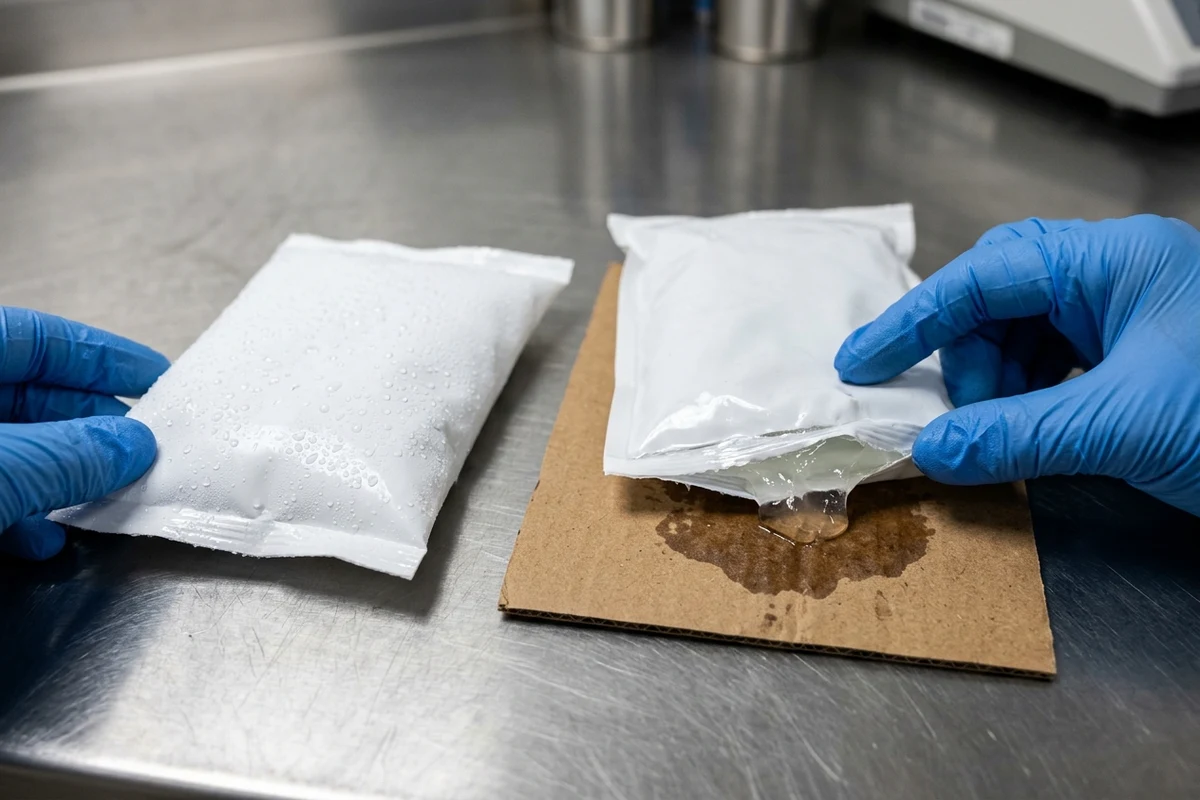
Physical residue inspection, coolant formulation records, and pack weight checks distinguish pure condensed water vapor from leaked pouch contents across gel-based and water-based coolants:
- Gel-based ice packs often contain polymer derivatives including sodium polyacrylate (the substance used in nappies), which does not break down naturally, can clog drains when disposed of incorrectly, and can contaminate food during transit when leaking.
- Cold Chain Technologies Koolit 500-ST series gel packs feature a puncture-resistant nylon laminate film with a suppressed temperature (ST) -23°C (-16.6°F) freezing point formula for products that need to stay below freezing temperatures.
- Cold Chain Technologies Koolit 600 series encases 0°C (32°F) polymer ice gel in a thick 5-mil white polyethylene pouch, whereas the 800 series is sweat-proof and designed to absorb condensation.
- Pelton Shepherd Glacier Ice features a puncture-resistant film with a slow-to-thaw water-based gel and a 30 F eutectic point, while EcoGel solves the problem of shipping products with sharp corners.
- Hydropac’s analysis of the current EPR fee structure suggests a standard 500g water ice pack like HydroPure could attract disposal fees of around ½ a penny per unit (only the plastic film is reported) compared with approximately 14.3p for an equivalent gel pack where both the plastic film and gel contents are chargeable.
- In the WHO SEARO Immunization Handbook, operators must fill water only up to the level mark on the side to leave 10 mm room for expansion as water freezes, and must not use ice packs with cracks or leakage.
- WHO PQS Test 2 specifies four standard water-pack sizes: Type 1 (0.3 L, 0.25 to 0.35 litres, 173 x 120 x 26 mm, max 70 g empty / 420 g filled), Type 2 (0.3 L, 0.25 to 0.30 litres, 163 x 90 x 34 mm, max 80 g empty / 380 g filled), Type 3 (0.4 L, 0.35 to 0.40 litres, 163 x 94 x 34 mm, max 100 g empty / 500 g filled), and Type 4 (0.6 L, 0.55 to 0.60 litres, 190 x 120 x 34 mm, max 120 g empty / 720 g filled).
Coolant-Pouch Seal Burst vs Pinhole Leak Mechanics
Resolving a gel pack pouch seal burst vs condensation dispute requires testing how the flexible pouch behaves under freezing expansion, internal pressurization, and flat-face compressive loading inside a stacked shipping case. Unrestrained inflation stresses the center of the pouch film, whereas flat-face restraint between parallel restraining plates applies pressurization stresses more uniformly along the perimeter seals:
- Under the WHO PQS frozen water-pack thickness and adhesion acceptance criteria, the increase in sample thickness due to swelling does not exceed the measured dimensions from Test 2 by more than 25% for any sample, and the thawed thickness of each sample equals the measured thickness from Test 2 (±1.0mm).
- In unrestrained package testing (1.1), the burst test (1.2) increasingly pressurizes the package until the package fails, and the creep test (1.3) maintains a specified pressure for a specified time or until the package fails.
- Under Test Methods F1140, stresses are not distributed uniformly to all areas of the package seal: under unrestrained conditions the stress on the package is highest at the middle of the pouch where it inflates to the package’s maximum diameter, so Test Methods F1140 may not reliably detect the weakest area of the seal.
- The CFIA transit packaging guidelines state that palletisation and stacking heights of the cases should be specified to minimize the risk of compressing the pouch contents and thereby stressing the seals, and warn that at low temperatures there may be a danger of reduced flex-crack resistance.
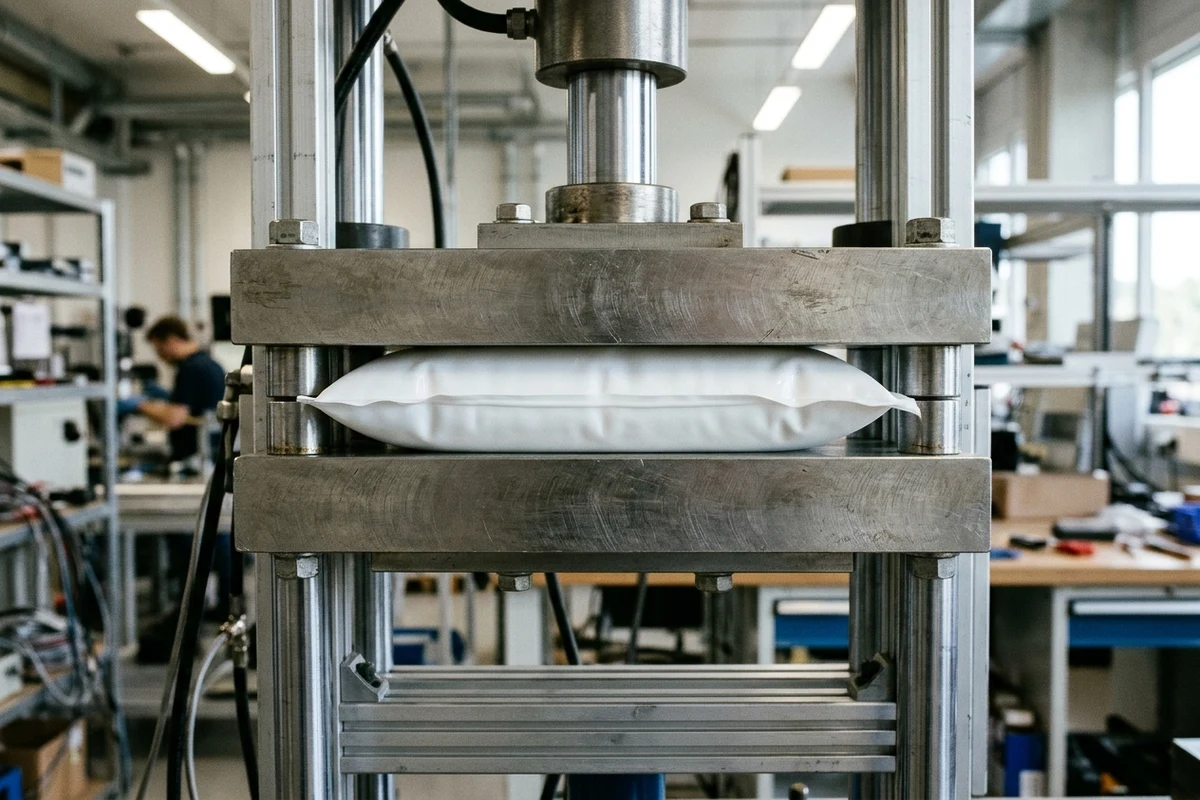
Flat-face compression tests, free-fall impact protocols, seal-width inspections, and underwater bubble-emission methods quantify whether a pouch failed from compressive weld rupture or from a substrate pinhole:
- In the WHO PQS lateral pressure leakage test, Step 2 places water-packs in a refrigerator at +5°C (± 2°C) for 24 hours, and Step 3 places an 80kg uniformly distributed load on the flat face of each water-pack for 30 seconds, requiring no leakage from any sample.
- In the CFIA Static Load Burst Test, a filled and sealed pouch compressed horizontally between two parallel plates must withstand a force of 7.5 kg for 15 mm of internal seal length applied for 15 seconds.
- Hydropac’s ice pack sealing technology seals all four sides of the ice pack with two layers of material to achieve leak resistance, with burst strength tested to over 200kg.
- In the WHO PQS frozen water-pack robustness test (Step 2), each frozen water-pack is dropped using a free fall drop tester from a height of 2.0 metres (measured from the lowest part of the water-pack at the start of each test) onto a smooth dense concrete floor.
- The CFIA Flexible Retort Pouch Defects Manual requires measuring the width of manufacturer and processor seals at a number of locations along the seal to ensure they meet the required minimum width of 3 mm, and examining the seals under steady pressure for signs of seal creep or delamination.
- Under CGSB -32.302-M87 (Footnote 11 and Footnote 9), pouches after retorting must hold 105 kPa (15 psig) internal air pressure for 30 seconds with no evidence of seal rupture and a final seal width of 3 mm or greater; prior to retorting they will need to meet a higher criterion such as 140 kPa (20 psig) or greater.
- To control tail-bending forces when measuring seal strength, Technique A (4.2.1 Unsupported) secures each tail of the specimen in opposing grips while the seal remains unsupported, and Technique B (4.2.2 Supported 90° By Hand) supports the seal at a 90° perpendicular angle.
- In bubble emission package integrity testing (Clauses 5.5 and 1.1), the test method detects substrate holes, channels, and gross leaks in tray and pouch packages with a method sensitivity down to 250 μm (0.010 in.) with an 81 % probability (Section 11).
Corrugated Wet-Collapse Mechanics: Symmetrical Corner Buckling vs Asymmetric Leak Blowout
Preventing cold chain box condensation wet collapse requires matching containerboard sizing, ring crush, and starch adhesive bond strength to the moisture exposure profile of the distribution lane. When liquid condensate or leaked gel wets the linerboard, surface absorption and glue-line delamination degrade the composite column strength of the corrugated wall:
- FEFCO testing methods for corrugated board and boxes specify Method 6 for flat crush resistance, Method 7 for water absorptiveness (Cobb test), Method 8 for edgewise crush resistance, Method 9 for water resistance of the glue bond, Method 10 for basis weight, Method 11 for adhesion strength of the glue bond, and Method 50 for box compression resistance.
- CorrugatedNews, under a Basis weight (TAPPI T410) heading, states that containerboard basis weight (lb/MSF) is tested after conditioning at standard atmosphere (73°F, 50% RH) and must fall within ±5% of the specified target; typical grades listed by CorrugatedNews include 26, 33, 38, 42, 47, 56, 69, and 90 lb linerboard and 23, 26, 30, 33, 36, and 40 lb medium.
- Typical ring crush compressive values are 75-95 lbs for 42 lb kraft linerboard, 55-70 lbs for 42 lb recycled linerboard, 25-35 lbs for 26 lb medium, and 40-55 lbs for 33 lb medium.
- The Cobb test measures containerboard surface water absorption over 120 seconds in g/m²: Under 20 g/m² is rated Excellent (high moisture resistance), 20-30 g/m² is Good (standard kraft performance), 30-45 g/m² is Adequate (typical recycled linerboard), and >45 g/m² is Poor (not suitable for moist environments).
- ECT is tested by placing a precisely cut specimen (2“ x 2“ for short-column method) between compression platens and loading to failure (force in lbs divided by length in inches), alongside the Flat Crush Test (TAPPI T825).
- In the Pin Adhesion Test, liner-to-medium bond strength >100 lbs/ft is Excellent (paper tears before bond fails), 60-100 lbs/ft is Good, 40-60 lbs/ft is Acceptable, and Under 40 lbs/ft is Failure where the adhesive bond will fail in service.
- Box Compression Test (BCT) strength is approximated by the McKee formula BCT = 5.87 × ECT × √(caliper × box perimeter), where ECT is in lbs/in and caliper and box perimeter are in inches, with boxes typically specified at a safety factor of 2-5×.
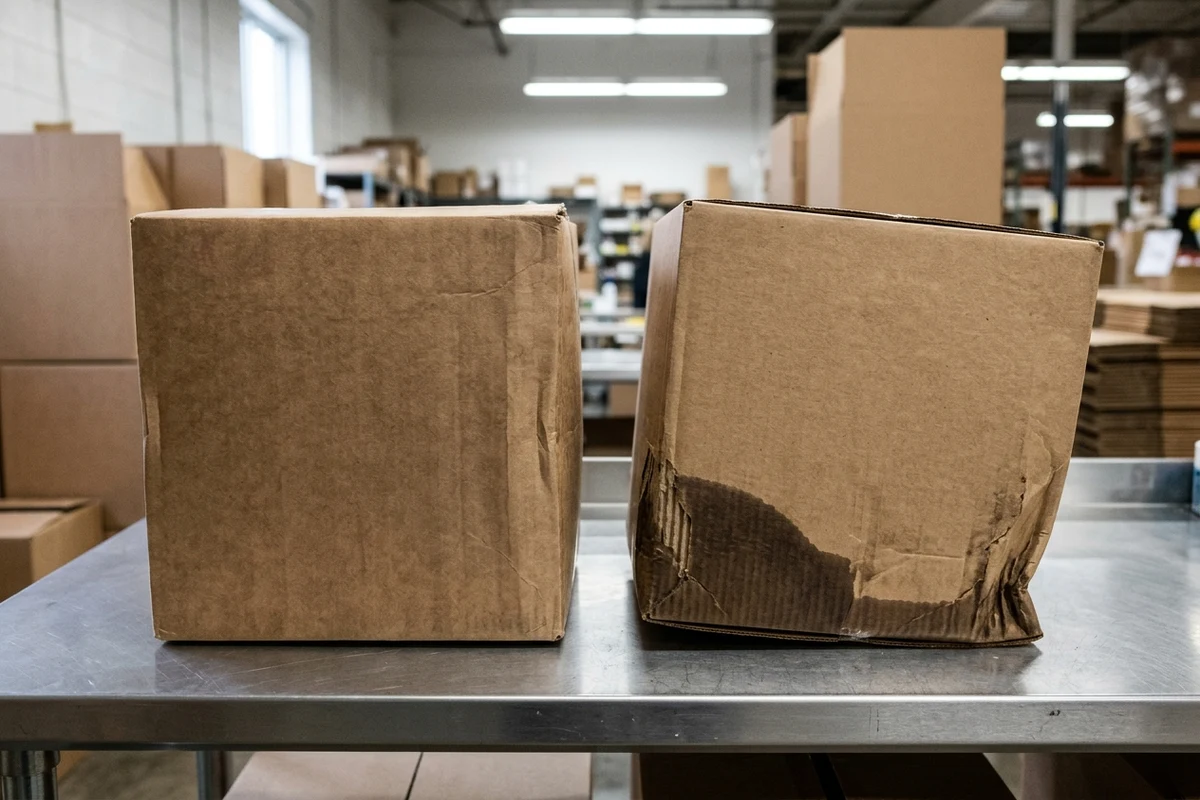
Ambient humidity multipliers, cyclic humidity creep testing, and corner-load rules explain why diffuse dew-point wetting bows vertical walls while a localized bottom leak tilts the stack toward its weakest corner:
- A Clemson University study tested 3,000 industry supplied corrugated boxes across seven relative humidity conditions from 30 to 90 percent in ten batches with preconditioning and conditioning meeting TAPPI T402.
- According to Fibre Box Association relative humidity multipliers under load, corrugated compression loss is 0 percent at 50 % RH (1.00), 10 percent at 60 % RH (0.90), 20 percent at 70 % RH (0.80), 32 percent at 80 % RH (0.68), and 52 percent at 90 % RH (0.48).
- In USDA Forest Products Laboratory testing of corrugated fiberboards, the average strength of the stronger board in a dynamic crush test was 30% greater than the weaker board, but its safe load level yielding a 5% probability of failure after 48 h in cyclic humidity was 115% greater.
- Under Hyster-Yale Supplier Packaging Guidelines Clause 2.1.2.6, two-thirds of the stacking strength of a corrugated carton is concentrated at the corners, and misaligned carton corners can reduce stacking strength by up to 30%.
- Under Hyster-Yale Supplier Packaging Guidelines, interlocked stacking patterns can reduce corrugated carton stacking strength by up to 50%, and carton overhang off the pallet can reduce stacking strength by up to 32%.
- Under Note 2 (5), fixed-platen compression machines generally cause corrugated box specimens to fail at their strongest point, whereas swivel-platen machines allow the platen to move to the weakest point of the container.
Prevention and Packout Station Controls: Conditioning, Sweat-Proof Barriers, and Cold Closure
Controlling moisture at the packing station starts with bench preconditioning so sub-zero packs equilibrate before entering the carton, paired with condensation-absorbing pouch laminates where surface sweating must be contained. Teams standardizing gel pack preconditioning time and core temperature checks apply documented bench spacing and staging durations:
- Under the WHO SEARO Immunization Handbook, ice packs come out of the freezer at about -20°C and need to be kept at room temperature for a period of time to allow the ice at the core of the ice pack to rise to 0°C; this takes up to one hour at +20°C.
- During WHO SEARO bench conditioning, operators take frozen ice packs from the freezer and lay them out on a table leaving a 5 cm space all round each ice pack.
- In Coldpack System’s gel pack preconditioning guide, the Staging-Time Reference Chart sets TIC panel staging durations of 35 Minutes for 3L (5x5), 25 Minutes for 4L (6x6), 30 Minutes for 8L (6.5 x 6.5 and 6.5 x 11), and 45 Minutes for 10L (8.5 x 8.5).
- The CDC Vaccine Storage and Handling Toolkit states that PCMs between 4°C and 5°C (39°F and 41°F) can be purchased to maintain proper temperatures, and warns not to use frozen gel packs or coolant packs from original vaccine shipments because they can still freeze vaccines even if conditioned or appearing to be sweating.
- Sonoco ThermoSafe Standard PolarPacks (PP) are enclosed in durable polyethylene film, whereas MoistureGuard PolarPacks (MG) use a multi-layered exterior that minimizes surface condensation and an outer film layer that absorbs condensation to protect products from moisture damage.
- Sonoco ThermoSafe Standard PolarPack PP6 has a case pack of 96, a 0°C (+32°F) phase temperature, and dimensions of 5.50 x 3.50 x 0.80 in / 140 x 89 x 19 mm, while PCM Brick TPB3020A has a fill of 47, case pack of 12, +4°C (+39°F) phase temperature, and dimensions of 10.80 x 9.30 x 1.00 in / 273 x 235 x 25 mm.
Isolating internal coolant surfaces from the corrugated wall also depends on verifying liner chamber integrity under our inflatable insulated packaging checks and matching carton-closure adhesives to chilled flap conditions in our cold-room case sealer tape versus hot melt specification:
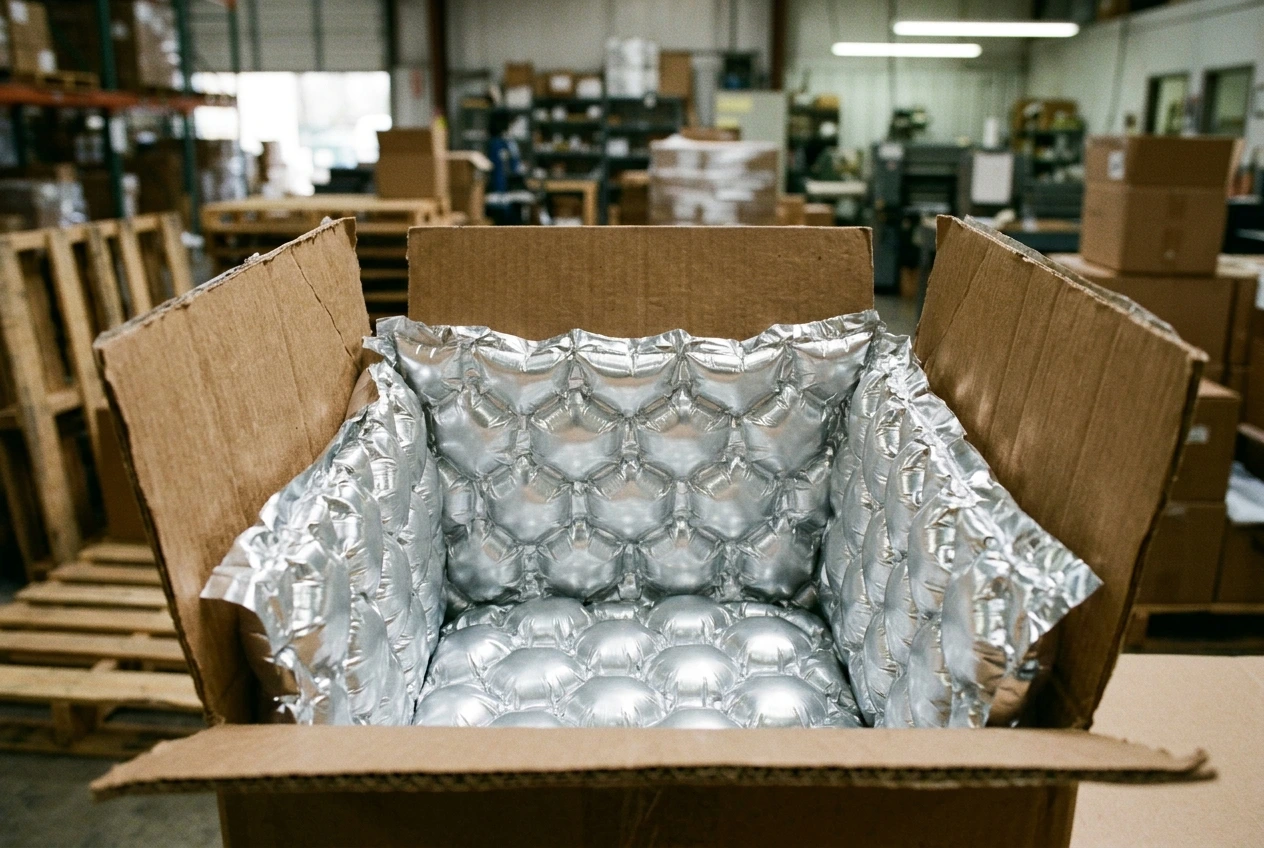
- Coldpack System’s inflatable insulated packaging guide instructs operators to follow the replacement criteria for a damaged chamber instead of assuming adjacent chambers provide enough protection, and to insert the prepared liner into the actual carton and check the bottom and corners before loading.
- Standard rubber-resin hot-melt carton-sealing tapes typically require application temperatures above +7 °C to +10 °C (+45 °F to +50 °F) and lose initial tack on chilled or damp board, whereas freezer-grade acrylic or cold-temperature rubber-modified tapes (such as Shurtape cold-temperature AP/HP grades) are formulated to wet out down to -7 °C to +4 °C (20 °F to 40 °F).
When documenting a moisture or box-collapse incident across your inflatable insulation lanes, record the ambient dew point along the route, the containerboard Cobb and pin-adhesion specifications, and whether post-journey inspection found intact sweating pouches or ruptured perimeter seals.
Sources
- NOAA National Weather Service — Dew Point vs. Humidity and Meteorological Glossary
- IMO/ILO/UNECE — Code of Practice for Packing of Cargo Transport Units Informative Material
- World Health Organization Regional Office for South-East Asia — Immunization Handbook for Medical Officers
- World Health Organization PQS — Water-Pack Independent Type-Testing Protocol
- Centers for Disease Control and Prevention — Vaccine Storage and Handling Toolkit
- Canadian Food Inspection Agency — Flexible Retort Pouch Defects Manual
- ASTM International — Standard Test Methods for Package Burst, Creep, Seal Strength, Bubble Emission, and Shipping Container Compression
- European Federation of Corrugated Board Manufacturers — Testing Methods and Recommendations
- CorrugatedNews — Quality Control in Corrugated Manufacturing
- Clemson University — Relative Humidity Effects on the Compression Strength of Corrugated Boxes
- Axis Corrugated Container — Fibre Box Association Relative Humidity Multipliers
- USDA Forest Products Laboratory — Strength and Life of Corrugated Containers in Cyclic Relative Humidity
- Hyster-Yale Group — Supplier Packaging Guidelines
- Sonoco ThermoSafe — Gel Packs, MoistureGuard PolarPacks, and Phase Change Materials Product Catalogs
- Cold Chain Technologies — Koolit Refrigerant Gel Packs Technical Documentation
- Pelton Shepherd — Glacier Ice and EcoGel Refrigerant Specifications
- Packaging Strategies and Packaging Europe — Hydropac Ice Pack Sealing and Water Ice Pack Coverage