
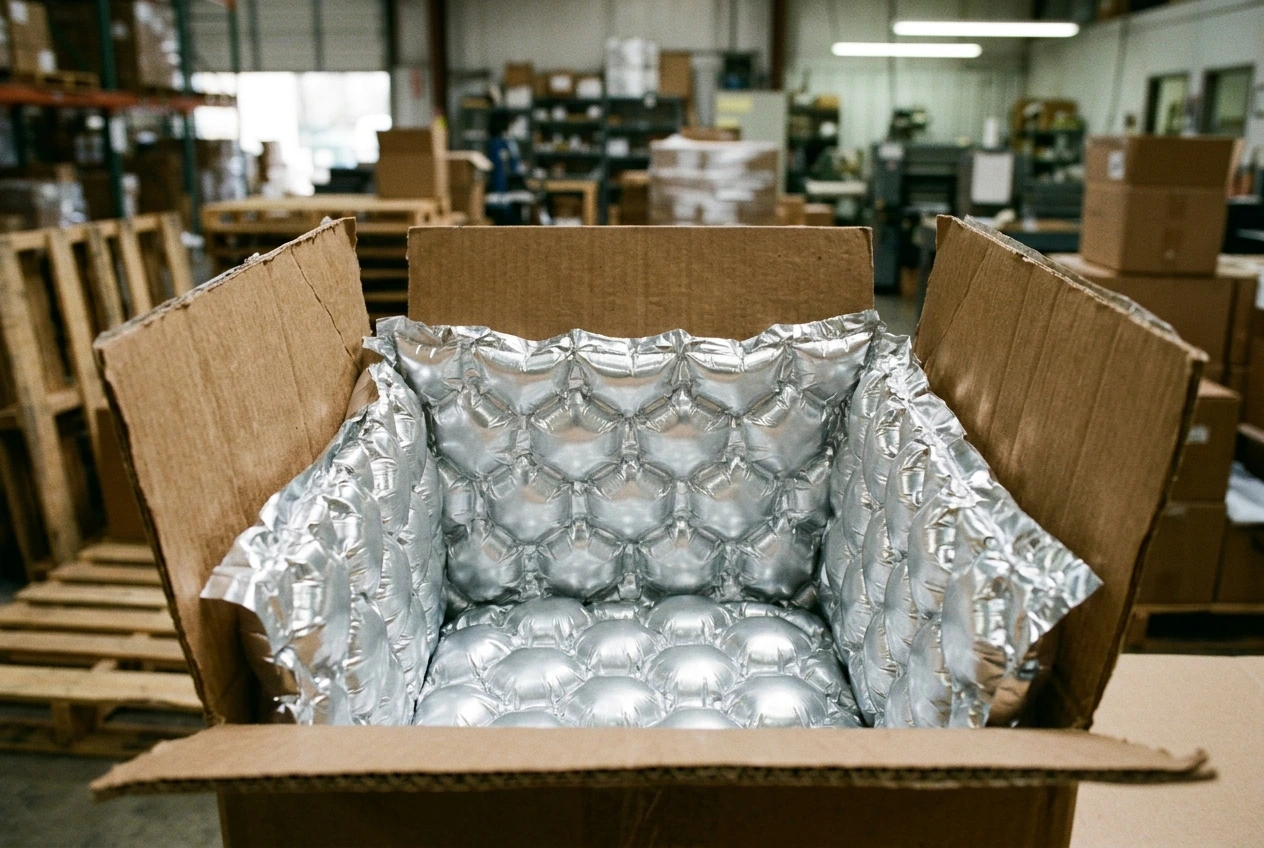
Identify the liner’s expansion mechanism before specifying an inflation station. A valve-inflated air-column pack, a preformed reflective bubble liner and a self-expanding foam liner are different constructions. Use the instruction for the exact material; silver appearance and visible air cells do not identify its preparation method.
This guide covers inflatable insulation as an assembly decision. It does not revive a former product brand, describe its proprietary equipment or establish thermal performance for generic cushioning.
Check what actually arrives at the station
Ask for a supplied sample, material reference and assembly instruction. Inspect the inlet or valve if the system uses one. A preformed bubble sheet has closed cells from manufacture; it does not automatically need a nozzle at packout. Self-expanding foam can recover after removal from compression packaging without an air-supply connection.
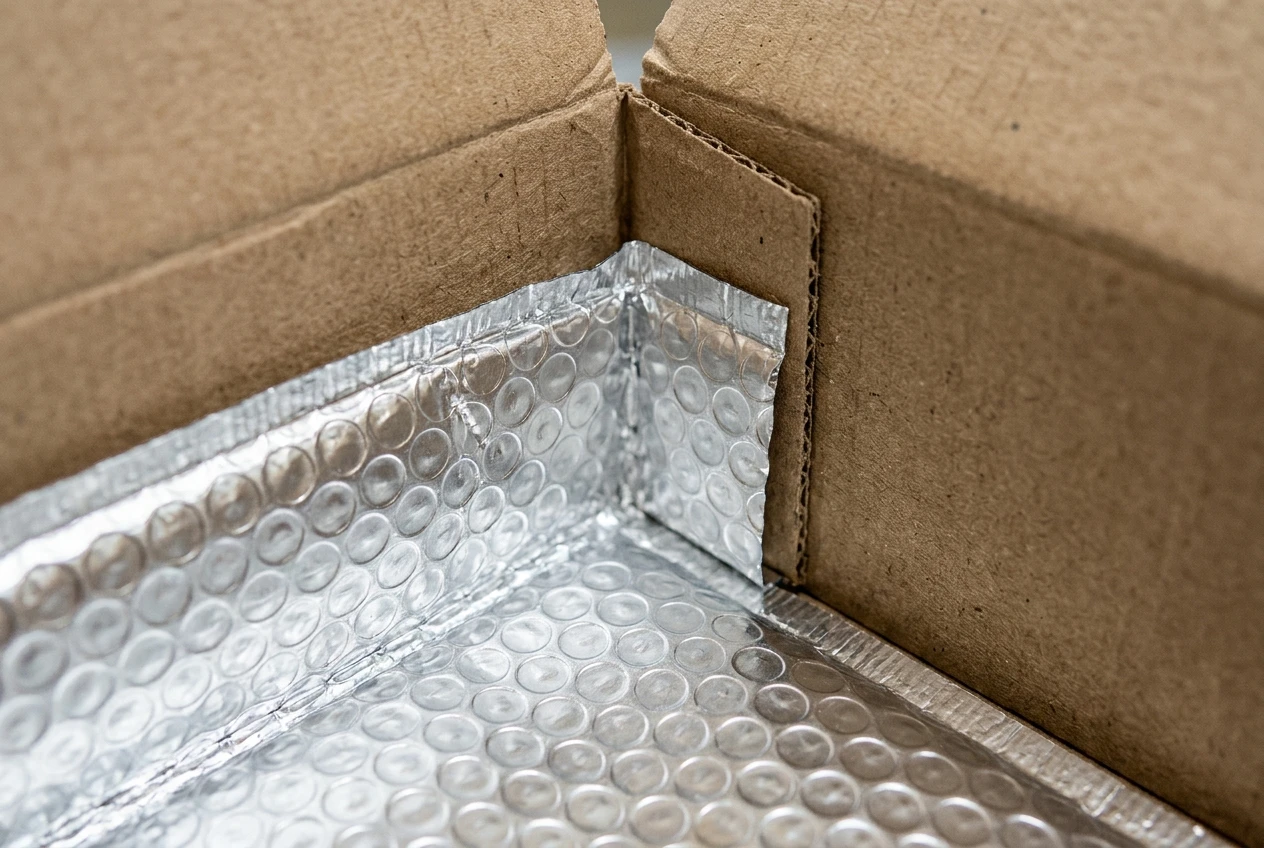
The scene shows the bottom corner of a reflective air-cell liner inside a carton. It cannot establish whether those cells were formed during manufacture or inflated at the packing station. That distinction must come from the material documentation.
| Construction you have identified | Preparation question | Equipment implication |
|---|---|---|
| Valve-inflated air-column profile | Which air supply, inlet and validated setting does this product require? | A matched inflation operation and retention check may be required |
| Preformed reflective bubble liner | Does the instruction require opening, unfolding and an adhesive or other closure? | Present and assemble the liner without assuming an inflation machine |
| Self-expanding foam liner | How is compression packaging removed and the recovered shape checked? | Allow the documented preparation and fit process; do not add a nozzle by analogy |
| Unidentified multilayer liner | Can the supplier identify the structure and assembly route? | Hold equipment selection until the mechanism is confirmed |
IPC documents a self-expanding foam liner route. BENZ describes valve inflation for its protective air-column packaging. These examples establish a useful distinction; they are not evidence that one supplier’s material, pressure or thermal results transfer to another.
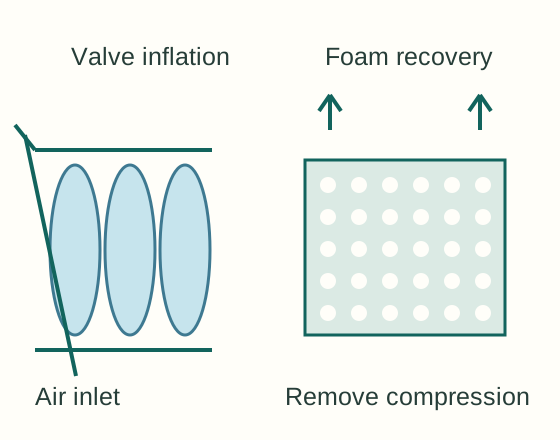
Define the checks for a genuine inflation operation
For a valve-inflated product, obtain the approved air-source, nozzle and setting requirements. Have the supplier define the acceptable formed profile and the retention-test method. Appearance alone cannot distinguish a correctly prepared profile from one that is overfilled or losing air.
Record material identity, equipment setup reference, observed profile and the agreed retention result. Keep sharp carton edges, projecting payload features and rough handling in the trial plan. Follow the replacement criteria for a damaged chamber instead of assuming adjacent chambers provide enough protection.
Test fit after preparation
A flat liner’s storage footprint does not give its assembled payload space. Insert the prepared liner into the actual carton, check the bottom and corners, and load the approved payload and coolant arrangement if this is a thermal packout. Inspect the intended closure before sealing the outer case.
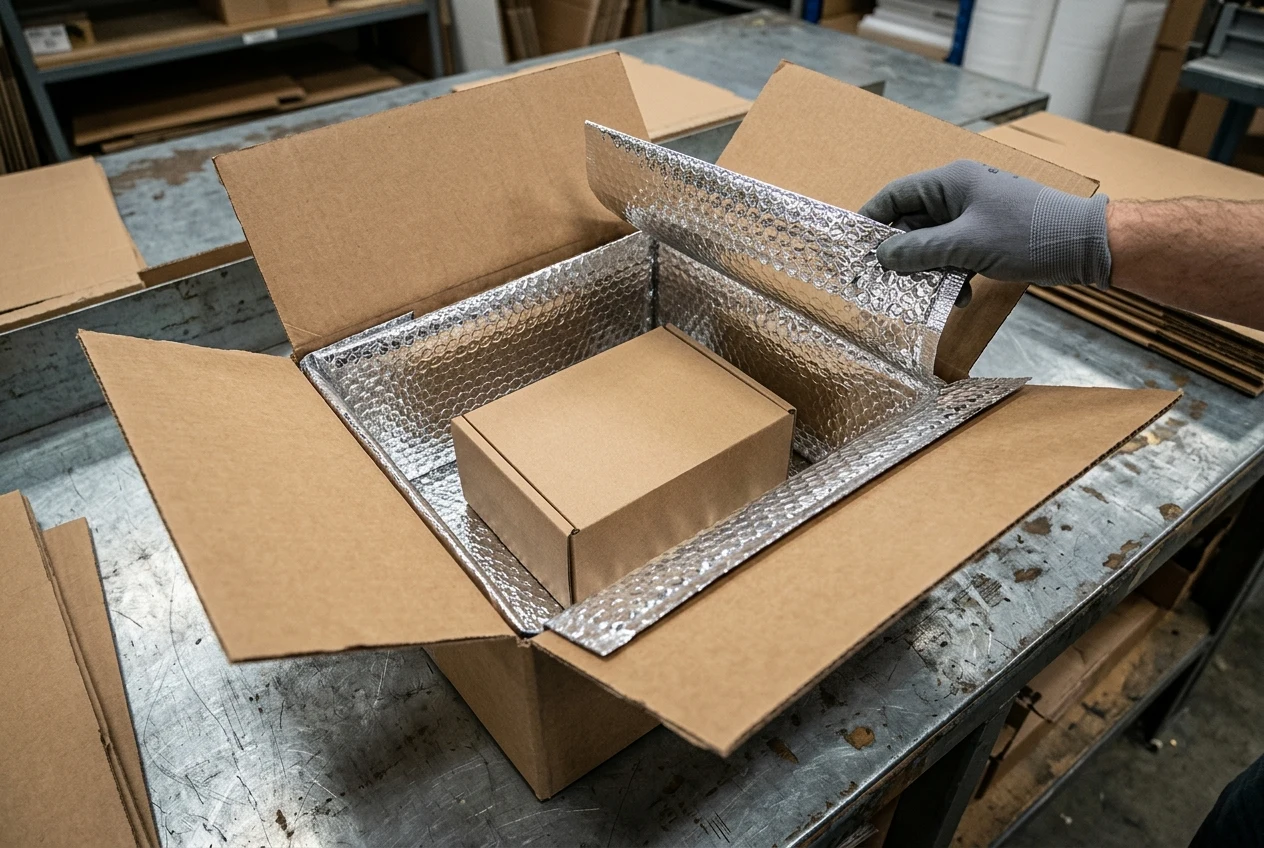
Check the liner closure before bringing the outer carton flaps down. If the assembled liner pushes against the carton or obstructs closure, return to the fit specification. Do not reduce inflation, cut material or substitute a larger case without reviewing the complete configuration.
Keep thermal evidence separate from cushioning evidence
A protective air-column pack may control movement or contact without having a demonstrated cold-chain duration. Obtain thermal evidence for the entire shipping configuration: material construction, coolant, payload, preparation and exposure profile. The CCT evaluation guide explains the importance of comparing those test conditions.
For purchasing, retain two records: the approved assembly instruction and the complete-pack performance basis. A pressure or profile check verifies one preparation step; it cannot establish the shipment’s temperature history. Use the equipment boundary worksheet to assign ownership of each record.
Method and sources
This guide compares documented preparation mechanisms using manufacturer sources from BENZ and IPC, with CCT guidance on complete-system evaluation. It deliberately provides no universal air pressure, retention duration or thermal rating. Schematics show generic structural relationships without dimensions. No pictured liner is identified as a tested product or a former Coldpack product.