
Specify a cold-chain packaging machine by the operation it must perform and the state of the pack at each handoff. Begin with the approved shipping configuration, then separate preparation, feeding, assembly, placement and closure. A packaging material system and an automated packing line require different evidence.
Use this guide within cold-chain packaging machinery. Its output is an equipment brief you can take to an evaluation, not a recommendation for a model or a promised production rate.
Observe the work before requesting a machine
Follow a representative order through the bench. Record the operator’s active work and the waits separately. A carton can wait for conditioned coolant, component release or a missing instruction even when the case sealer is idle. Count complete released packs at the line exit, not just machine cycles.
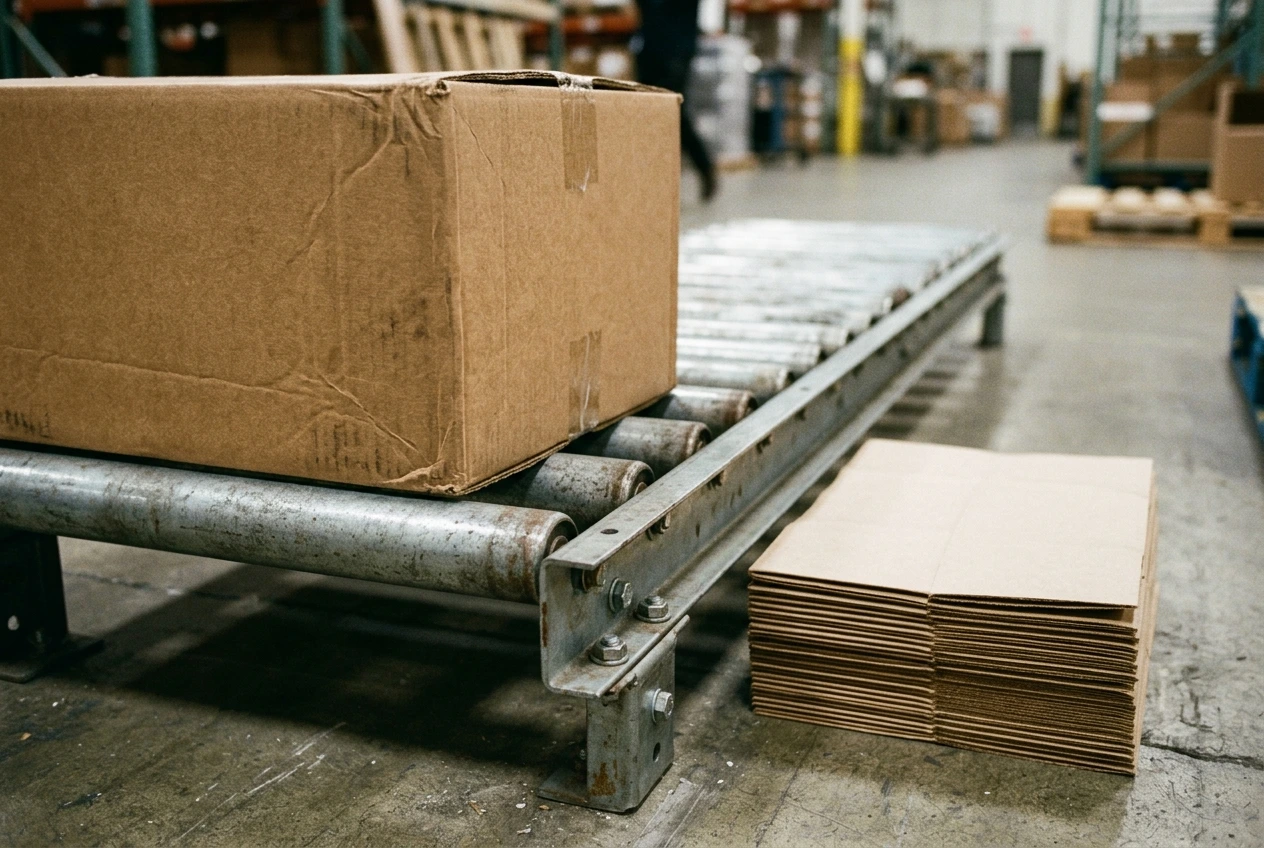
A roller conveyor only describes movement of the outer case. It does not show how the liner opens, how coolant is prepared or how the inner closure is checked. Put those operations into the brief rather than assuming the supplier includes them.
Write the boundary for each operation
| Operation | Incoming state to define | Required output | Evaluation evidence |
|---|---|---|---|
| Carton preparation | Flat blank or erected case; range and condition | Correctly supported open case | Trials with each approved case format |
| Liner presentation | Folded, rigid, self-expanding or inflated material | Correct liner available in the required orientation | Material-feed and first-piece inspection |
| Liner assembly | Component drawing and opening method | Bottom, sides and closure positioned | Inspection access before loading |
| Coolant handling | Released coolant type and preparation state | Correct identity and placement | Configuration match and exception handling |
| Payload loading | Approved load envelope and orientation | Load fits without displacing insulation | Representative extreme configurations |
| Inner closure | Flap, lid or specified adhesive interface | Closed liner without trapped components | Closure check before outer sealing |
| Case sealing | Loaded case geometry and specified tape or closure | Closed outer case with traceable pack identity | Complete-pack trial and restart check |
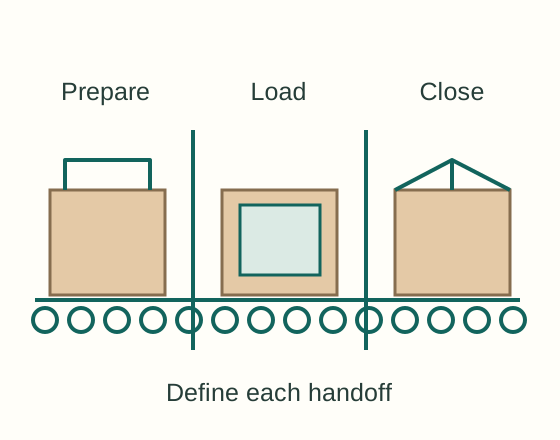
Treat the table as a set of interfaces even if one supplier offers several operations. Define which party controls component selection and which station can stop a mismatched pack. A machine’s ability to move an object says little about its ability to recognize the wrong object.
Let the liner construction determine the mechanism
IPC describes a collapsible one-piece reflective liner with an optional adhesive closure. That preparation route differs from handling a rigid insulated container or a liner that requires a controlled inflation step. Request the actual material drawing and representative supplied stock before deciding on a feeder or opening mechanism.
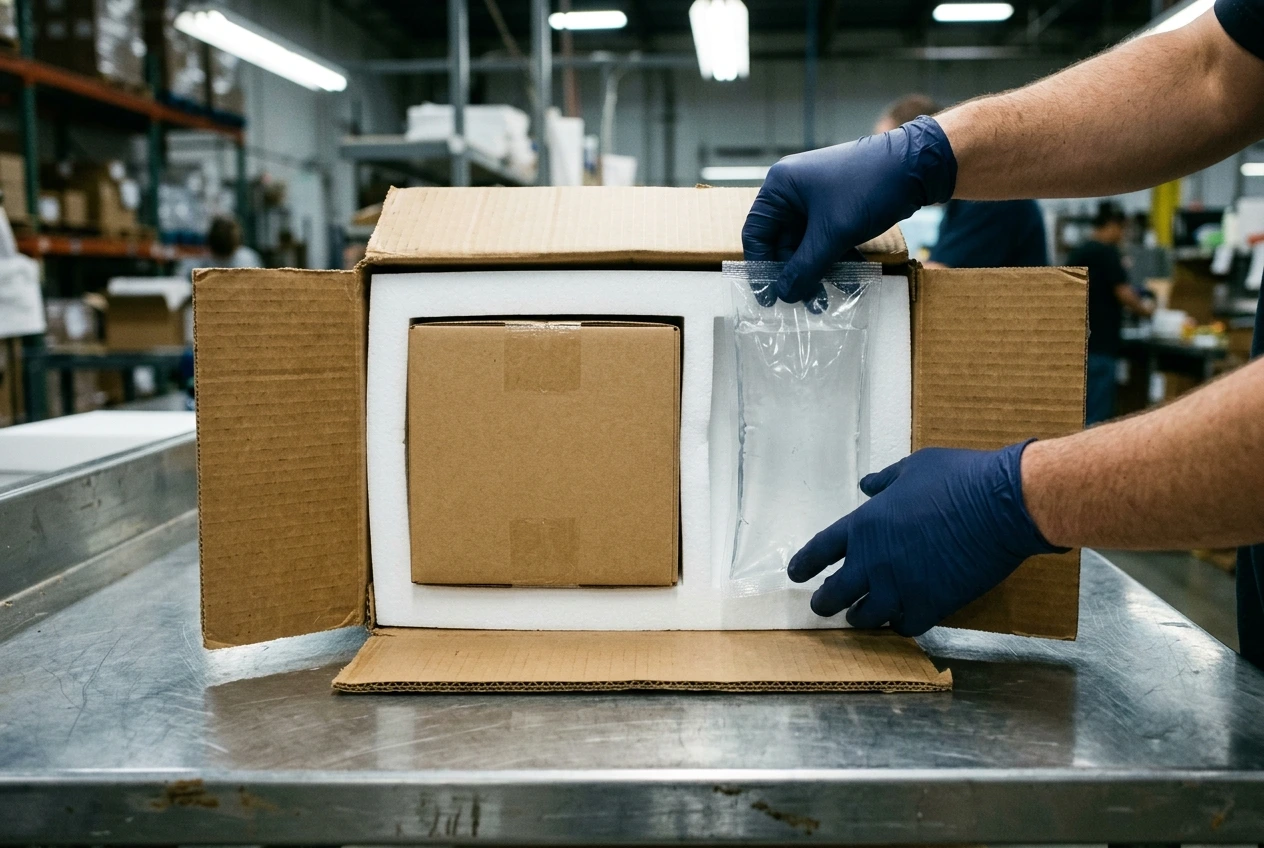
At loading, inspect the space needed for the payload and coolant together. The illustrated arrangement is a generic example, not a packout recipe. Automation must preserve the approved positions and keep them visible or otherwise verifiable before closure.
Make exception handling part of the acceptance trial
Ask how the line handles a missing component, a misfed liner, a stop with a partly assembled pack and a format change. Record what the operator sees and where the affected pack goes. Restarting equipment must not silently release unfinished work.
Use your real components for the trial, including the difficult approved format and representative acceptable variation. Separate the supplier’s unloaded cycle claim from the observed rate of complete accepted packs. Include replenishment, checks and changeover in any capacity estimate. This guide supplies no numeric target because those inputs have not been measured for your line.
Finish the brief with responsibility and evidence
Attach the packout revision, material identities, format range, incoming conditions, inspection points and required records. Mark unknowns as open decisions for the equipment and packaging owners. Specify who approves a change that could affect the thermal configuration.
The packout checklist can help turn each boundary into an operator check. If the proposed line adds inflation, first complete the inflatable-material identification checks.
Method and sources
The boundary worksheet is an editorial specification aid. CCT’s discussion of packout simplicity supports evaluating preparation and assembly together; IPC’s liner documentation supplies a specific example of why construction changes the handling route. No equipment model, dimension, speed, power requirement or universal compatibility is inferred from those packaging sources. Thermal qualification and machine acceptance remain separate evidence requirements.