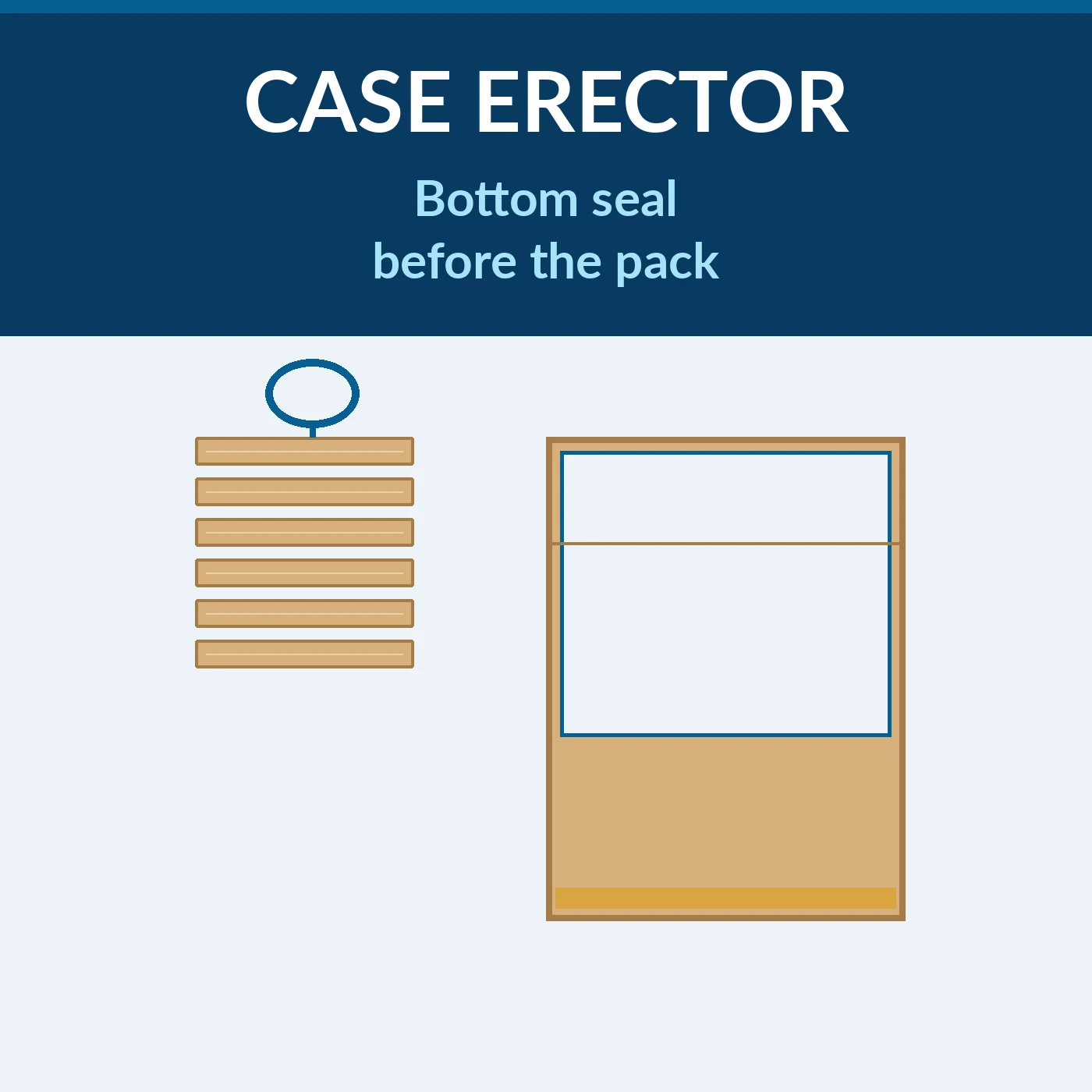
A case erector is an automated packaging machine that unfolds, squares, and seals the bottom of flat-packed corrugated boxes, called case blanks, to prepare them for packing.
Sigma says a semi-automatic case erector folds the major and minor flaps of an RSC case placed inside the machine by an operator, and that inserting the open case triggers pneumatic pushers to fold the flaps. Pro Pac says Adco corrugated tray formers run one-piece designs from simple end-slotted trays to complex shoulder and BTB style trays.
The encyclopedia says these machines increase throughput and reduce labor, operating at speeds ranging from 10 to over 30 cases per minute, and that they are for high-volume automated packing lines. The guide to choosing a cold-chain packaging machine says to separate a supplier’s unloaded cycle claim from the observed rate of complete accepted packs, and to include replenishment, checks, and changeover in any capacity estimate.
What does a case erector do to a blank?
The encyclopedia says corrugated fiberboard consists of a fluted corrugated sheet and one or two flat linerboards. The most common box style in the encyclopedia is the regular slotted container, RSC. All flaps are the same length from score to edge. Typically the major flaps meet in the middle and the minor flaps do not, unless the width is equal to the length.
The encyclopedia says the manufacturer’s joint is most often adhesive and may be taped or stitched, the box is shipped flat, knocked down, and the packager sets it up, fills it, and closes it. Closure may be by tape, adhesive, staples, strapping, or other means. The encyclopedia says European box styles use a 4-digit FEFCO code and that an RSC is coded 0201.
The encyclopedia says a full-overlap box is similar to an RSC except the major flaps fully overlap, and a half-slotted container is similar to an RSC but with only one set of flaps. The encyclopedia says a Bliss box is a three-piece box, usually with flaps meeting on the top, and that a corrugated tray is often used for display or with a shrink wrap. Pro Pac says the Polypack TR/TE series produces corrugated trays and contrasts that with RSC distribution packs.
TPC’s case-erector page says a case erector automatically folds, forms, and assembles cardboard cases from flat corrugated blanks.
How does an automatic erector open and seal?
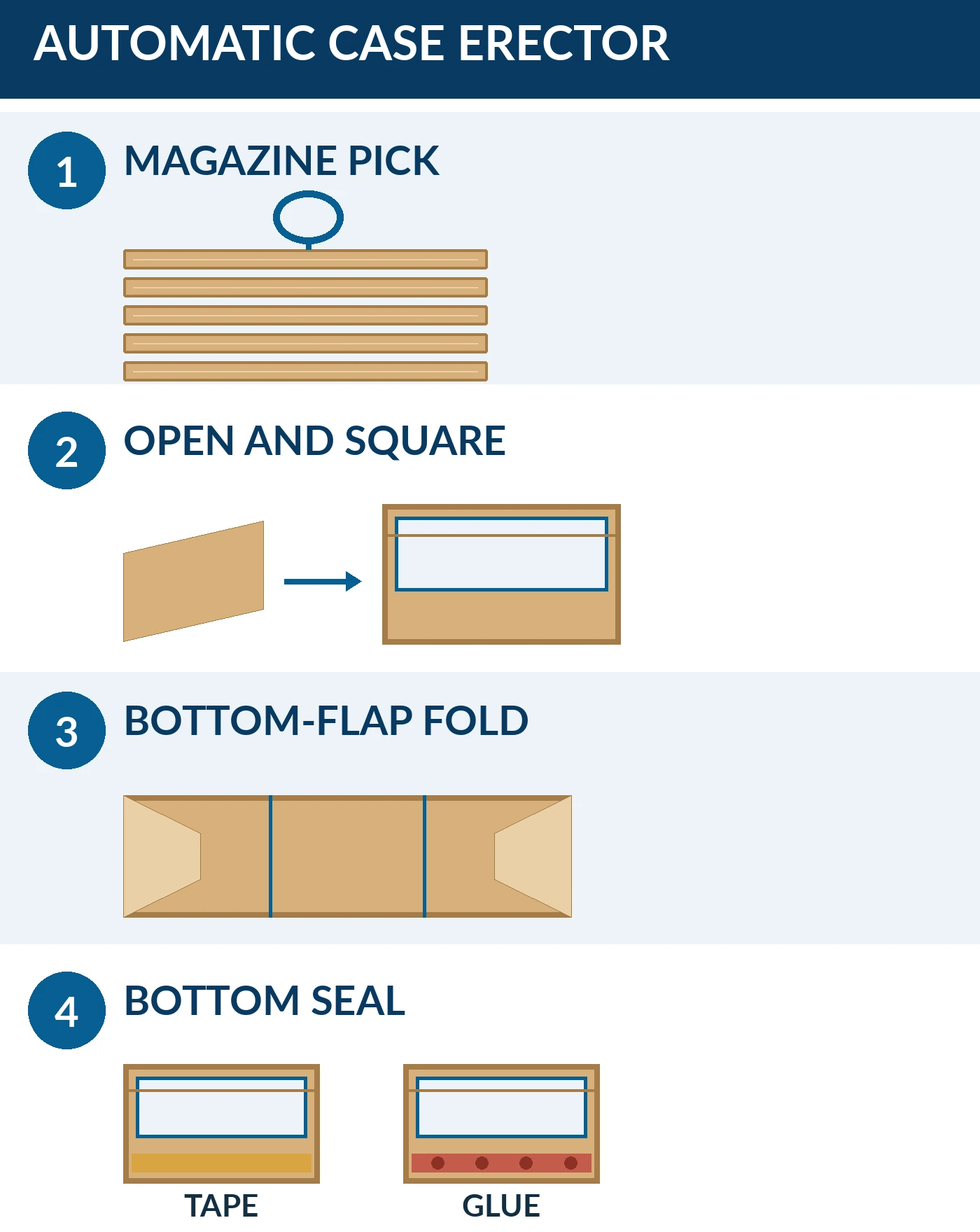
The encyclopedia lists a carton magazine that stores flat cardboard sheets before they are processed, and a vacuum picker that picks up individual sheets from the magazine and delivers them to the forming unit. The encyclopedia says the carton forming unit uses mechanical arms or push plates along with guiding mechanisms to open the flat cardboard and position it. The encyclopedia says the bottom folding unit folds the bottom flaps according to the designed sequence and angles. The encyclopedia says the bottom sealing unit seals the carton bottom using OPP tape, hot-melt glue, or staples.
The encyclopedia says the outfeed conveyor transfers the formed cartons to the next stage and is often equipped with sensors to detect proper carton formation. The encyclopedia says a PLC and HMI manage carton size, speed, and error detection.
What does one published knockdown erector specify?
The Pearson CE35 page says the erector forms knockdown cases at speeds of up to 35 cases per minute. The published knockdown erector feature list includes positive case selection and transfer. The published knockdown erector page says the machine reliably positions the knockdowns for accurate introduction into the machine. The published knockdown erector page says a dual opposed vacuum force opens the knockdown by grasping the case from both sides simultaneously to prepare case forming.
The published knockdown erector page says a synchronized dual chain drive transports the case through closing and sealing so completed cases are square as they exit. The published knockdown erector page says case position is controlled during flap folding so the folds land on the score lines. The published knockdown erector lists hot melt glue and tape as its sealing methods.
The published knockdown erector feature text says trained technicians can complete a changeover in under 8 minutes. The published knockdown erector specification says changeover is 7 min for tape and 9 min for glue, estimated for a trained technician.
The published knockdown erector minimum case size is listed as 6“L x 5”W x 3.5“H, with an extended range available. The published knockdown erector maximum case size is listed as 23.5”L x 16“W x 18.5”H, with an extended range available. The published knockdown erector lists case support codes CSSC, FOL, HSC, RSC, and RSC with integral divider, in that page order. The published knockdown erector options line lists low temperature environment, extended magazine, hand pack station, glue on demand, and an additional tape head, and the line states no temperature.
Utilities published for that knockdown erector:
- The published knockdown erector air requirement is listed as 80 PSI.
- The published knockdown erector power requirement is listed as 460 VAC.
- The published knockdown erector air consumption for glue is listed as 1.598 SCF per cycle.
- The published knockdown erector air consumption for tape is listed as 0.844 SCF per cycle.
- The published knockdown erector full-load amps of the base machine are listed as 18.3 amps for glue.
- The published knockdown erector full-load amps of the base machine are listed as 7.4 amps for tape.
The encyclopedia names ASTM D6198 and ASTM D5639 among standards that suggest design factors including cost of materials, labor, and capital, plus machinability and transport hazards of compression, impact, rupture, humidity, condensation, and temperature.
When does a semi-automatic erector fit?
Sigma says incorporating a semi-automatic case erector is typically the first step in automation for a company looking to move out of a completely manual operation. Sigma says these are best for smaller companies looking to scale up. Sigma says a first automation step may have no upstream or downstream equipment because the line is still mostly manual.
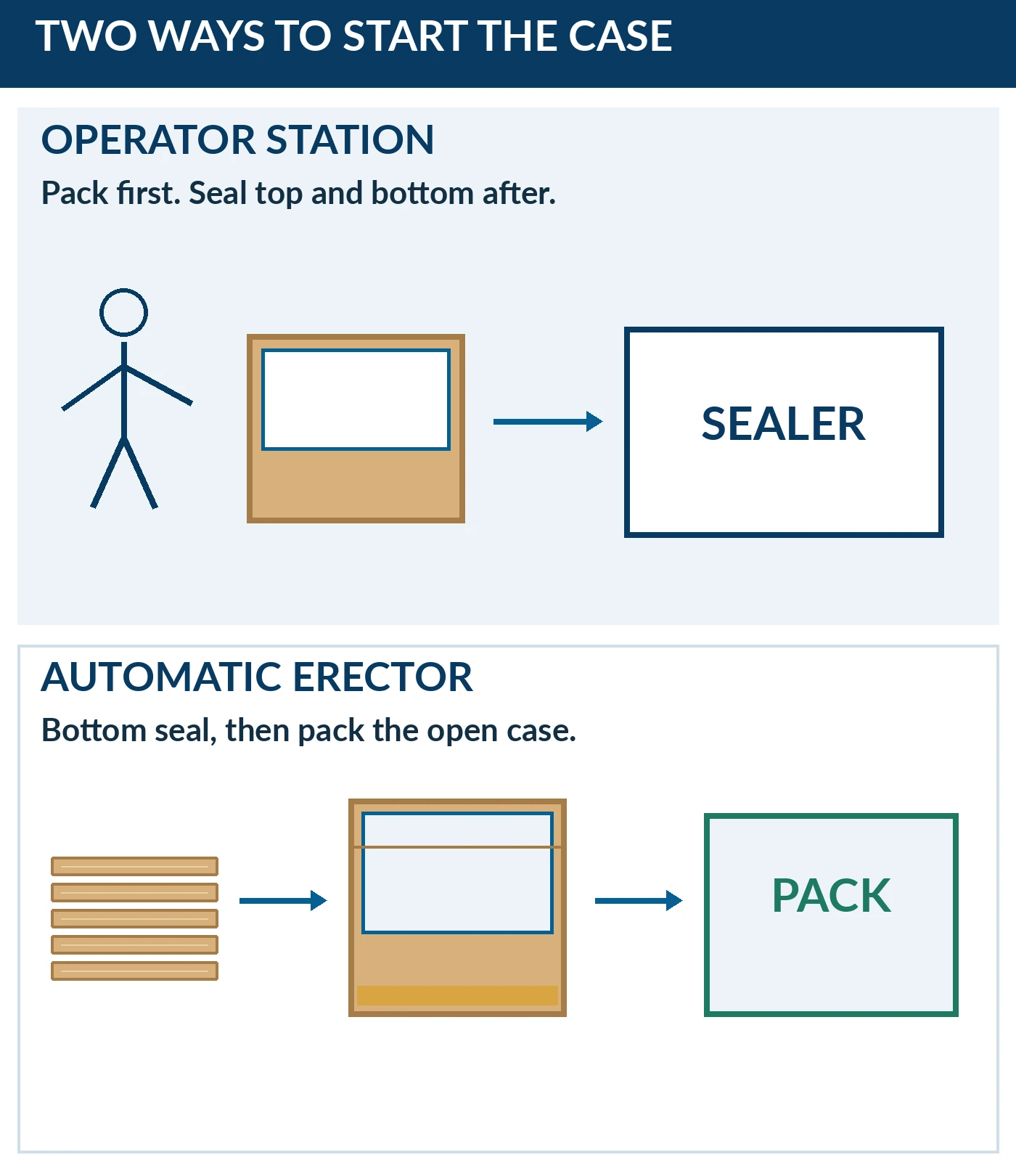
Sigma says the semi-automatic machine needs an operator to fold and open the cartons, put the case in the machine so the flaps can be folded, then hand pack the case and push it into a sealer or onto another conveyor. Sigma’s video description says the operator places the box on top of the semi-automatic case erector and the machine folds the major and minor flaps to create the bottom of the case. Sigma says that in a production facility the operator would fold the case, load it with the product, and send it down the line to be sealed both at the top and the bottom.
Sigma says the semi-automatic case erector is most of the time paired with the case sealer, which builds and then seals the case so it is ready for packing. Sigma lists case sealers, either glue or tape, among equipment that may be added as the line is automated. Sigma says the semi-automatic case erector suits short production runs that need quick case changeovers, and that the machines can run left-handed or right-handed cases. Sigma says the most important question before adding a semi-automatic case erector is the case size.
TPC says automatic case erectors are fully automated and minimize human intervention on high-volume lines. TPC labels semi-automatic case erectors as formers in parentheses and says they require some operator intervention.
The Wexxar description says conventional case opening relies on suction cups that grab case panels, and that Pin and Dome technology controls the case by its flutes and is described as overcoming environmental factors and irregular glue joints. The Wexxar Bel description says case formers hold the case so the operator can use both hands to pack, and that a case sealer can be combined with that former. The Wexxar BEL 505 is described as a semi-automatic case former and case erector for low to mid volume, with speeds up to 15 cases per minute, and as able to run multiple case sizes.
How does an erector differ from a packer?
Pro Pac says Pearson robotic case and carton packers load product styles and pack patterns into cartons, cases, and trays. The guide to choosing a cold-chain packaging machine says to specify a cold-chain packaging machine by the operation it performs and the state of the pack at each handoff, starting from the approved shipping configuration. That guide’s output is a station-by-station equipment specification of input states, handoff boundaries, inspection access, and trial acceptance criteria.
On that brief, carton preparation starts from a flat blank or an erected case and requires a correctly supported open case, tried on each approved case format. The same guide’s case-sealing row starts from a loaded case and a specified tape or closure and ends as a closed outer case with a traceable pack identity. On the packaging machinery page, carton erection stays separate from liner opening, material feeding, coolant placement, and case closing.
Where do a bag inserter and a sealer fit?
The Pearson BI18 page says the bag inserter opens, inserts, and cuffs perforated plastic bags from roll stock into corrugated cases at speeds of up to 18 cases per minute. The bag-inserter page says opposing vacuum plenums open the bag by grasping both sides and pulling them in opposite directions. The bag-inserter page says vacuum plenums hold the bag relative to the top of the case as the bag is pushed to the bottom, then cuffing fingers contain the top perimeter.
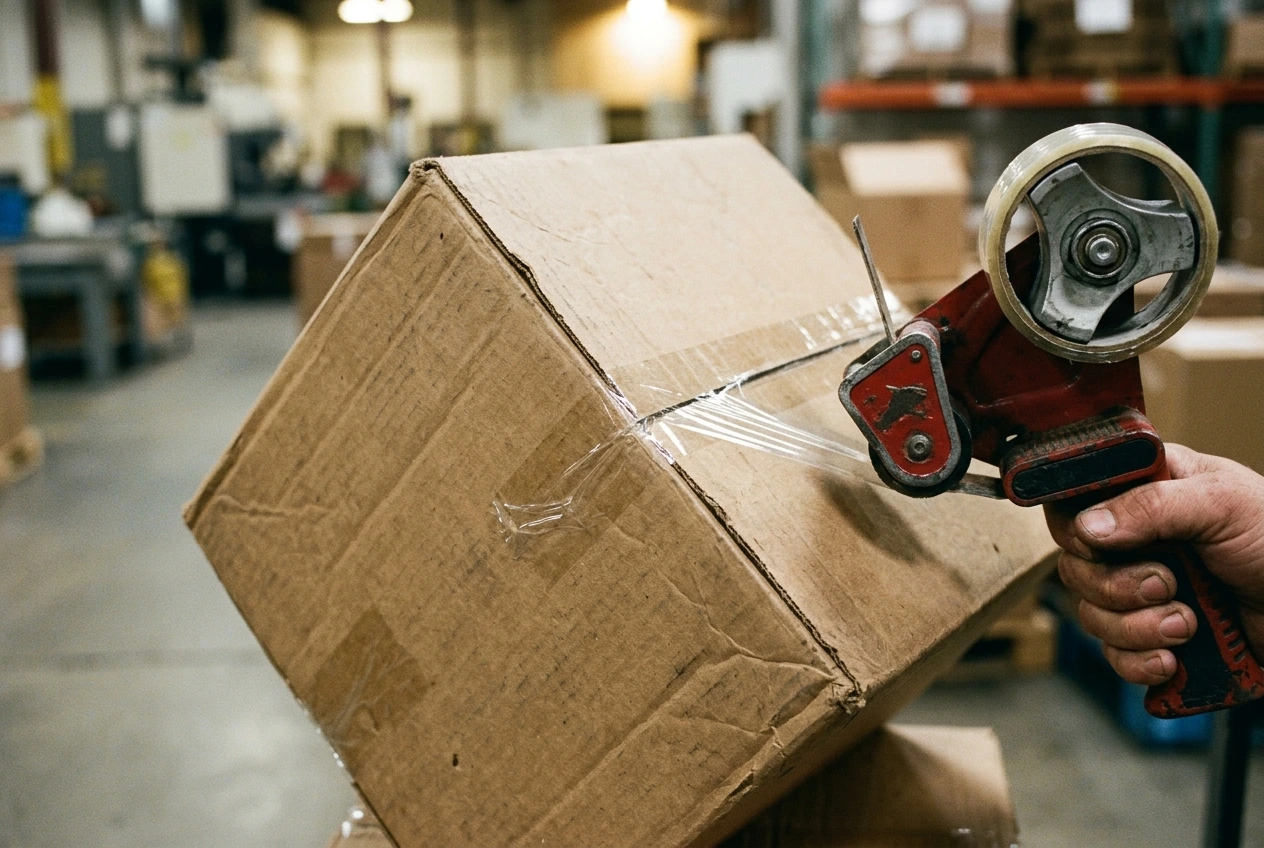
The same Wexxar page lists a BEL 270 hot-melt glue case sealer as its own machine. The same Wexxar page lists a BEL 150 pressure-sensitive tape case sealer as its own machine. The encyclopedia says box sealing tape is a pressure-sensitive tape and that taping is done manually or by a semi-automatic case sealer. It also names water-based or hot-melt adhesive applied manually or by machine, and staples. Premier Tech says a closer shuts the upper flaps and seals them with adhesive tape or hot-melt adhesive.
Premier Tech says square cases pack better, stack better, and protect better, and that they provide the structural integrity the designer intended. Premier Tech says one of the machines shapes, squares, and seals RSC cases, and that inline placement is for integration into an existing line. Premier Tech also says a machine erects, squares, and seals flat blanks into cases and trays of varying formats.
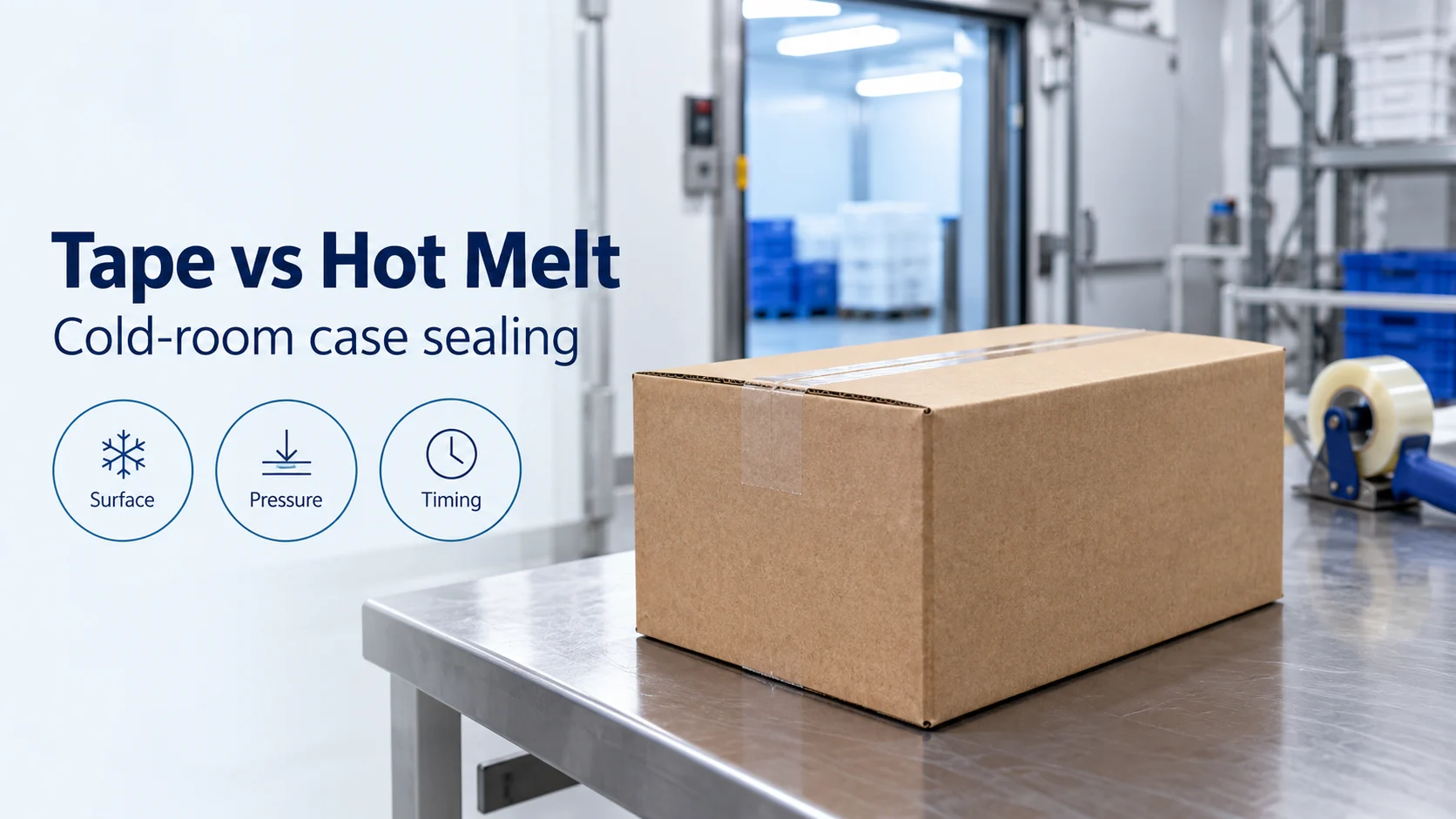
The cold-room tape versus hot-melt guide starts the tape versus hot-melt decision from the adhesive’s temperature threshold and the moisture state of the board. That sealer guide sends the chosen sealing sequence, inspection access, and exception handling into the case-closing equipment specification.
What blank storage jams erection?
The saved storage bulletin is PMMI B155-TR2.3-2018, Storage and Handling of Corrugated Material, prepared by the Fibre Box Association and the Packaging Machinery Manufacturers Institute, copyright 2018. The bulletin recommends storage at 40 to 100 degrees Fahrenheit, 4 to 38 degrees Celsius, and relative humidity of 30% to 70%.
The bulletin says high humidity greater than 70 percent, or direct contact with water, may degrade the board so it may not stand up to automatic or semi-automatic case erection, filling, and sealing, causing container failure or equipment jams. The bulletin says high humidity may increase the coefficient of friction of the linerboard so packaging sticks in automatic equipment or on conveyors. The bulletin says high humidity may alter dimensions, resulting in equipment jams. The bulletin says high humidity may cause warp. The encyclopedia says corrugators have become complex with the objective of avoiding warp and washboarding in board production.
The bulletin says extremely low humidity, less than 30 percent, can reduce the moisture content of the board and may alter dimensions or make the board or its corrugating adhesive brittle. The encyclopedia says moisture content of corrugated board ranges from 6.5 to 9.5 percent. Below a certain limit it will cause cracking, and above that it will reduce the compression strength of the board.
The bulletin says temperature less than 40 degrees Fahrenheit or greater than 100 degrees Fahrenheit, 4 degrees or 38 degrees Celsius, can alter the board and adversely affect run-ability. The bulletin says combinations of humidity and temperature outside the recommended ranges can adversely affect run-ability and physical performance. The encyclopedia says that if long-term storage of corrugated boxes in high humidity is expected, extra strength and moisture resistance is called for.
The bulletin says corrugated packaging should not be stored directly on the floor. The bulletin says that when storage is outside the recommended conditions, bring the packaging to the packing line long enough to reach those conditions before use, and that in some cases this may take 24 hours or more. If both areas are extreme, condition the packaging in a third area. The bulletin says containers are best run on automated machinery within 3 to 6 months from manufacture.
The bulletin says damage to the flute structure from crushing, puncture, or tears reduces the packaging’s ability to run on automated machinery. The bulletin says torn, bent, or scuffed edges can affect proper erection or performance on automatic packaging machinery. The bulletin says corrugated packaging should be stored horizontal, flat, in knocked-down form, from receipt until it is used or fed into the automatic machinery magazine. Premier Tech says thinner corrugated, temperature and humidity changes, and variations in case blanks can cause cases to be unsquared or lead to machine jams.
Line-fit checklist
Confirm the blank, the opener, the bottom seal, and the storage condition before the erector is released to the packout line.
- Blank style and size: RSC, full overlap, half-slotted, Bliss, or a one-piece tray, checked against the case size the erector lists.
- Opening method: an operator places an opened RSC, the encyclopedia forming unit uses mechanical arms or push plates, or the published knockdown erector uses a dual opposed vacuum.
- Bottom-seal medium: OPP tape, hot-melt glue, or staples, or hot melt glue and tape on the published knockdown erector. Cold-room tape or hot melt stays on the cold-room tape versus hot-melt guide.
- Blank storage: horizontal, flat, knocked down, and off the floor, inside the storage bulletin’s recommended conditions.